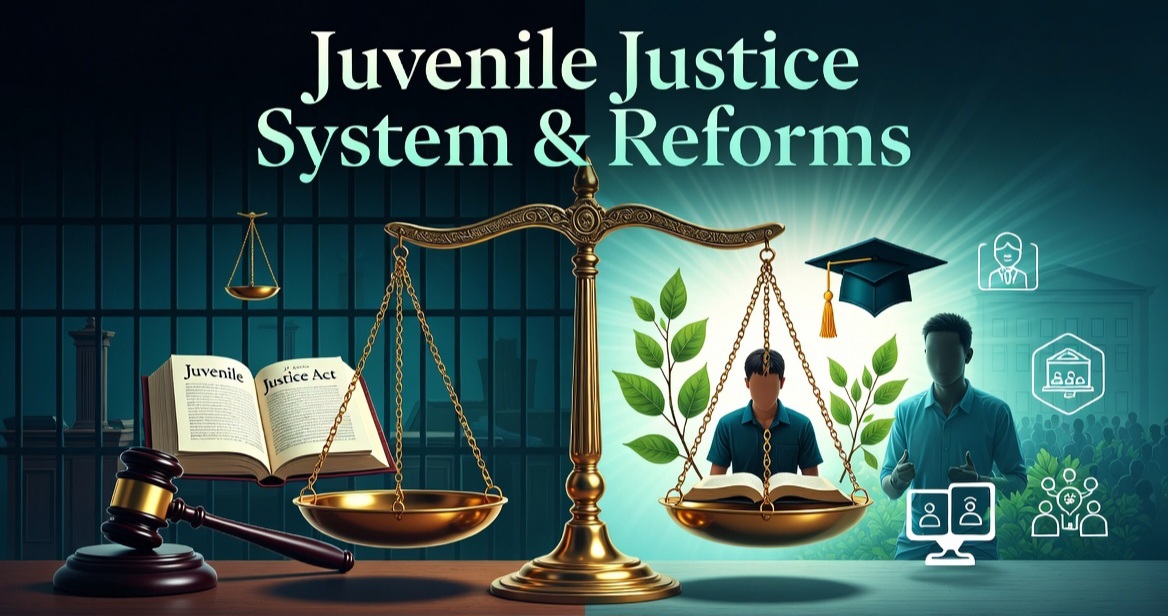
Written by :- Khushi Chandra (University of Delhi, Faculty of Law, Law Centre 1)
ABSTRACT
Juvenile delinquency, that is, crimes committed by children, is becoming a growing concern worldwide. Such offenses affect not only the children involved but also society as a whole. The increasing incidence of juvenile crime emphasizes the need for a system focused on reforming children rather than purely punishing them.
In India, the Juvenile Justice (Care and Protection of Children) Act, 2015 governs children in conflict with the law or those in need of care. This Act is influenced by international principles, such as the United Nations Convention on the Rights of the Child (UNCRC), and emphasizes rehabilitation, education, and protection of children. This paper analyzes the key features of the Act, its rehabilitation mechanisms, and landmark judicial pronouncements while highlighting the ongoing need for continuous reforms.
INTRODUCTION
Children are widely regarded as the future of every nation. Their growth, development, and moral education are essential for building a healthy society. However, the increasing involvement of children in unlawful activities, referred to as juvenile delinquency, poses a serious challenge.
The legal system today recognizes that children involved in crimes require guidance, care, and proper support rather than lifetime punishment, which could violate their fundamental right to life and personal liberty. The Juvenile Justice system in India focuses on reforming and rehabilitating children so that they can become responsible members of society.
The Juvenile Justice (Care and Protection of Children) Act, 2015 provides a comprehensive framework to protect children’s rights and ensure their well-being.
LEGAL FRAMEWORK IN INDIA
The primary law governing juvenile justice in India is the Juvenile Justice (Care and Protection of Children) Act, 2015. This Act replaced previous laws to establish a more effective system aligned with international standards, including the UNCRC, emphasizing both protection and development of children.
Key Features of the Act
- Defines “Juvenile” as any person below 18 years of age.
- Provides separate mechanisms for children rather than treating them like adult offenders.
- Establishes specific institutions:
- Juvenile Justice Board (JJB) for children in conflict with the law
- Child Welfare Committee (CWC) for children needing care and protection
- Promotes rehabilitation and reform through programs rather than punishment.
REHABILITATION MEASURES
The core aim of the juvenile justice system is rehabilitation, not punishment. The Act outlines several methods to reform children:
Counselling and Therapy
Children receive psychological support to understand their actions and improve behavior. Psychiatrists and trained counselors work with children to help them express fears, emotions, and thoughts in a safe environment.
Education
Ensuring access to education helps children build a better future and learn social and moral values.
Skill Development
Vocational training is provided according to the interests of children, allowing them to achieve financial independence.
Community-Based Programs
Children are encouraged to remain within their communities whenever possible, fostering social integration rather than institutionalization.
Observation and Special Homes
Temporary care institutions provide supervision, care, and rehabilitation for children in need.
LANDMARK CASE: SHEELA BARSE V. UNION OF INDIA (1986) SC 1773
Facts: Sheela Barse, a journalist, highlighted inhumane conditions for children in jails, noting that many juveniles were housed with adult prisoners and subjected to mistreatment.
Issue: Whether children in custody were being treated properly and whether their rights were violated.
Judgment: The Supreme Court issued directions to ensure that children are not kept with adult prisoners, are placed in separate juvenile homes, provided with care, protection, and legal aid, and guaranteed speedy trials.
This case reinforced the principle that children require special care and rehabilitation within the legal system.
CONCLUSION
The Juvenile Justice System in India embodies a compassionate and forward-looking approach, emphasizing that children are capable of change and deserve a second chance.
Instead of punitive measures, the system prioritizes rehabilitation, education, skill development, and community integration. While progress has been made, challenges remain. Continuous reforms and effective implementation are necessary to ensure the system fulfills its objectives, providing children with guidance, care, and opportunities to become responsible citizens.
Disclaimer: This article is published for educational and informational purposes only and does not constitute legal advice, legal opinion, or professional counsel. It does not create a lawyer-client relationship. All views and opinions expressed are solely those of the author and represent their independent analysis. Times Law does not endorse, verify, or assume responsibility for the author’s views or conclusions. While editorial standards are maintained, Times Law, the author, and the publisher disclaim all liability for any errors, omissions, or consequences arising from reliance on this content. Readers are advised to consult a qualified legal professional before acting on any information herein. Use of this article is at the reader’s own risk.