Written by – Pushpak Singh (Oriental University, Indore)
ABSTRACT
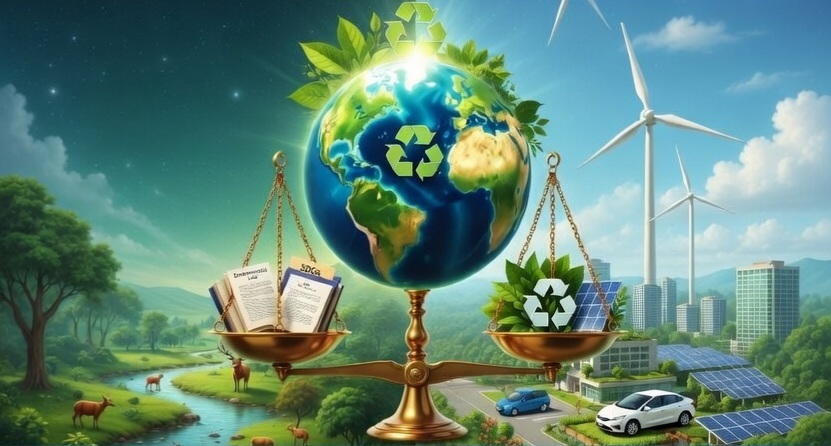
Environmental law, designed for a world of relative ecological stability, now applies in a world of increasingly rapid biodiversity loss, circular economy pressures, and demands for intergenerational accountability. The foundational environmental law frameworks, designed in the mid-twentieth century, were intended for sovereign-to-sovereign negotiation, not for governing nonlinear ecological systems across irreversible thresholds of change.
This paper analyzes the structural contradiction between legal inflexibility and ecological flexibility across three interrelated fields:
First, the shift in the jurisprudence of ‘protecting nature’ towards the legal personification of ecosystems, along with the category errors that this has entailed;
Second, the dissection of the enforcement divide the gulf between the aspiration of legal instruments and the actual ecological achievement through the lens of the European Union’s Carbon Border Adjustment Mechanism, the Ecodesign for Sustainable Product Regulation, and the Forest Rights Act of India;
Third, the introduction of a new paradigm of Regenerative Law, built on the four pillars of outcome-based obligations, adaptive legal mandates, extra-territorial material accountabilities, and intergenerational fiduciary duty.
INTRODUCTION
There is a peculiar arrogance in the assumption that legal instruments fashioned in the twentieth century are adequate to manage a biosphere in free-fall in the twenty-first. Environmental law, with all its stratified conventions, nested protocols, and laboriously negotiated annexes, was constructed for a world that has changed beyond all recognition.

Species are not waiting for their next scheduled review. Glaciers have not perused the timelines contained in nationally determined contributions. The law, on the other hand, proceeds at the pace of political will which is to say: slowly, begrudgingly, and always after the fact.

The tension underlying this paper is not simply procedural; it is philosophical. It is the tension between law’s essential hunger for fixity defined rights, prescribed remedies, predictable enforcement and ecology’s essential dynamism.

The convergence of three concurrent pressures makes this moment unlike any before:

First, biodiversity loss is escalating beyond even the most pessimistic scenarios modeled by the IPBES, with more than one million species now classified as threatened.

Second, the circular economy has emerged as a legislative frontier, illuminating the lack of binding legal architecture on material management and international waste accountability.

Third, a quiet jurisprudential shift is underway.
THE ANTHROPOCENE LIABILITY: HOW THE LAW IS MOVING FROM ‘PROTECTING NATURE’ TO ‘ASSIGNING PERSONHOOD TO ECOSYSTEMS’
The old environmental law paradigm was based on a subject-object relationship so deeply entrenched that it was no longer questioned. The object was nature, to be protected, cleaned, or conserved. The subject the one with the right to appear in court was always human. Companies, states, and even future generations, in some hypothetical scenarios, were granted procedural capacity. Rivers and rainforests were not.
1. Ecosystem Personhood and Its Practical Limitations
This change has consequences that practitioners have not fully thought through. Making a river a legal person is easy in theory; making it so in practice is an entirely different matter.
Who will function as a guardian for the river?What is the criterion for harm that will invoke legal personhood?
In what circumstances will a river’s legal interest conflict with a hydroelectric utility whose constitutional property rights are protected?Which sovereign duty will prevail?
Case Law:
Te Awa Tupua (Whanganui River Claims Settlement) Act, 2017
The Act granted legal personality to the Whanganui River and created a guardian council with authority to act on behalf of the river. However, the council soon discovered that existing property and contract law provided virtually no procedural framework for invoking this legal personality in practice. Personhood was granted, but operationalization was absent.
Proposed Concept: Ecological Standing Doctrine
What is needed is an ecological standing doctrine. This framework does not merely assign legal rights but recognizes ecosystem functions. Instead of asking whether a river has rights, the framework evaluates the biological, hydrological, and geochemical functions that the system performs.
2. The Intergenerational Equity Problem
There is also the question of equity between generations a concept formally recognized in the Brundtland Commission’s 1987 formulation and repeated in numerous legal preambles without gaining real juridical force.
The Paris Agreement refers to equity and common but differentiated responsibilities but does not clarify how a nation’s short-term sovereign right to exploit natural resources should be limited when those resources form part of a global ecological commons upon which future generations depend.
THE ENFORCEMENT GAP: WHY ‘GREEN PAPER’ RARELY TURNS INTO ‘GREEN ACTION’
The machinery of international environmental law has always been ambitious. From CITES to the Kunming-Montreal Global Biodiversity Framework (2022), the global community has demonstrated its ability to create complex legal agreements.
However, these agreements are often implemented with a level of disregard that approaches indifference. The enforcement gap the difference between binding commitments and actual outcomes is not merely a flaw; it is often a structural feature.
3. The EU Carbon Border Adjustment Mechanism (CBAM)
The EU’s Carbon Border Adjustment Mechanism (CBAM), phased in from 2023, represents a novel legal instrument: a trade measure designed to internalize the cost of carbon in imported goods. It effectively extends the EU’s emissions pricing system beyond its territorial boundaries.
However, enforcement requires tracking supply chains that span dozens of countries, many of which lack any carbon pricing mechanisms. This creates a significant implementation challenge.
4. India’s Forest Rights Act, 2006
India’s Forest Rights Act, 2006 granted tribal communities legal rights over forest land. If fully implemented, it could have created a robust network of ecological reserves.
However, fifteen years after its enactment, fewer than half of the claims have been processed. The issue is not the law itself which is well-structured but the implementation environment, which often prioritizes industrial land acquisition over ecological and community rights.
FUTURE-PROOFING JURISPRUDENCE: TOWARDS ‘REGENERATIVE LAW’
The concept of sustainable development has had a long yet largely ineffective legal history. The Brundtland Commission’s definition development that meets present needs without compromising future generations has often functioned as diplomatic ambiguity rather than enforceable doctrine.
Sustainable development has become the legal equivalent of a gentleman’s agreement: frequently invoked, rarely enforced.
5. Outcome-Based Obligations, Not Process-Based Ones
Environmental law today is dominated by process requirements: conducting impact assessments, publishing reports, and meeting procedural standards.
Regenerative law shifts the focus to outcomes actual ecological improvement rather than procedural compliance.
6. Adaptive Legal Mandates
Current legal systems are largely static. In contrast, regenerative law incorporates adaptive management principles.
Emissions targets, biodiversity goals, and circular economy benchmarks would be dynamically linked to real-time ecological data. Standards would become stricter as environmental conditions worsen and relax, within limits, as conditions improve.
CONCLUSION
The friction examined in this paper is not ultimately between law and nature. Rather, it is between two human constructs:On one side is the legal imagination, with its need for order, precedent, and definable causation.
On the other is the scientific understanding of ecological reality, which embraces non-linearity, threshold effects, and cascading impacts that resist simple legal categorization.Bridging this divide requires not incremental reform, but a fundamental rethinking of how law interacts with the living world.
Disclaimer: This article is published for educational and informational purposes only and does not constitute legal advice, legal opinion, or professional counsel. It does not create a lawyer–client relationship. All views and opinions expressed are solely those of the author and represent their independent analysis. Times Law does not endorse, verify, or assume responsibility for the author’s views or conclusions. While editorial standards are maintained, Times Law, the author, and the publisher disclaim all liability for any errors, omissions, or consequences arising from reliance on this content. Readers are advised to consult a qualified legal professional before acting on any information herein. Use of this article is at the reader’s own risk.