Author: Nargis
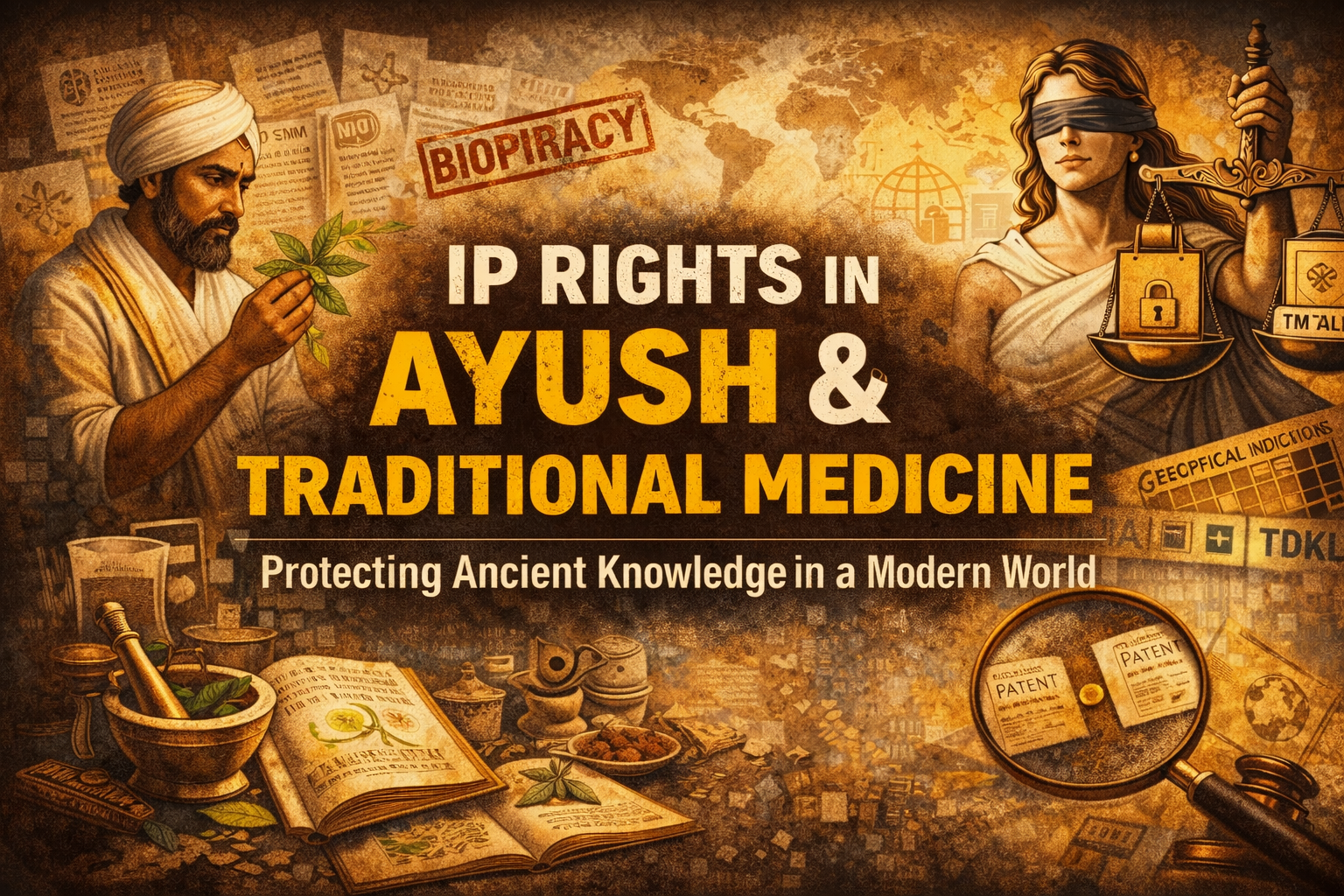
The Intersection between Ancient Wisdom and Contemporary Legal Frameworks
Traditional medicine systems and components of AYUSH are based on millennia-old systems of acquired knowledge and practice. However, most of this ancient knowledge does not conform to modern IP systems due to inherent differences between the two:
- Traditional Medicine is: -Collective -Evolutionary -Inter-generational
- Modern intellectual property (IP) laws are designed for: -Individual Innovation -Fixed Inventorship -Novelty
In this disconnect which has resulted in one of the most challenging discussions regarding IPR within the healthcare context today.
Understanding AYUSH as Intellectual Property
The AYUSH systems include:
- Ayurveda
- Yoga
- Unani
- Siddha
- Homeopathy
The various forms of AYUSH contain an array of intellectual property as follows:
- Medicinal Formulations
- Principles of Treatments
- Methods of Diagnosis
- Herbal Combinations
- Concepts of Prevention of Illness
AYUSH as a system does not have an abundance of “inventions” – this means their intellectual property is valuable.
Why Traditional Medicine is Vulnerable to IP Law
Traditional medical wisdom has unique levels of risk, which include:
- Historically, it was largely undocumented;
- There are rarely identifiable inventors of this knowledge;
- It is often viewed as in the “public domain”;
- It is often older than the current patent system (therefore established);
- Traditional medicine can be easily misappropriated due to these attributes.
Biopiracy – The Greatest Threat to Traditional Medicine
Biopiracy includes:
- Patenting traditional medicinal knowledge;
- Commercial exploitation without the consent of the community; and
- Denying access to the ability to share the benefits derived from traditional knowledge with the community.
Through their action, companies can isolate and patent the active ingredients contained in traditional medicines with the belief that they were new products or inventions.
While companies can use clever legal methods, this type of action is ethically questionable.
Can AYUSH Formulations be Patented?
Classical Formulation’s mentioned in Authoritative Texts cannot be patented because they do not meet the requirements of patentability (i.e., they are not novel).
Modified Innovations
To the extent that a modified innovation meets the requirements of patentability (i.e., new delivery systems; new extraction techniques; new dosage forms; standardised combinations), then a patent can be granted.
This will promote innovation without usurping traditional knowledge.
The Role of the Traditional Knowledge Digital Library
India has developed the Traditional Knowledge Digital Library as a model for protecting traditional knowledge on a global basis through Intellectual Property.
- Translates classical text into patent examiner’s terminology.
- Prevents any wrongful patent applications in other countries.
- The patent institute throughout the world contact TKDL prior to granting patents.
Consequently, TKDL has supported the successful revocation of several fraudulent patents for Indian traditional medicines
IPR (Intellectual Property Rights) Protection Systems for AYUSH
1. Defensive Protection
Protecting against others’ claims of ownership of traditional knowledge.
e.g. TKDL and documentation of prior art
2. Positive Protection
Allowing communities/institutions to receive economic benefits.
Includes:
• Geographical Indications (GI)
• Benefit-sharing models
• Community rights systems
Geographical Indications in Traditional Medicines
Certain herbals and other medicines (e.g., turmeric) are attributed to specific geographic areas.
GI protection can preserve the uniqueness of an herbal product and prevent misuse, as well as promote economic growth for the area.
For example, many herbs and their formulations have specific geographical attributes; therefore, these herbal products need GI status.
Copyright in AYUSH:
Formulations may not be protected by copyright; however, the manner in which a formulation is expressed can be.
Copyright will apply to:
• Books
• Research papers
• Translations
• Commentaries
• Digital content
Copyright will protect the scholarly attributes of AYUSH.
Trade Secrets in Herbal Medicine:
Secrecy has helped the continued survival of many traditional medicines.
The components of a trade secret are:
• Not publicly known
• Have a monetary value
• Reasonable efforts are made to keep it secret.
Trade secret systems have traditionally been used:
• By herbal medicine companies
• By family practitioners
• By small-scale producers.
International Protection of AYUSH Knowledge:
Globally, Patents are most often given for new and innovative products. Traditional knowledge lacks the required documentation and is therefore less likely to be patented. Although countries have some level of IPR protection (patents), enforcing IPRs across multiple jurisdictions can be very difficult.
Ethical Dimensions of IP in Traditional Medicine
The core ethical questions include:
- Who owns traditional knowledge?
- Should healing knowledge be monopolized?
- How do we ensure benefit-sharing?
Intellectual Property law must adapt to protect both innovation and cultural heritage.
The Future of IPRs in AYUSH
The future lies in:
- Strong documentation
- Community participation
- Hybrid IPR models
- Ethical commercialisation
- Global recognition of Traditional Knowledge Systems
AYUSH should not be locked in the past but shouldn’t be exploited either.
Conclusion – Protection Without Erasure
AYUSH and Traditional Medicine are not relics, but living knowledge systems.
Intellectual Property Rights should:
- Prevent exploitation
- Facilitate responsible innovation
- Respect cultural origins
- Help achieve public health
Only then will Traditional Medicine endure not as folklore but as a preserved, respected and continually evolving scientific medical discipline.