Mansi Pal from JIMS EMTEC, GGSIPU University,
Greater Noida, Department of Law
ABSTRACT
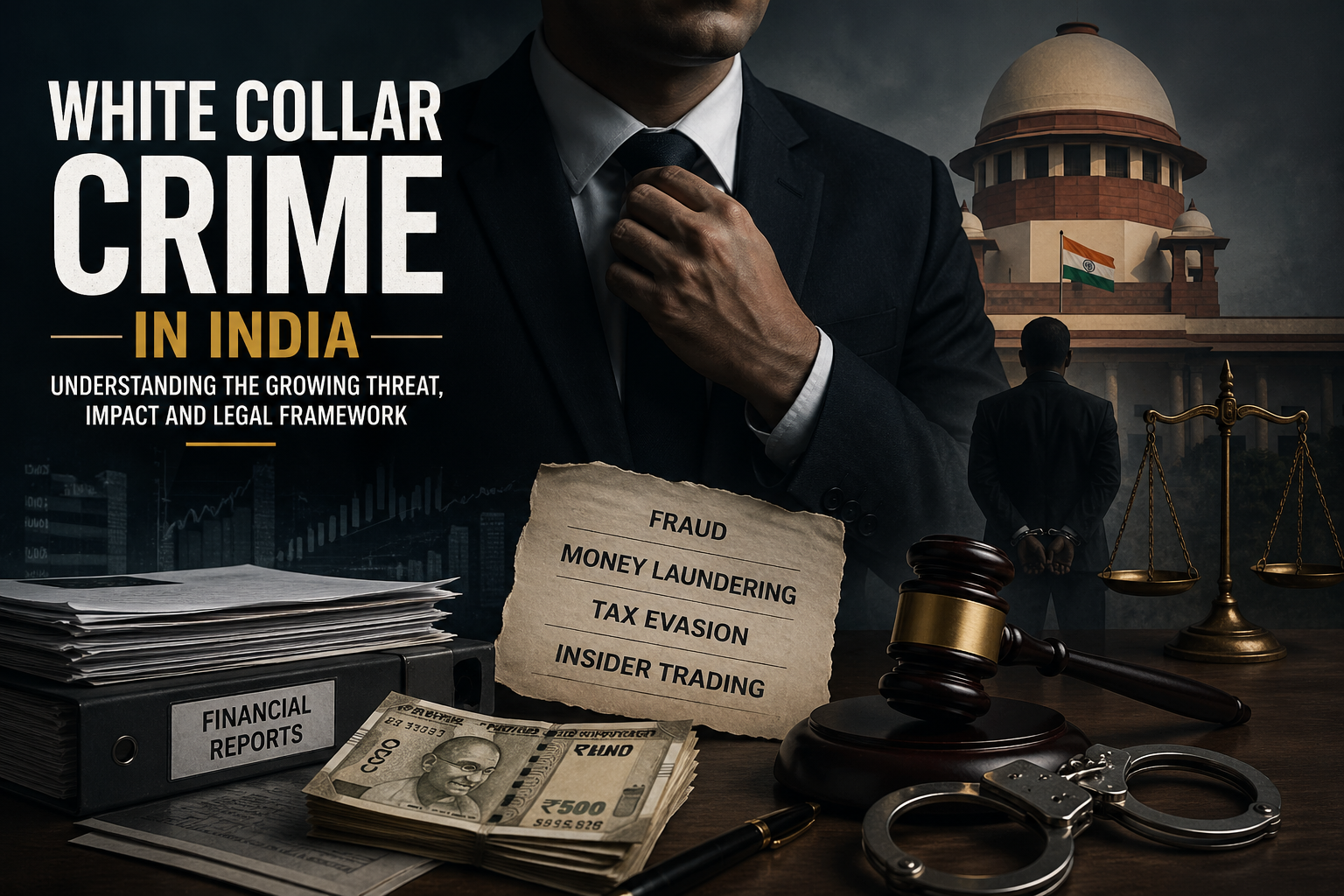
The proliferation of global trade and technological advancements has led to the global expansion of white-collar crime. White-collar crime exerts a significant impact on India, as it does on any other country. Contemporary swindlers exhibit an unprecedented level of motivation to acquire immediate monetary gain at the cost of their victims. The Santhanam committee’s report provides a comprehensive depiction of how individuals in esteemed positions, such as industrialists, businessmen, contractors, and corrupt public officials, engage in white-collar crimes. The committee recommended the inclusion of a supplementary section in the IPC to address these offences, although the proposition was declined.
Subsequently, a committee known as the “Chagla Commission” was established, with former Chief Justice M.C. Chagla serving as a sole member of the commission of inquiry. This committee was tasked with investigating the “Mundhra-LIC scam,” the first major financial scandal in independent India. or “The Vivian Bose Commission,” which inquired into the Dalmia-Jain group of companies’ scams, have highlighted how these big corporations indulge in fraud, tampering, and falsification of accounts and tax evasion, etc.
INTRODUCTION
The problem is severe, both in terms of its breadth throughout India and its depth inside the country’s middle class. For instance, in the educational sector, unapproved organisations and colleges are costing the future of understudies, as in “considered college.” There is almost no checking or responsibility system set up to guarantee the significance and quality of the education conferred, and counterfeit degree and phoney confirmation rackets are common. Medical services and the clinical calling are once again under con artist for controlling and expanding hospital expenses, unlawful clinical practises like foetus removals and sex assurance, and the HRD Ministry de-recognized 44 recognised colleges with more than 2 lakhs students trying them out in legitimate calling cases of bogus and created proof, abusing moral principles, and conspiracy with court ecclesiastical staff.
The banking and financial administrations sector continues to face difficulties due to rising NPA (non-performing assets). According to RBI estimates, bad debts in India reached a staggering INR 624,119 crore at the end of December 2015. Government officials are committing more “scum” in the open arena via true cheating and infractions, in addition to defilement. The disruptive force of technology and digitalization has also reimagined business, bringing with it a wide range of new challenges.
“The causes for rapid growth in white-collar criminality are given below:
- Rapid economic growth and industrial growth have created an unequal society and resulted in the accumulation of wealth and power with few people.
- Economic and social status of white-collar criminal shielding and insulating him from rigors of the law.
- They are tactful in their approach.
- Generally, the legislators and law implementers belong to the same class and same status group to which these criminals belong thus extending sympathy for them. Apart from this, lack of police effort, favorable laws, less impact on individuals are the reasons that these offenders go unpunished.
- The emergence of new technology, digitization, the internal pressure of corporates fueled by the profit motive, increasing market competition, external political pressures has opened new avenues for these criminal organizations to prosper.
- Unique features of white-collar crimes like difficult detection, lack of evidence, hard to track and investigate, etc. make the authorities reluctant to pursue cases.
The Emergence of White-Collar Crime in India
White-collar crime is commonly referred to as “socio-economic crime” due to its significant influence on both the economy and society. The impact of new political ideas or socioeconomic inequalities on criminal law, as well as the influence of advancements in the sciences, moral and social theories, have been significant factors in the reorganization of society. The evolution of criminal law is typically not attributable to a singular cause, but rather the result of a convergence of various factors. On occasion, the intersection of scientific developments, including emerging ethical and sociological paradigms, may require a re-evaluation of criminal legislation.
These two factors, together with societal reorganization, could also lead to changes in criminal law. Both the new communist theory and a movement within individualism have influenced criminal law thought to varying degrees. We have seen a dramatic uptick in state activities recently. The country is no longer seen as a dictatorship and is instead seen as having made significant contributions to national development. It has provided the state with fresh opportunities. The criminal code has evolved as a result of these changes. Due to the widespread pursuit of this ideal, many nations’ governments have come to view socialism as a viable economic model and socialism as a viable social structure.
Legal Framework in India
India has developed several laws and institutions to combat white collar crime. Key statutes include:
The Companies Act, 2013, which regulates corporate governance and fraud.
The Prevention of Corruption Act, 1988, aimed at controlling corruption among public officials. The Prevention of Money Laundering Act, 2002, which addresses the concealment of illegally obtained funds.
The Information Technology Act, 2000, which deals with cyber-related offences.
Investigative bodies such as the Central Bureau of Investigation (CBI) and the Enforcement Directorate (ED) also play an important role in detecting and prosecuting such crimes.
Another wave of changes that would ultimately affect manufacturing method and structure occurred in the 18th century. Because of these changes, a new kind of economic system emerged. Artists and craftspeople who previously worked from their homes under the “domestic system” have plenty to be grateful to the industrial system for. Consequences in the industrial and commercial sectors around the world, including England, were felt because of the many new mechanical innovations and chemical discoveries.
In tandem with the development of urban civilization, a new socioeconomic class emerged. A new social structure emerged, and with it came questions about established norms and values. Home handiwork declined as urbanisation increased, many farmers were expropriated, manufacturing towns arose inside the new industrial centres, and commodity production increased dramatically as a consequence of the industrial revolution.
The Crime of Bribery
Bribery occurs when one party pays another to influence their actions. Black’s Law Dictionary specifies that bribery is a crime. As a result of providing, donating, receiving, or soliciting something of value in order to influence the behaviour of a public servant. The employment of bribery within the Encyclopaedia. The act of receiving or providing compensation, willingly, in exchange for an official action that has been or will be carried out is commonly referred to as Americana.
In P.V. Narsimha Rao v. State, “Sibu Soren & Suraj Mandal took money to save the Narsimha Rao Government from toppling. The political leader would tend to maintain their political parties financially sound and at the same time insure themselves and their families against uncertainties of the future. This led to increasing nexus between politicians and organized crime. Section 171 B of IPC, 1860 defines bribery as giving or acceptance of a gratification either as a motive or reward to any person, to induce him to stand or not to stand as a candidate or to withdraw from the contest or to vote or not to vote at an election. It also includes an offer or agreement to give or offer and attempt to procure gratification, as explained in section 7 of the Prevention of Corruption Act, 1988, which includes an offer of gratification. It is not restricted to pecuniary gratification or gratification estimable in money.”
Previously, the Supreme Court held a distinct viewpoint regarding the conviction of an accused individual for bribery in cases where the bribe in question was found in possession of the said individual. During the decision-making process, the judges solely concentrated on the accused’s acquisition of the fix, without regard to the circumstances surrounding its recovery from the accused.
Corruption- A White-Collar Crime
In India, corruption is among the most serious offences. Many centuries have passed since its inception. The many sorts of corruption that existed during Chanakya’s period have been noted by historians. Despite the pledges of many political parties to root out corruption, those who commit such acts are mostly government officials and politicians. According to the CBI, between 2010 and 2012, around 1,450 cases of alleged corruption were lodged under the Corruption Prevention Act, 1988.
Public Servant Unlawfully Engaging in Trade
Public officials’ credibility is at stake, yet if they are permitted to engage in commercial activity, they may be unable to focus entirely on their official duties. Furthermore, they will use their official position to get an unfair edge over other merchants in order to progress their trade. S.168 of the Code states, “Whoever, being an employee, and being legally bound essentially as a public servant not to engage in trade, engages in trade, shall be punished by simple imprisonment for a term which may reach one year, or with fine, or with both.” In its broadest meaning, “trade” encompasses any and all commercial activities. According to the Oxford Dictionary, commerce is the buying and selling of goods at any level inside a country or between nations.
The Supreme Court in the State of Gujarat v. Mahesh Kumar Thakkar has held that trade in its narrow sense means “exchange of goods for goods or for money with the object of creating profit and in its widest sense means any business to earn profit. The Court ruled that where a tracer in the office of Sub-Divisional conservation Office removed earned leave and through that period of leave obtained training as an Electrical Signal Maintainer from the railway administration, it had been held that he cannot be convicted under section 168 of the IPC, 1860 as he has not engaged himself in any trade, although he was receiving a stipend from the railways during the amount of his training.”
Public Servant Unlawfully Buying or Bidding for Property
A governmental official is not allowed to bid on or purchase the property illegally under Section 169 of the IPC, 1860. The scope of Code Section 168 is expanded here. This clause applies only to the sale of property by a public worker acting in his official role. The logic behind this is that he will be at an advantage over the opposing party and will be able to sway the transaction in his favour. However, this clause does not apply if the public servant’s position is unrelated to the transaction and he is not acting in his official capacity while making the purchase or bid. For instance, a police officer could decide to buy an impounded pony.
“Whoever, being an employee, and being legally bound intrinsically employee, not to purchase or bid surely property, purchases or bids for that property, either in his name or within the name of another, or jointly, or in shares with others, shall be punished with simple imprisonment for a term which can reach two years, or with fine, or with both; and the property, if purchased, shall be confiscated.
Growth of White-Collar Crimes in Modern Era of Economy
India’s rapid industrialisation after World War One (1914-1919) resulted in a sharp social divide. Entrepreneurs, or those who owned the necessary tools for assembly, or the bourgeoisie, have historically been one group, while those who worked in factories have been another. As a result of their limiting economic circumstances, which the rapidly developing economic system helped create, the poor class polish became socially shunned. There was an increase in criminal activity because of the high degree of competitiveness and the need to respect a syndication. The germ of middle-class malfeasance is now fully formed. These illicit enterprises increased in quantity at a time when the nation’s attention was divided between the autonomy fight and fighting a war.
Growth of White-Collar Crimes in India
“Greed, competition, and lack of proper laws to prevent such crimes are the major reasons behind the growth of white-collar crimes in India.
- Greed: The father of contemporary political philosophy, Machiavelli, strongly believed that guys via nature are greedy. He said that a person can sooner and without difficulty overlook the loss of life of his father than the loss of his inheritance.
- Easy, swift, and prolong effect: The speedy growing era, business, and political pressure have delivered criminals to more present-day ways of committing white-collar crimes. Technology has moreover made it less hard and quicker to inflict damage or reason loss to the alternative man or woman. This would possibly reduce down the opposition.
- Necessity: People additionally dedicate white-collar crimes to satisfy their wishes and the wishes in their families. But the most vital element that human beings of excessive social status want to feed their egos. Competition: Herbert Spencer coined a phrase that evolution means ‘survival of the fittest. This means that there’ll continually be an opposition between the species, and the high-quality person to evolve himself to the circumstances and situations should continue to exist.
- Lack of awareness: The essence of white-collar crime is distinct from that of traditional crime. The majority of people are unaware of it and do not realize that they are the most vulnerable victims of violence.
- Lack of stringent laws: Since the internet and automated means of payment enable most of these offences, law enforcement officials are unable to prosecute these investigations because prosecuting and monitoring them becomes a complex and time-consuming task. It’s tough to track them down since they’re normally committed in the privacy of a home or workplace, with no eyewitnesses present.
The reasons behind white-collar criminals going unpunished are:
Legislators and others who carry out the rules are members of the same class as these trained criminals. The police bring forward little time in the operation because they find the procedure stressful and difficult, and these inexplicable searches often fail to provide positive results.
The laws are written in such a way that only career criminals profit.
The judiciary has long been chastised for its slowness in making decisions. It is not uncommon for the convicted to have died by the time the court renders its decision. This makes criminals lose in committing crimes. While white-collar crimes are increasing at a faster rate, the judiciary must increase its pace of delivering judgments.”
Adulteration of Food
Annapurna, a Sanskrit girl’s name that means “Goddess of Food” in the form of the deity Devi Bhagwati, has been used to refer to India. Annapurna, the Hindu goddess of food preparation and motherhood, is considered essential in the religion. That’s why Annapurna is a deity for the whole world. Even though they are not necessary for survival, food and water are often treated as if they were deities. Despite this, food adulteration is not only a widespread problem in today’s culture, but its roots can be traced back to Kautilya’s day. To “adulterate” anything implies to reduce its strength or quality by adding something else, as defined by the Cambridge Advanced, Learner’s Dictionary. According to English Collins Dictionary adulterate means to debase by adding inferior material.
In Kharak Singh v. the State of U.P., it was observed, “that Article 21 means not merely the continuance of a person’s animal existence, but right to the possession of his organs, his arms, and legs, etc. It cannot be argued that health is not a part of life when possession of all organs of the body is protected by the fundamental right to life. The Consumer Protection Act, 1986, the Prevention of Food Adulteration Act, 1954, the Food Safety and Standard Act, 2006, are enacted to prevent these offences which affect public health. The constant rise in price and cost of living has made the consumer cost-conscious. The unscrupulous traders take advantage of the situation and provide adulterated articles of food, drinks or drugs, etc. at a cheaper rate and earn huge profits.”
The term “adulteration” refers to the practise of adding a substandard ingredient to a high-quality product, for as acorn powder to coffee, copper to silver, water to wine, or wood fibre to rag paper.
Adulteration of Food or Drink Intended For Sale
The legal statute prohibits the act of adulterating food or beverages that are intended for commercial distribution. It is pertinent to replicate the verbiage of section 272 of the Code, which states: “Any individual who alters the composition of any substance intended for consumption as food or drink, rendering it harmful for human consumption, with the intention of selling or knowing that it is likely to be sold as food or drink, shall be subject to imprisonment for a period of up to six months, or a fine of up to one thousand rupees, or both.”
Section 272 of the IPC, 1860 stipulates that the act of combining deleterious components in food or beverage is subject to legal sanction. The act of adding benign substances to a product for the purpose of increasing profit margins does not fall under the purview of this section. For instance, the admixture of water with milk or the combination of ghee with vegetable oil does not render the product harmful or unsuitable for human consumption.
Sale of Noxious Food or Drink
The sale of noxious food or drink is an offence under the Code and in this regard, it would be beneficial for us to reproduce the language of section 273 of the Code which runs as under:
“Whoever sells, or offers or exposes purchasable, as food or drink, any article which has been rendered or has become noxious, or is during a state unfit for food or drinks, knowing or having reason to believe that an equivalent is noxious as food or drink, shall be punished with imprisonment of either description for a term which can extend to six months, or with fine which can reach one thousand rupees, or with both.”
The section has the following three important ingredients:
Selling or offering for sale as food or drink of some article.
Such an article must have become noxious or must be in a state unfit for food or drink.
The sale or exposure must be made with knowledge or reasonable belief that the article is noxious as food or drink.
Adulteration of Drugs
Adulteration of drugs has been considered a serious offence at all times. Keeping in mind the gravity of this offence the Code provides that whoever adulterates any drug or medical preparation in such a manner as to lessen the efficiency or change the operation of such drug or medical preparation, or to form it noxious, intending that it shall be sold or used for, or knowing it to be likely that it will be sold or used for, any medicinal purpose as if it had not undergone such adulteration, shall be punished with imprisonment of either description for a term which may extend to six months, or with fine which may extend to one thousand rupees, or with both.
Under this section adulteration of the drug is punished. The purpose of this section is to preserve the purity of drugs for medicinal purposes. Such adulteration of drugs doesn’t have to develop toxic to life, it is sufficient if the efficacy of a drug is lessened. 6.4 Sale of Adulterated Drug Section 275 of the Code deals with punishment for selling adulterated drugs. It would be profitable for us to reproduce the language of section 275 of the Code which runs as under:
“Whoever, knowing any drug or medical preparation to possess been adulterated in such a fashion on lessening its efficiency, to vary its operation, or to render it noxious, sells an equivalent or offers or exposes it purchasable, or issues it from any dispensary for medicinal purposes as unadulterated, or causes it to be used for medicinal purposes by an individual not knowing of the adulteration, shall be punished with imprisonment of either description for a term which may reach six months, or with fine which may extend to one thousand rupees, or with both”.
This section not only prohibits the sale of an adulterated drug but also its issue from any dispensary. However, it’s going to be found that the sale of the adulterated drug is additionally an offence under the Drugs and
Cosmetic Act, 1940. Adulterated drugs have been defined in Section 17A of the Drugs and Cosmetic Act. It runs as follows- “A drug shall be deemed to be adulterated if it consists in whole or part of any filthy putrid or decomposed substance”
CRITICAL ANALYSIS
White collar crime poses a serious threat to society because its impact is often widespread but less visible than conventional crimes. These offences are usually committed by individuals in positions of authority, such as corporate executives, business leaders, or public officials. When financial scams or corporate fraud occur, they can lead to huge economic losses, affect investors and employees, and weaken public trust in financial and governmental institutions.
Another major issue is that white collar crimes are often complex and difficult to detect. They usually involve manipulation of financial records, misuse of professional authority, or exploitation of legal loopholes. Because of this complexity, investigations require specialized knowledge and technical expertise, which can slow down the process of justice.
There is also a common perception that punishments for white collar crimes are not always proportionate to the damage caused. Influential offenders may have access to strong legal resources, which sometimes leads to delays in trials or lighter penalties. This can create a sense of inequality in the justice system and reduce public confidence in law enforcement.
Conclusion: The escalation of white-collar crimes has become a significant concern worldwide. Research has found that the societal harm caused by white-collar crimes exceeds that of other forms of criminal activity. Furthermore, India is categorised as a developing country, and as such, it is experiencing an unparalleled surge in white-collar crime, which not only undermines its image but also poses a threat to its economic progress. Furthermore, white-collar offences inflict psychological distress not only upon the direct victims of the crime but also upon the broader community. When an individual is unable to bear the costs associated with pursuing legal action against a white-collar criminal despite having evidence, it can erode public trust in the government. If individuals in positions of authority within the government, possessing significant levels of authority, engage in inappropriate utilisation of said power, to whom else can the populace turn for validation?
Furthermore, with the proliferation of these crimes throughout the United States, individuals find themselves in a state of unease, disconnected from both the physical and virtual realms. The advent of the digital realm was initially intended to alleviate humans from mundane tasks such as waiting in queues to conduct banking transactions and reduce physical exertion. However, it has now emerged as a significant platform for the perpetration of white-collar crimes. Nowhere can humans find a completely secure environment for themselves.
Disclaimer: This article is published for educational and informational purposes only and does not constitute legal advice, legal opinion, or professional counsel. It does not create a lawyer–client relationship. All views and opinions expressed are solely those of the author and represent their independent analysis. Times Law does not endorse, verify, or assume responsibility for the author’s views or conclusions. While editorial standards are maintained, Times Law, the author, and the publisher disclaim all liability for any errors, omissions, or consequences arising from reliance on this content Readers are advised to consult a qualified legal professional before acting on any information herein. Use of this article is at the reader’s own risk.