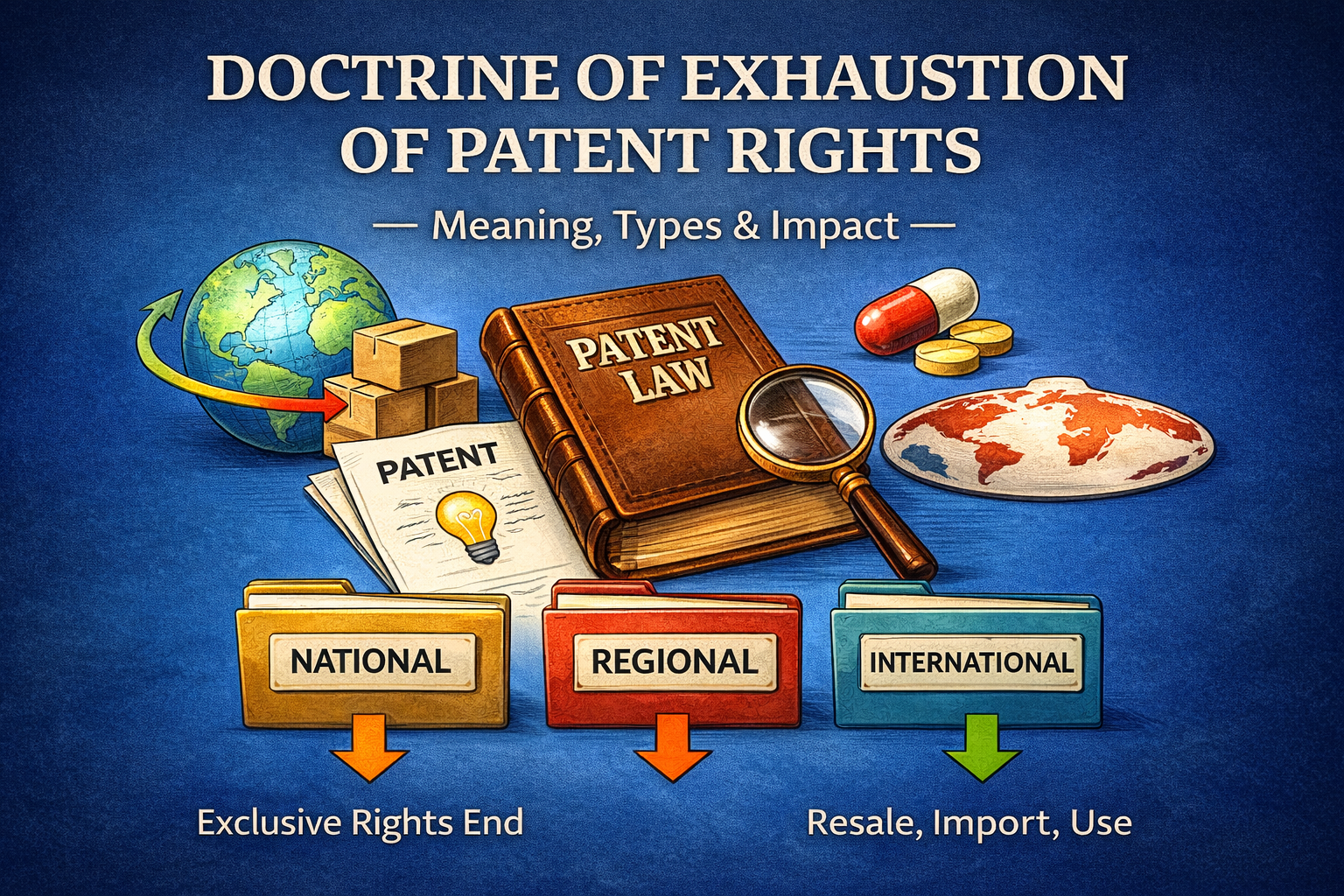
Explore the doctrine of exhaustion of patent rights — how it works, differences in global law, types (national, regional, international), and why it matters for innovation, trade, and access.
Author: Nargis
Introduction
The purchase of a product leads to the permanent loss of patent rights according to patent law. The answer in patent law is yes — but only under a specific principle called ” the Doctrine of Exhaustion of Patent Rights.”
The basic meaning of this doctrine states that:
The patent owner loses all rights to a patented product after they sell it or give someone else permission to sell it. The purchaser can use, resell, or distribute that item without further permission.
This concept is essential because it affects global trade, generics, parallel importation, and how manufacturers protect their rights after the first sale.
What Is the Doctrine of Exhaustion?
A patent grant creates exclusive rights for its owner, which permit the owner to manufacture, distribute and import the patented invention. The doctrine of exhaustion restricts these rights after the first authorised sale of the patented product.
The owner loses all control over a patented product after selling it together with its authorised sales. The system creates a balance between patent rights and unrestricted product distribution. The United States and common law countries use the First Sale Doctrine as the common name for the Doctrine of Exhaustion.
The concept contains a basic structure which states:
- Patent owner sells a product
- Patent owner loses control over that particular product
- Buyer can resell, use, or export it freely.
Types of Exhaustion Regimes Around The World
Patent exhaustion is not the same. Countries have rules when it comes to patent exhaustion.
1. National Exhaustion: Patent rights for a product are exhausted in the country where the patent was issued. For example if a product is sold in India the patent owner loses control over that product in India not in other countries.
2. Regional Exhaustion: Patent rights are exhausted in a region like the European Union. If a product is sold in the European Union, the patent owner cannot stop it from being sold or used in European Union countries.
3. International Exhaustion: If a product is sold anywhere in the world by the patent owner, the patent rights are exhausted everywhere. This means that the patent owner cannot control the product anymore, no matter where it is sold. This approach is good for trade. Not all countries follow it.
How Different Countries Treat Patent Exhaustion
- In the United States, patent rights are exhausted nationwide when a product is sold. This is because of the First Sale Doctrine. Once a product is sold, the patent owner cannot control it anymore.
- In the European Union: The European Union follows exhaustion. This means that if a product is sold in one European Union country it can be sold or used in European Union countries without the patent owners permission.
- In India: India follows exhaustion. This means that patent rights are exhausted in India if a product is sold in India. The patent owner still has control over the product in certain countries.
- Why This Matters To People: Different exhaustion rules affect things, such as:
- Parallel imports
- Price differentiation
- Cross-border resale
- Market segmentation by manufacturers
Why The First Sale Doctrine Matters To People
1. Access To Cheaper Products: If patent rights are exhausted after a sale, people can buy and sell products at lower prices.
2. Parallel Imports: Products can be imported from countries without the patent owners permission as long as they were originally sold with permission.
3. Limits Patent Control: The First Sale Doctrine ensures that patent owners do not have control over a product forever. Once a product is sold the patent rights disappear. This is important for patent exhaustion and the rules that countries follow. Patent exhaustion is important because it affects how products are sold and used around the world. Patent exhaustion rules are different, in each country. This affects people who buy and sell products.
Real Life Examples
If a consumer purchases a smartphone that is patented in India, the manufacturer is not allowed to prohibit the consumer from reselling the smartphone.
A drug sold in the EU and that enjoys patent protection cannot be limited from resale within the EU market.
Policy Debate and Future Trends
The doctrine is no longer just an academic matter. It no longer just an academic doctrine, it affects:
In different countries, companies set a different price for a product. Exhaustion rules decide on the reselling of imported goods.
In developing countries, exhaustion can help in reducing drugs prices through parallel importation. With software, eBooks and APIs, exhaustion rules keep changing – especially in cases where ‘sale’ is ambiguous. With global trade agreements and WTO negotiations, countries may revisit exhaustion principles.
Common Misconceptions
- It only applies to that particular item after the first sale.
- Manufacturing, production, and first sale decisions remain under the control of patent owners.
- It depends on the exhaustion regime of every country.
Conclusion
The Doctrine of Exhaustion of Patent rights is one of those legal maxims that silently controls the manner in which products, markets, and the global trade operate. It creates a balance between: Rights of Patent Owner Freedom of Buyers After Buying Trade efficiency and prices
Understanding this doctrine is therefore essential for businesses, lawyers, and policymakers as markets become more global and digital.