By: Sohini Seal
Abstract:
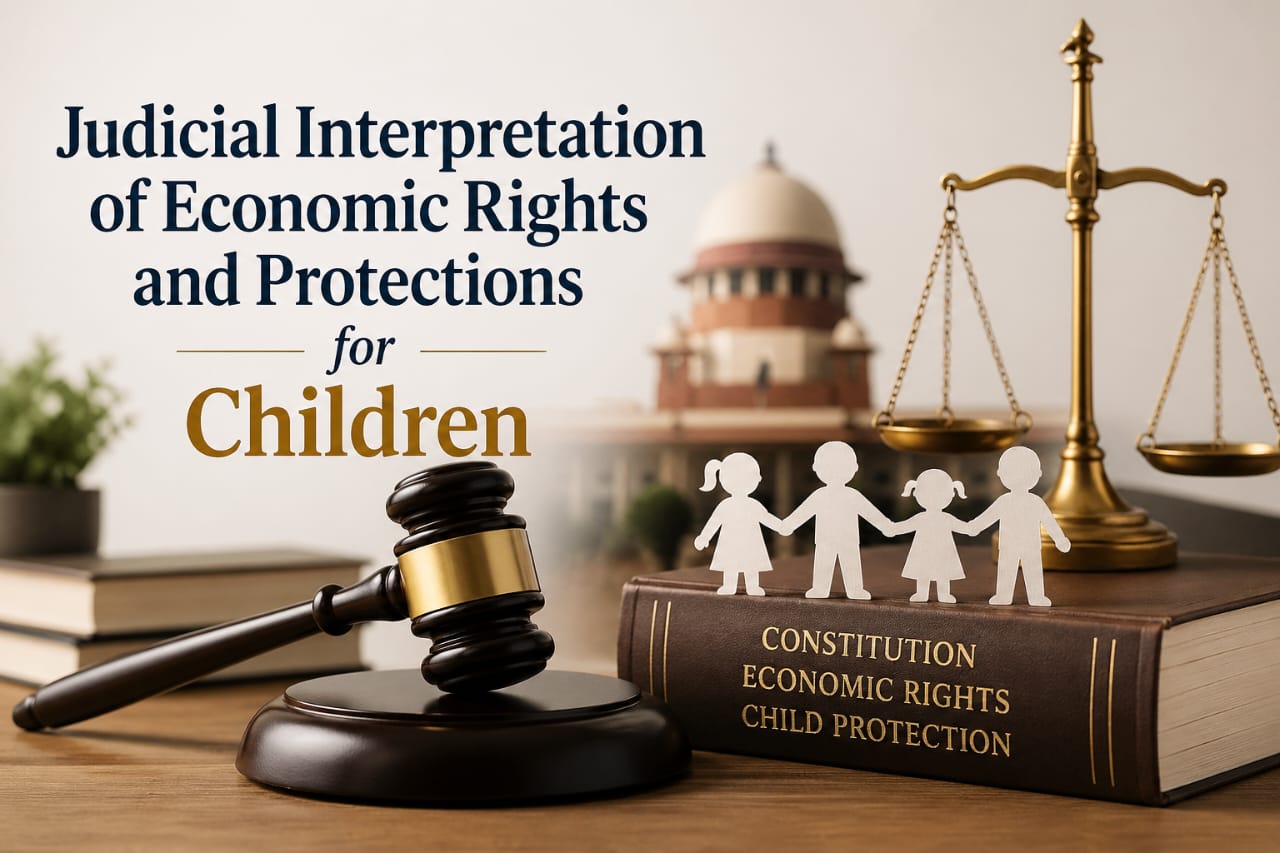
The Indian judiciary has played a transformative role in shaping and enforcing children’s economic protections by interpreting constitutional provisions in a progressive and expansive manner. Courts have consistently stressed that the State has a binding duty to safeguard children from exploitation and deprivation. This responsibility has been understood broadly, extending beyond prohibiting child labour to ensuring access to education, rehabilitation for rescued children, social security measures, and judicially mandated financial support such as maintenance or compensation. By adopting a holistic approach, the judiciary has emphasized that economic protections are essential not just for survival but for the overall dignity and development of children.
In interpreting these protections, the courts have expanded the scope of constitutional guarantees. Articles 21 and 21A have been read to cover a wide range of socio-economic entitlements, while Directive Principles such as Articles 39(e) and (f), 41, and 45 have been relied upon to provide normative guidance. These constitutional foundations have enabled the judiciary to enforce obligations even when legislative or executive action has been insufficient. Statutory safeguards like the Child Labour Act, the RTE Act, and the Bonded Labour System (Abolition) Act have been reinforced through judicial orders that operationalize their intent and impose clear duties on state authorities and employers. Landmark judgments have given shape to this jurisprudence. In Mohini Jain and Unni Krishnan, education was recognized as a fundamental right.
In Bandhua Mukti Morcha and M.C. Mehta, the Court mandated release, rehabilitation, and welfare funding for child labourers. Bachpan Bachao Andolan addressed child trafficking in circuses, while R.D. Upadhyay ensured custodial safeguards for children of incarcerated mothers. More recently, Rajnesh v. Neha clarified the principles of maintenance to protect dependent children. These rulings show how abstract constitutional and statutory provisions have been translated into enforceable economic protections.
The judiciary has also adopted innovative methods, such as issuing structural orders, requiring compliance monitoring, creating welfare funds, and directing rehabilitation schemes. These approaches underline the recognition that lasting protection requires institutional frameworks rather than one-time relief. However, persistent challenges remain. Weak enforcement, inadequate rehabilitation mechanisms, financial shortfalls, and administrative indifference continue to undermine the impact of judicial directions, leaving many children vulnerable to cycles of poverty and exploitation.
The contribution of the judiciary remains significant. By reinforcing constitutional principles, strengthening statutory frameworks, and compelling state action, courts have ensured that children’s economic rights are treated as enforceable entitlements rather than aspirational ideals. Going forward, stronger collaboration between the judiciary, legislature, and executive, along with adequate resources and effective grassroots implementation will be crucial to achieving comprehensive and sustainable economic security for children.
Keywords:
Economic Rights, Judicial Interpretation, Constitutional Protections, Child Labour and Rehabilitation, Socio-Economic Justice for Children
Introduction:
Children’s economic vulnerability in India manifests in multiple, interrelated forms. Poverty often drives children into exploitative labour markets, where they may be employed in hazardous industries, engaged in bonded work, or trafficked for commercial gain. The lack of access to formal education perpetuates cycles of deprivation, while the absence of reliable maintenance or social protection leaves children exposed to economic insecurity. This vulnerability is not only a reflection of poverty but also a deeper consequence of systemic rights deprivation. A child deprived of basic protections is unable to exercise the right to education, health, or dignified living, and this, in turn, reinforces poverty and exclusion across generations.
The legislative framework provides the foundational standards for safeguarding children’s economic interests. Statutes such as the Child Labour (Prohibition and Regulation) Act, 1986, the Right of Children to Free and Compulsory Education Act, 2009, and the Bonded Labour System (Abolition) Act, 1976 are designed to prohibit exploitative practices and to promote affirmative entitlements. Yet, legislation alone cannot ensure effective protection, especially in a socio-economic environment marked by inequality, entrenched informality, and weak enforcement mechanisms. It is here that the role of the judiciary becomes critical. Courts serve as the link between constitutional guarantees, statutory mandates, and international obligations on one hand, and practical enforcement on the other. Through judicial interpretation, they have transformed normative principles into actionable duties, making children’s economic protections a matter of enforceable right rather than mere aspiration.
In India, where socio-economic inequality and informal labour dominate large segments of the economy, judicial intervention has often been the most immediate recourse for children subjected to economic exploitation. The judiciary, particularly the Supreme Court and High Courts, has made extensive use of public-interest litigation as a vehicle to protect children’s rights. Non-governmental organizations and concerned citizens have invoked the courts’ writ jurisdiction to highlight instances of child labour, trafficking, denial of education, and lack of rehabilitation. Through these cases, the courts have broadened the reach of constitutional provisions such as Article 21 (right to life with dignity), Article 21A (right to education), and Directive Principles like Articles 39(e) and (f), which call for the protection of childhood and youth against exploitation.
The methods of judicial intervention have varied depending on the nature of the violation. In several landmark cases, courts have issued structural orders that go beyond individual relief and mandate systemic reforms. For instance, they have directed governments to establish monitoring committees, design rehabilitation schemes, and regularly report compliance to the judiciary. In other situations, the courts have focused on monetary remedies by imposing financial liabilities on employers who exploit child labour, ordering compensation for victims of trafficking, or directing the creation of welfare funds for the long-term rehabilitation of affected children. Additionally, the judiciary has, on many occasions, mandated the expansion of welfare schemes to ensure that children rescued from exploitative conditions are not left without alternatives.
What emerges from this trajectory is a case-centred jurisprudence that reflects the courts’ attempt to balance constitutional ideals with the harsh realities of socio-economic conditions. Each significant case has contributed not only to the enforcement of existing rights but also to the evolution of new frameworks for protection. The judiciary’s interventions have, therefore, served as both a corrective measure for state inaction and a catalyst for systemic reform. This thematic study of case law illustrates how judicial interpretation has been instrumental in ensuring that children’s economic protections are not confined to paper promises but are implemented as tangible safeguards in the lives of the most vulnerable.
Constitutional And Statutory Frame:
The Constitution provides the core foundation for protecting children’s economic rights in India. Through a purposive interpretation of Article 21, the Supreme Court and High Courts have expanded the right to life to include the conditions necessary for a child’s dignity, survival, and development. This approach was reinforced by the Eighty-sixth Amendment, which inserted Article 21A making free and compulsory education for children aged six to fourteen a justiciable right, and revised Article 45 to prioritize early childhood care. The Directive Principles, especially Articles 39 and 41, further enrich this framework by mandating protection from exploitation, promoting opportunities for healthy development, and directing the State to provide education and assistance within its capacity. These provisions together form the constitutional horizon from which courts derive the authority to enforce socio-economic entitlements for children.
Legislation has translated these constitutional promises into enforceable obligations. The Right of Children to Free and Compulsory Education Act, 2009, operationalizes Article 21A by requiring the State to secure school admission, prevent discrimination, and provide remedial measures for out of school children. The Child Labour (Prohibition and Regulation) Act, first passed in 1986 and later expanded, prohibits employment of children in hazardous occupations, sets minimum age standards, and provides for rehabilitation. Similarly, the Bonded Labour System (Abolition) Act, 1976 abolished bonded labour and introduced mechanisms to restore economic freedom. Courts have actively used these statutes, filling gaps through directions, monitoring compliance, and mandating financial or institutional remedies where necessary.
International law has also influenced judicial interpretation. The UN Convention on the Rights of the Child (CRC) has been a vital guide, with its principles of non-discrimination, best interests of the child, and special protection obligations shaping judicial reasoning. Likewise, the International Labour Organization’s conventions on minimum working age and worst forms of child labour have set global benchmarks that Indian courts have cited to strengthen domestic protections. Even where provisions have not been directly incorporated into law, these instruments have been invoked as persuasive standards to push for stronger policies and effective remedies.
Taken together, constitutional guarantees, legislative measures, and international norms create a layered framework for children’s economic protection. Courts have not only relied on these sources but have actively integrated them, expanding Article 21 to cover socio-economic rights, interpreting statutes in light of constitutional duties, and using international principles to close domestic gaps. This approach has ensured that children’s economic rights are not abstract ideals but enforceable protections supported by practical measures and institutional mechanisms.
Landmark Judicial Interventions, Case Studies And Principles:
The Indian judiciary has consistently interpreted constitutional guarantees to provide children with concrete economic protections, with several landmark rulings shaping this jurisprudence. In Mohini Jain v. State of Karnataka (1992), the Supreme Court recognized that education is intrinsic to human dignity under Article 21, striking down practices like capitation fees that made schooling unaffordable. Soon after, Unni Krishnan v. State of Andhra Pradesh (1993) elaborated the contours of the right to education, framing obligations of the State and regulating private professional institutions. These decisions laid the foundation for the later constitutional insertion of Article 21A and the enactment of the Right to Education Act, transforming education into a legally enforceable socio-economic right and a vital protection against intergenerational poverty.
The Court has also been at the forefront of eliminating exploitative labour. In Bandhua Mukti Morcha v. Union of India (1980s onwards), the Supreme Court issued wide-ranging remedial orders for the release, rehabilitation, and protection of bonded and child labourers, while also instituting ongoing monitoring mechanisms. Similarly, in M.C. Mehta v. State of Tamil Nadu (1996), which dealt with children working in hazardous match and fireworks factories, the Court required employers to contribute to a welfare fund, directed the State to create rehabilitation schemes, and emphasized reintegration of rescued children through education and vocational training. These rulings went beyond abstract condemnation of child labour, establishing financial and institutional mechanisms to protect children from exploitation.
In Bachpan Bachao Andolan v. Union of India (2011), the Supreme Court addressed trafficking and exploitation of children in circuses. The Court prohibited child employment in such environments, ordered immediate rescue operations, mandated registration of criminal cases in instances of missing children, and directed rehabilitation measures including schooling, care home facilities, and vocational training for rescued children. This judgment highlighted the judiciary’s role in tackling systemic exploitation by linking rescue operations with long-term rehabilitation.
Another dimension of protection emerged in R.D. Upadhyay v. State of Andhra Pradesh (2006), where the Court dealt with children living with their mothers in prisons. Recognizing the developmental needs of infants and young children, the Court directed that children could remain with their mothers only for limited periods, subject to safeguards, and insisted on facilities such as healthcare, education, and proper registration. This marked an important recognition that children’s economic and developmental rights must be protected even in custodial contexts.
Family law jurisprudence has also strengthened children’s economic security. In Rajnesh v. Neha (2020), the Supreme Court clarified the principles for granting maintenance, directing that awards should balance the needs of dependents with the payer’s means, and that maintenance could be ordered from the date of the application. By prioritizing the claims of wives and children even against competing creditor demands, the Court reinforced the protective role of maintenance as a financial safety net for children.
Together, these rulings illustrate how the judiciary has transformed constitutional principles and statutory provisions into tangible economic protections, combining prohibitions with affirmative entitlements to secure children’s dignity, survival, and development.
Modes Of Judicial Relief:
The judiciary has used several remedial devices to secure economic protections for children:
- Structural orders and monitoring: Appointment of committees, periodic compliance reports, and ongoing judicial oversight (seen in Bandhua Mukti Morcha, Bachpan Bachao Andolan).
- Monetary remedies and welfare funds: Directing employer contributions, creation of rehabilitation-cum-welfare funds for rescued child labourers (e.g., M.C. Mehta).
- Prohibitory and affirmative measures: Blanket or sector-specific prohibitions (circuses, hazardous industries), rescue operations, and mandatory rehabilitation and schooling pathways.
- Interpretation of rights as enforceable entitlements: Reading Article 21 together with Directive Principles (and international norms) to craft enforceable social protections (right to education, protection from economic exploitation).
Positive Impacts And Recurring Implementation Problems:
• Positive impacts: Judicial action has (1) created legal scaffolding for immediate rescue and protection, (2) developed financial mechanisms (welfare funds) for victim rehabilitation, (3) compelled states to run child-sensitive schemes (education, healthcare, shelter), and (4) progressively mainstreamed international standards into domestic practice. Recent court mandated registration protocols for missing children and enforced anti-trafficking steps illustrate the reach of judicial remedies.
• Implementation gaps: Despite strong orders, failures persist: raids and rescues continue to uncover bonded and trafficked children, prosecution and rehabilitation are uneven across States, and funding/administration of welfare schemes is often slow. Recent news reports of cases of bonded labour and continuing rescues show the persistent ground-level challenge of enforcement.
Critical Appraisal:
- Separation of powers concerns: Structural orders and direction of executive policy raise questions about judicial overreach and the long-term sustainability of court-driven programs. Courts justify intervention on the ground that fundamental rights demand action when the political branches fail.
- Resource and implementation constraints: Judicial decrees often presuppose effective bureaucracy, trained frontline workers (child welfare committees, police, special courts) and reliable funding flows, these are unevenly available.
- Risk of one-off relief without systemic reform: Rescue and release without credible pathways for education, family reintegration or livelihoods can produce relapses. Effective economic protection requires integrated social policy, not merely episodic court orders.
- Measurement and accountability: Monitoring mechanisms exist, but systematic outcome metrics (school retention rates for rescued children, rehabilitation outcomes, prosecution rates) are still patchy, making it hard to evaluate the actual economic uplift delivered by judicial interventions.
Recommendations For Stronger Judicial Executive Synergy:
- Child-sensitive budgeting and ring-fenced welfare funds: Parliaments and finance departments should create predictable, transparent budget lines for child rehabilitation, education and social protection so courts can avoid ad hoc monetary directions.
- Strengthen implementation agencies: Invest in professional child welfare committees, trained prosecutors for trafficking and child-specialized police units; courts should demand statutory timelines and public dashboards.
- Data and impact evaluation: Mandate outcome metrics (education retention, recidivism into child labour, economic rehabilitation) that courts can review on a periodic basis.
- Legislative fine-tuning: Align statutory thresholds (e.g., definitions of hazardous work, minimum age categories) with international standards and close loopholes that permit exploitative working arrangements.
- Community-centric reintegration: Court-mandated rehabilitation must coordinate with local education, health and livelihood programs to ensure rescued children and their families have durable alternatives to exploitative work.
Conclusion:
Indian courts have emerged as powerful guardians of children’s economic rights, often stepping in where legislative measures or executive action have proven inadequate. Their role has been both decisive and creative, as they have transformed broad constitutional promises, statutory provisions, and international commitments into concrete remedies capable of addressing the lived realities of children. By expansively interpreting constitutional guarantees such as the right to life and dignity under Article 21, the right to education under Article 21A, and the Directive Principles concerning child welfare, the judiciary has given enforceable meaning to values that might otherwise remain aspirational. In many cases, courts have used international norms, such as the UN Convention on the Rights of the Child and ILO conventions on child labour, as interpretive tools, reinforcing the State’s duty to align domestic practice with global standards.
A number of landmark rulings illustrate how judicial intervention has been able to convert abstract notions of justice into tangible economic protections. For instance, judgments on the right to education, beginning with Mohini Jain and Unni Krishnan, laid the foundation for recognizing schooling as an enforceable entitlement rather than a matter of policy choice. Similarly, decisions in cases like Bandhua Mukti Morcha and M.C. Mehta addressed the systemic problem of bonded and hazardous child labour by not only ordering the release and rehabilitation of children but also mandating employer-funded welfare schemes. In Bachpan Bachao Andolan, the judiciary tackled the issue of trafficking and exploitation in circuses, directing rescue, rehabilitation, and preventive mechanisms. The Court’s sensitivity is also reflected in cases like R.D. Upadhyay, which highlighted the rights of children living with incarcerated mothers, mandating safeguards for their development. In the realm of family law, judgments such as Rajnesh v. Neha have strengthened the principle that maintenance must be structured to ensure children’s economic security, thereby reinforcing the idea that private support obligations are an integral part of children’s welfare.
Despite these far-reaching contributions, the persistence of child labour, trafficking, and economic exploitation reveals the limits of judicial intervention when not accompanied by systemic reform. Court orders, no matter how progressive, cannot by themselves dismantle entrenched poverty, social inequality, or the informal structures that perpetuate children’s vulnerability. The recurring need for judicial rescue highlights the gaps in consistent policy implementation, the inadequacy of institutional capacity, and the absence of sustained political will to prioritize child protection as a central feature of governance. Without robust welfare programs, sufficient funding, and effective administrative machinery, judicial mandates risk remaining episodic solutions rather than catalysts for durable change.
The challenge for the future lies in ensuring that protections for children are normalized within everyday governance structures rather than secured only through exceptional court orders. What is required is a shift from judicially driven remedies to proactive and routine public policy that guarantees children’s economic rights as a matter of course. This means embedding protections in the functioning of schools, labour markets, welfare schemes, and family law systems so comprehensively that children’s security is not dependent on litigation. Stronger institutions, consistent investment in social protection measures, and political commitment to children’s welfare must become the cornerstones of this process. Judicial creativity will remain important as a safeguard against violations, but the ultimate goal is to make such interventions the exception rather than the norm, ensuring that every child in India enjoys economic security as a fundamental aspect of citizenship and human dignity.
References:
• Bachpan Bachao Andolan v. Union of India, (2011) 5 SCC 1 (India).
• Bandhua Mukti Morcha v. Union of India, A.I.R. 1984 S.C. 802 (India).
• M.C. Mehta v. State of Tamil Nadu, (1996) 6 SCC 756 (India).
• Miss Mohini Jain v. State of Karnataka, A.I.R. 1992 S.C. 1858 (India).
• Unni Krishnan, J.P. v. State of Andhra Pradesh, A.I.R. 1993 S.C. 2178 (India).
• R.D. Upadhyay v. State of Andhra Pradesh, A.I.R. 2006 S.C. 1946 (India).
• The Right of Children to Free and Compulsory Education Act, No. 35 of 2009, INDIA CODE (2009).
• The Child Labour (Prohibition and Regulation) Act, No. 61 of 1986, INDIA CODE (1986).
• The Bonded Labour System (Abolition) Act, No. 19 of 1976, INDIA CODE (1976).
• Rajnesh v. Neha, (2021) 2 SCC 324 (India).
• Convention on the Rights of the Child, Nov. 20, 1989, 1577 U.N.T.S. 3.
• International Labour Organization (ILO) Convention No. 138 on Minimum Age, June 26, 1973, 1015 U.N.T.S. 297.
• International Labour Organization (ILO) Convention No. 182 on the Worst Forms of Child Labour, June 17, 1999, 2133 U.N.T.S. 161.
• Reports on bonded labour rescues, The Times of India.
Disclaimer: This article is published for educational and informational purposes only and does not constitute legal advice, legal opinion, or professional counsel. It does not create a lawyer–client relationship. All views and opinions expressed are solely those of the author and represent their independent analysis. Times Law does not endorse, verify, or assume responsibility for the author’s views or conclusions. While editorial standards are maintained, Times Law, the author, and the publisher disclaim all liability for any errors, omissions, or consequences arising from reliance on this content. Readers are advised to consult a qualified legal professional before acting on any information herein. Use of this article is at the reader’s own risk.