BY: Riya Yadav
Student of B.A. LL.B. (Hons.), GLA University, Mathura
Introduction
In today’s highly competitive business environment, companies are constantly trying to stay ahead of their rivals. Information has become one of the most valuable assets, and how a company gathers and uses that information often determines its success. This is where the concepts of corporate espionage and competitive intelligence come into play.
Although both involve collecting information about competitors, they are very different in terms of legality and ethics. While competitive intelligence is a legitimate and accepted business practice, corporate espionage crosses legal boundaries and may lead to serious consequences.
This report aims to clearly explain the difference between the two, identify the legal boundaries, discuss relevant laws and case examples, and provide a balanced analysis of where exactly the line should be drawn.
Understanding the Concepts.
- Corporate Espionage
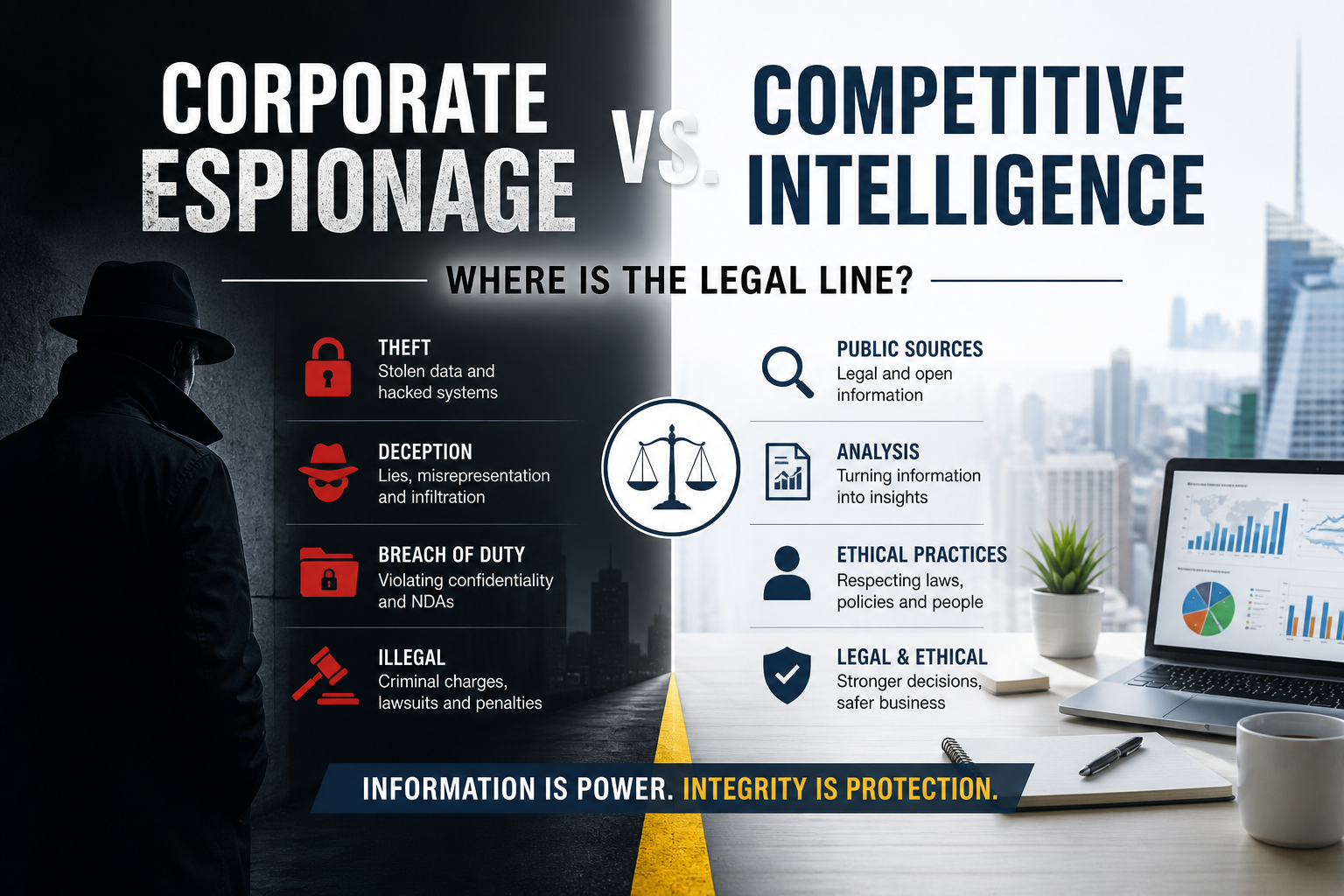
Corporate espionage refers to the illegal and unethical practice of obtaining confidential or trade secret information from a competitor. This may include:
• Stealing trade secrets
• Hacking into systems
• Bribing employees
• Unauthorized surveillance
• Industrial spying
The intention is usually to gain an unfair advantage in the market. Corporate espionage is punishable under various laws and is considered a serious offence in most jurisdictions.
- Competitive Intelligence
Competitive intelligence, on the other hand, is a legal and ethical process of gathering and analyzing publicly available information about competitors. It helps businesses make informed decisions without violating any laws.
Examples include:
• Studying competitors’ websites
• Analyzing market trends
• Reviewing public financial reports
• Observing marketing strategies
It is widely accepted as a normal business practice as long as it follows ethical guidelines.
Legal Framework (India)
India does not have a single specific law dealing exclusively with corporate espionage, but several laws indirectly address it.
- Information Technology Act, 2000
• Deals with cybercrimes such as hacking, data theft, and unauthorized access
• Section 43 and 66 impose penalties for data breaches and hacking
- Indian Penal Code (IPC)
• Section 378 (Theft)
• Section 403 (Dishonest misappropriation)
• Section 405 (Criminal breach of trust)
These sections can be applied when confidential business information is stolen.
- Contract Law & NDAs
• Non-Disclosure Agreements (NDAs) are commonly used
• Breach of confidentiality can lead to civil liability
- Trade Secret Protection
India does not have a specific statute for trade secrets, but protection is provided through:
• Contract law
• Equity principles
• Judicial precedents
Global Legal Perspective
United States
• Economic Espionage Act, 1996
• Clearly criminalizes theft of trade secrets
• Provides both civil and criminal remedies
European Union
• Trade Secrets Directive (2016)
• Harmonizes protection across EU countries
United Kingdom
• Laws related to breach of confidence and misuse of information
• Strong emphasis on contractual obligations
Case Examples
- Waymo vs Uber (Global Example)
A former employee of Waymo allegedly stole confidential self-driving car technology and joined Uber. The case highlighted how employee mobility can sometimes lead to misuse of trade secrets. Uber eventually settled the case.
Learning: Even indirect use of confidential information can be treated as corporate espionage
- Coca-Cola Trade Secret Case
An employee attempted to sell Coca-Cola’s confidential documents to Pepsi. Instead of accepting, Pepsi informed authorities, leading to legal action.
Learning: Ethical conduct in business is equally important alongside legal compliance.
- Indian Context Example
While India has fewer publicly reported cases, disputes involving employee confidentiality and misuse of data are increasing. Courts often rely on breach of trust and contract principles.
Where is the Legal Line?
The legal line between corporate espionage and competitive intelligence is mainly based on:
- Source of Information
• Public information → Legal
• Confidential information → Illegal (if obtained without permission)
- Method of Collection
• Ethical research → Allowed
• Deception or hacking → Prohibited
- Intent
• Strategic understanding → Acceptable
• Unfair advantage through theft → Illegal
Challenges in Defining the Boundary
Despite clear principles, practical challenges exist:
• Rapid digitalization makes data easier to access
• Employees switching companies may unintentionally share knowledge
• Lack of strict trade secret laws in some countries (like India)
• Difficulty in proving intent and method
Personal Analysis
In my view, the difference between corporate espionage and competitive intelligence lies not just in legality but also in ethics. Many companies try to operate in the “grey area,” where actions may not clearly violate the law but still raise ethical concerns.
For example, aggressively collecting competitor data through indirect means may not always be illegal but can still be questionable. This shows that businesses should not only focus on “what is allowed” but also on “what is right.”
India, in particular, needs a clearer and stronger legal framework for trade secrets to reduce ambiguity. At the same time, companies must invest in internal policies, employee training, and strong confidentiality agreements.
Conclusion
Corporate espionage and competitive intelligence may appear similar at first glance, but they are fundamentally different in terms of legality, ethics, and business impact. While competitive intelligence supports healthy competition and innovation, corporate espionage undermines trust and fairness in the market.
The legal line between the two is primarily determined by the source of information, the methods used, and the intent behind the action. As business environments become more complex, maintaining this boundary becomes even more important.
Ultimately, companies must ensure that their strategies are not only legally compliant but also ethically sound. A responsible approach to information gathering is essential for long-term success and credibility.
Disclaimer: This article is published for educational and informational purposes only and does not constitute legal advice, legal opinion, or professional counsel. It does not create a lawyer–client relationship. All views and opinions expressed are solely those of the author and represent their independent analysis. Times Law does not endorse, verify, or assume responsibility for the author’s views or conclusions. While editorial standards are maintained, Times Law, the author, and the publisher disclaim all liability for any errors, omissions, or consequences arising from reliance on this content. Readers are advised to consult a qualified legal professional before acting on any information herein. Use of this article is at the reader’s own risk.