By: Parbati Bose
Introduction
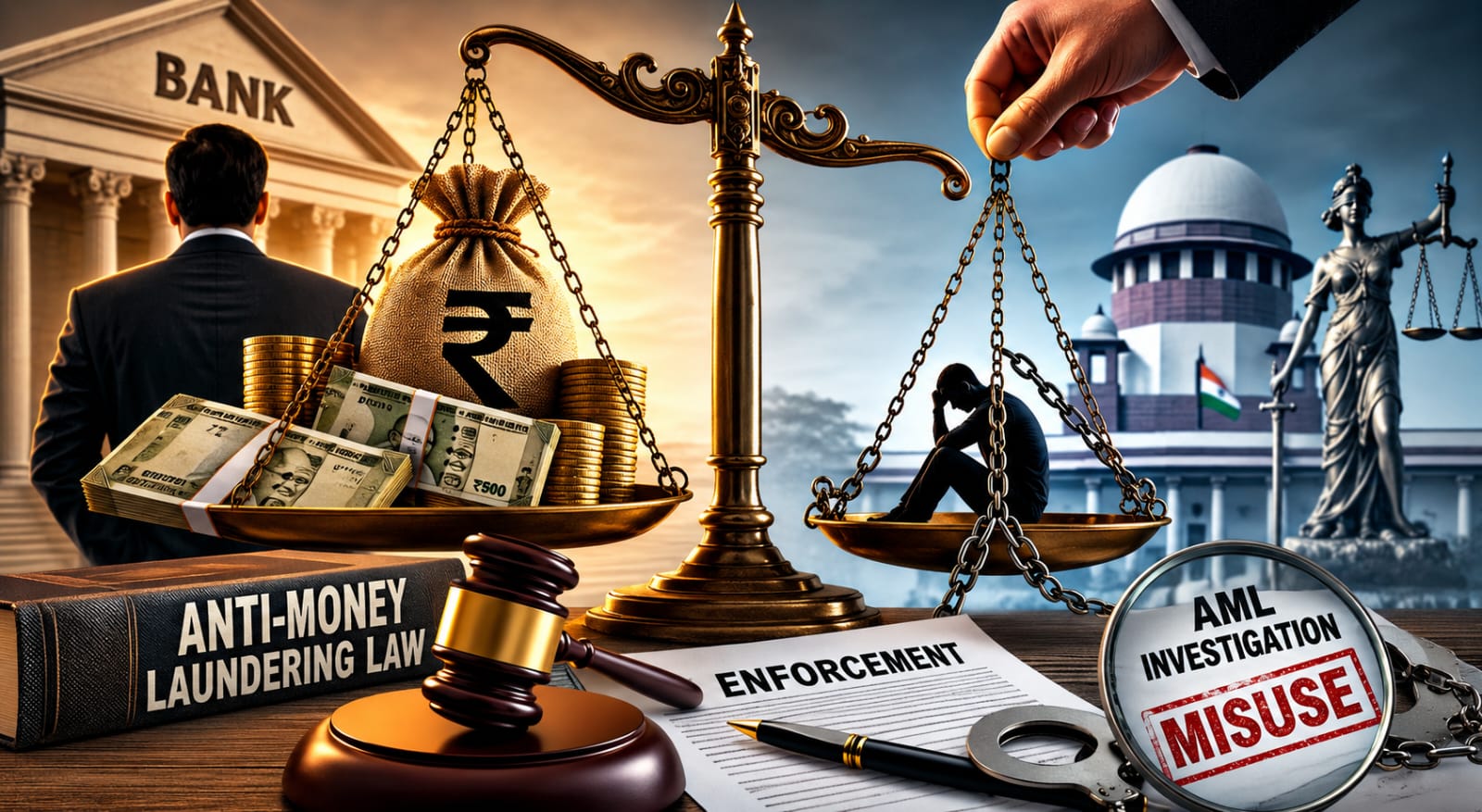
The primary objective of Anti-Money Laundering (AML) legislations has been the preservation of financial institutions’ ability to preserve and channel legitimate economic activities by combating the laundering of ill-gotten gains into otherwise clean money streams. The laws have been promulgated and adopted by a myriad of countries to build fortresses against organized criminal and terrorist organisations. In the real sense, however, what we have observed over the years is the selective implementation of the laws – using it to persecute political opponents, the civil society and other ‘unpopular’ individuals and groups whilst creating escape routes for the economic and political elites.1
The Structural Vulnerability of AML Frameworks
The AML regimes of today, including India’s Prevention of Money Laundering Act (PMLA) are designed to capture wide categories of the ‘proceeds of crime’ and confer sweeping powers to enforcement agencies in relation to search, seizure and arrest. This inherent vulnerability means that any predicate offense may give rise to the application of money laundering laws. After the registration of a case under a predicate offense, the full might of the money laundering regime is unleashed, largely disregarding traditional criminal law procedure and protections.2
Navigation by the Economically Powerful
Strongly resourced defendants may engage in complex maneuvers to avoid or mitigate the sting of AML enforcement such as: Corporate Layering to distance themselves from the origin of funds; Regulatory Arbitrage by moving assets swiftly across different jurisdictions before the courts can get the freezing order through; or Institutionally Influence the system, delaying enforcement proceedings for years through an onslaught of interlocutory applications that exhaust the state.
The Disproportionate Impact of Enforcement
In contrast, such authorities have been seen to take a much lighter touch against those not powerful enough to exercise any undue influence. For example, the reversing of the ‘burden of proof’- a commonly found feature in tough AML legislation – simply transforms the standard law into a weapon for oppression against the average citizen or weaker player in society. Though legally speaking the prosecution will have to demonstrate the underlying predicate offense, in practice the defendant can spend years incarcerated pre trial due to the fact thatbail facilities are rarely an option.
Analysis of Judicial Trends (Relevant Case Law)
There is a developing pattern in judicial discussions, particularly within the Supreme Court of India, of trying to striking a equilibrium between the authority of the condition and the liberty of an personal within money laundering circumstances. The Supreme Court has affirmed the constitutional legitimacy of the most of the PMLA sections together with the demanding bail stipulations in Vijay Madanlal Choudhary v. Union of India (2022), nonetheless the Courtroom was also apparent that authority to make an arrest ought to not be applied in an arbitrary and capricious manner.3
Further, there is an increasing scrutiny by courts about how money laundering offenses cannot be offenses without a reasonable nexus with an act of crime producing unlawful gain. We are expecting the courts will watch for if these agencies are merely using the PMLA as a backdoor by passing the rigorous process of investigation under the Bharatiya Nagarik Suraksha Sanhita (BNSS), 2023.4
Conclusion
Enforcement and the rule of law AML laws are being used to the detriment of some of the basic principles of the rule of law. State power under the regulations are applied in a capricious manner and the laws are being employed not to tackle crime in general but for harassment and persecution of opponents of government not only financially but personally and they will also serve to create an environment where public will and confidence in the government’s regulation is eroded to irreparable loss. Institutional reform must, thus be at the earliest the call for the independent watchdog, timely investigations with time limit and in which, there is willingness by the judiciary to guard personal liberty from state apparatus in overdrive.
Endnotes
- Vijay Madanlal Choudhary v. Union of India, (2022) SCC OnLine SC 929.
- Financial Action Task Force, International Standards on Combating Money Laundering and the Financing of Terrorism & Proliferation: The FATF Recommendations (2012-2023).
- Transparency International, Corruption Perceptions Index 2024 (2025).
- The Bharatiya Nagarik Suraksha Sanhita, 2023, Act No. 46 of 2023.
Disclaimer: This article is published for educational and informational purposes only and does not constitute legal advice, legal opinion, or professional counsel. It does not create a lawyer–client relationship. All views and opinions expressed are solely those of the author and represent their independent analysis. Times Law does not endorse, verify, or assume responsibility for the author’s views or conclusions. While editorial standards are maintained, Times Law, the author, and the publisher disclaim all liability for any errors, omissions, or consequences arising from reliance on this content. Readers are advised to consult a qualified legal professional before acting on any information herein. Use of this article is at the reader’s own risk.