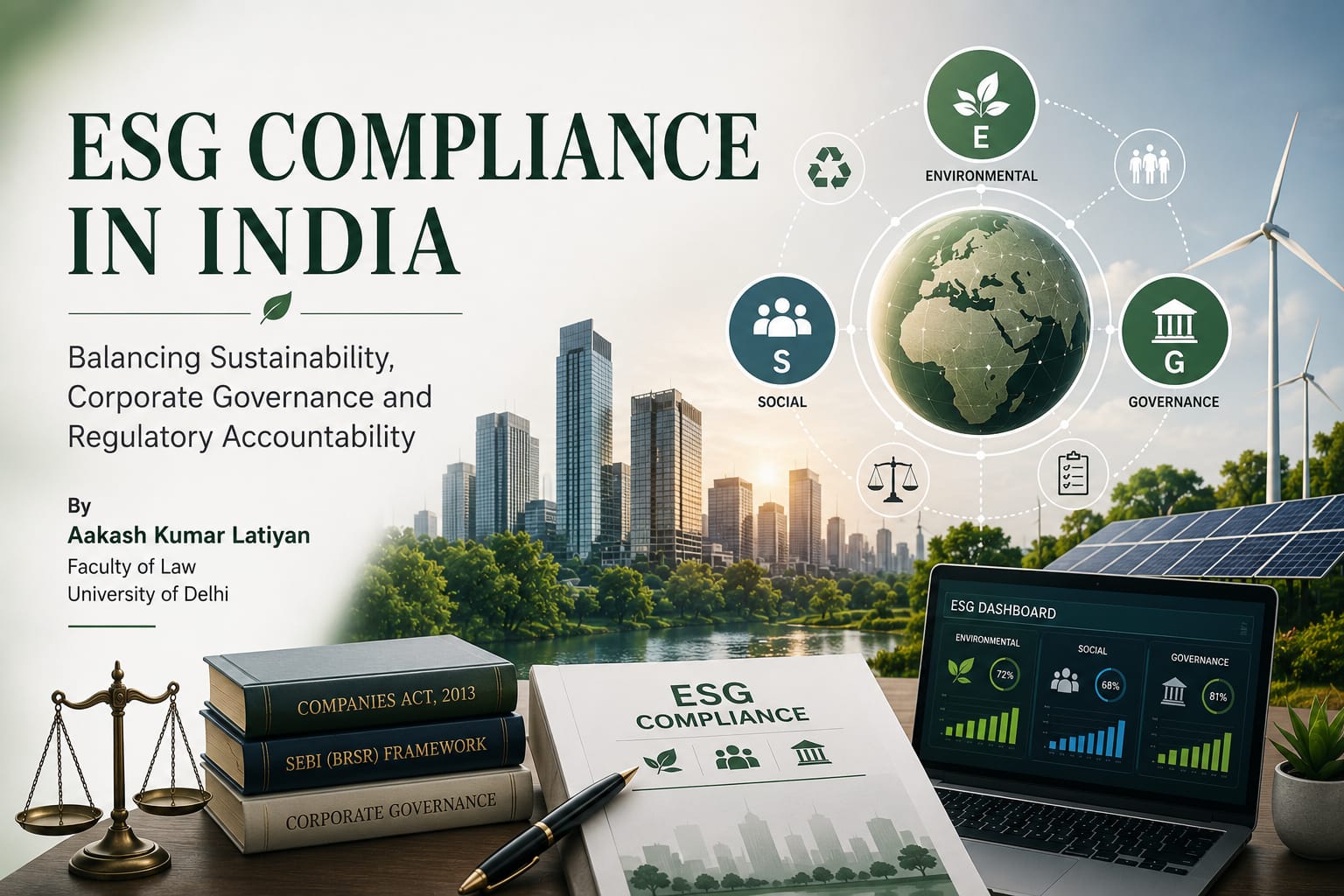
By: Aakash Kumar Latiyan, Faculty of Law, University of Delhi
ABSTRACT
Environmental, Social, and Governance (ESG) compliance has emerged as one of the most significant developments in modern corporate governance systems. ESG refers to a governance and compliance framework through which corporations are evaluated not only on financial performance but also on sustainability practices, social responsibility, ethical governance, and long-term accountability. In recent years, investors, regulators, consumers, and international institutions have increasingly demanded greater corporate transparency and responsible business conduct. As a result, ESG compliance has become an important component of investment decisions, regulatory supervision, and corporate accountability mechanisms across the world.
In India, ESG governance has gained considerable importance due to increasing environmental concerns, international sustainability commitments, investor activism, and evolving regulatory standards. Regulatory authorities such as the Securities and Exchange Board of India (SEBI) have introduced Business Responsibility and Sustainability Reporting (BRSR) requirements to improve sustainability disclosures and corporate transparency. Simultaneously, corporations are facing growing pressure to integrate environmental sustainability, social welfare obligations, and governance ethics into business operations.
Despite these developments, the Indian ESG framework continues to face several legal and practical challenges including greenwashing, inconsistent disclosures, lack of standardised reporting frameworks, regulatory uncertainty, compliance burden, and inadequate enforcement mechanisms. The growing overlap between ESG obligations and corporate governance has also raised questions regarding director liability, investor protection, fiduciary duties, and corporate accountability.
This research paper analyses the evolving ESG framework in India and critically examines the emerging legal and regulatory challenges associated with ESG compliance and corporate governance. The paper further evaluates the role of regulatory institutions, corporate entities, investors, and international sustainability frameworks in shaping ESG governance in India.
KEYWORDS
ESG Compliance, Corporate Governance, Sustainability Reporting, SEBI, BRSR, Greenwashing
INTRODUCTION
Environmental, Social, and Governance (ESG) compliance has become an increasingly important aspect of modern corporate governance and regulatory supervision. Traditionally, corporations were primarily assessed on the basis of profitability and shareholder returns. However, changing global economic conditions, sustainability concerns, investor expectations, and increasing public awareness have significantly transformed the understanding of corporate responsibility. Corporations are now expected to function not merely as profit-generating entities but also as socially responsible institutions accountable to stakeholders, regulators, consumers, and society at large.
The concept of ESG seeks to evaluate corporate performance through three broad dimensions. The environmental component focuses on issues such as climate change, pollution control, waste management, energy efficiency, and sustainability practices. The social component examines labour standards, employee welfare, diversity, human rights, consumer protection, and community engagement. Governance relates to corporate ethics, board accountability, transparency, anti-corruption mechanisms, and regulatory compliance.
Globally, ESG governance has become closely associated with responsible investing and sustainable finance.
Investors increasingly consider ESG risks while making investment decisions, and corporations with stronger ESG frameworks are often viewed as more stable and sustainable in the long term. International institutions such as the United Nations, Organisation for Economic Co-operation and Development (OECD), and Global Reporting Initiative (GRI) have encouraged countries to integrate sustainability principles into corporate governance frameworks.
In India, ESG governance has evolved rapidly over the last decade. Regulatory developments introduced by the Securities and Exchange Board of India (SEBI), especially the Business Responsibility and Sustainability Reporting (BRSR) framework, indicate a growing shift toward sustainability-oriented corporate governance. ESG principles are also indirectly reflected in the Companies Act, 2013 through provisions relating to Corporate Social Responsibility (CSR), board accountability, disclosure obligations, and stakeholder protection.
The increasing significance of ESG compliance has substantially expanded the responsibilities of corporate boards and management. Directors are now expected to address environmental risks, ethical governance concerns, data protection responsibilities, and long-term sustainability objectives while exercising corporate powers. ESG compliance therefore represents a shift from narrow shareholder-centric governance to broader stakeholder-oriented governance.
However, despite the growing importance of ESG frameworks, several legal and practical challenges continue to affect implementation in India. Concerns regarding greenwashing, lack of standardised reporting metrics, weak enforcement structures, compliance burdens, and inconsistent sustainability disclosures have raised important regulatory and governance issues. Furthermore, the absence of comprehensive ESG legislation creates uncertainty regarding liability standards and regulatory obligations.
This paper seeks to analyse the evolving ESG governance framework in India and critically examine the emerging legal challenges associated with sustainability compliance and corporate accountability.
RESEARCH METHODOLOGY
The present research is doctrinal and analytical in nature. The study is primarily based on secondary sources including statutes, SEBI regulations, government reports, policy papers, judicial decisions, academic journals, research articles, and commentaries relating to ESG compliance and corporate governance.
The research adopts an analytical approach to examine the regulatory developments governing ESG compliance in India and evaluate the practical and legal challenges affecting implementation. Comparative references to international ESG frameworks and sustainability standards have also been considered to understand global best practices and their relevance to the Indian corporate governance system.
REVIEW OF LITERATURE
Several scholars and institutions have analysed the growing significance of ESG compliance within corporate governance systems. Academic literature indicates that ESG-oriented governance promotes long-term sustainability, enhances investor confidence, improves transparency, and strengthens corporate accountability. Research studies conducted by international organisations and financial institutions suggest that corporations with strong ESG performance are often viewed as more resilient and sustainable in changing economic conditions.
Scholars have highlighted that ESG governance has transformed the traditional understanding of fiduciary obligations by requiring directors and management to consider environmental risks, social impact, and ethical governance practices in corporate decision-making. Research literature further indicates that institutional investors increasingly rely upon ESG metrics while evaluating corporate performance and investment risks.
Several studies have also examined the regulatory role played by authorities such as SEBI in promoting sustainability disclosures and responsible investing in India. Reports relating to the Business Responsibility and Sustainability Reporting (BRSR) framework suggest that ESG disclosures have improved corporate transparency and investor awareness.
However, existing literature also identifies major concerns relating to greenwashing, disclosure inconsistencies, weak enforcement mechanisms, lack of uniform ESG standards, and excessive dependence on self-reporting by corporations. Scholars argue that developing economies such as India face additional implementation challenges due to varying corporate capacities, evolving regulatory structures, and limited institutional enforcement capabilities.
The literature therefore demonstrates that while ESG governance represents an important development in modern corporate regulation, stronger legal frameworks and standardised compliance mechanisms remain necessary for effective implementation.
METHOD
- ESG Framework in India
India has gradually integrated ESG principles into its corporate governance structure through legislative reforms, regulatory measures, and sustainability reporting frameworks. One of the most important developments in this regard has been the introduction of Business Responsibility and Sustainability Reporting (BRSR) requirements by SEBI for top listed entities.
Initially, SEBI introduced the Business Responsibility Report (BRR) framework in 2012. However, due to increasing emphasis on sustainability governance and global ESG standards, the BRSR framework replaced the earlier reporting mechanism. The BRSR framework seeks to improve transparency and standardisation in ESG disclosures. The Companies Act, 2013 also supports ESG-oriented governance through several provisions relating to Corporate Social Responsibility (CSR), director duties, stakeholder protection, and disclosure obligations. Section 135 of the Companies Act introduced mandatory CSR expenditure requirements for qualifying companies, thereby incorporating social responsibility obligations within corporate governance.
Additionally, environmental legislations such as the Environment Protection Act, 1986 and labour welfare laws indirectly contribute toward ESG compliance obligations in India. - Role of SEBI in ESG Governance
SEBI has emerged as the primary regulatory authority governing ESG compliance and sustainability disclosures in India. Through the BRSR framework, SEBI seeks to encourage corporations to disclose sustainability-related information concerning environmental practices, employee welfare, diversity, governance structures, and stakeholder engagement.
SEBI has also introduced regulations governing ESG-focused mutual funds and sustainability rating providers. These developments reflect increasing regulatory emphasis on responsible investing and sustainable finance.
The BRSR Core framework introduced by SEBI represents another important regulatory development. It establishes quantitative ESG metrics and verification requirements aimed at improving reliability and comparability of sustainability disclosures.
However, despite these developments, challenges relating to implementation and verification continue to persist. ESG disclosures in India remain heavily dependent on self-reporting by corporations, thereby raising concerns regarding accuracy and transparency. - International ESG Frameworks and Global Influence
The evolution of ESG governance in India has been significantly influenced by international sustainability frameworks and global regulatory developments. International institutions such as the United Nations, OECD, and Global Reporting Initiative (GRI) have played an important role in shaping ESG standards across jurisdictions.
The United Nations Principles for Responsible Investment (UNPRI) encourage institutional investors to integrate ESG considerations into investment decisions. Similarly, the Paris Climate Agreement has increased global emphasis on environmental sustainability and climate-related corporate disclosures.
The European Union has also introduced extensive sustainability disclosure regulations through the Corporate Sustainability Reporting Directive (CSRD) and Sustainable Finance Disclosure Regulation (SFDR). These frameworks require corporations to disclose ESG-related risks and sustainability practices in a structured manner.
Global ESG developments have significantly influenced Indian regulatory authorities and corporations. Indian companies operating internationally increasingly face pressure to comply with global sustainability standards and investor expectations. - Greenwashing and Disclosure Challenges
One of the most significant legal challenges associated with ESG governance is the problem of greenwashing. Greenwashing refers to misleading or exaggerated sustainability claims made by corporations to create a false impression of environmental or social responsibility.
Many corporations project themselves as environmentally sustainable or socially responsible without implementing genuine sustainability measures. Due to the absence of strict verification standards and independent audit mechanisms, ESG disclosures often lack reliability and consistency.
Greenwashing can adversely affect investor confidence and undermine the credibility of ESG frameworks. Misleading disclosures may also expose corporations to regulatory liability, reputational damage, and shareholder disputes.
The absence of standardised ESG reporting metrics further complicates sustainability disclosures. Different corporations often use varying disclosure methods and reporting standards, making comparison difficult for investors and regulators.
Therefore, stronger regulatory supervision and independent verification mechanisms are necessary to improve the reliability of ESG disclosures. - ESG and Corporate Governance Challenges
The integration of ESG principles into corporate governance systems has significantly expanded the responsibilities of directors and corporate management. Directors are now expected to consider sustainability risks, environmental liabilities, ethical governance standards, and stakeholder interests while exercising corporate powers.
However, many corporations continue to treat ESG compliance merely as a disclosure requirement rather than integrating sustainability into business strategy and governance structures. In several cases, ESG initiatives remain superficial and primarily reputation-oriented.
Corporate boards often lack specialised expertise relating to sustainability governance and ESG risk management. Compliance costs associated with ESG reporting and verification also create practical difficulties, especially for smaller corporations.
Additionally, the absence of comprehensive ESG legislation in India creates uncertainty regarding liability standards and enforcement mechanisms. Questions relating to director liability, shareholder remedies, and regulatory accountability continue to remain legally unsettled. - Investor Activism and Responsible Investing
Investor activism has emerged as an important driving force behind ESG governance. Institutional investors and shareholders increasingly evaluate corporations not only on financial performance but also on sustainability practices and governance standards.
Responsible investing frameworks encourage investors to support corporations demonstrating strong ESG performance and ethical governance practices. Consequently, corporations are increasingly required to improve transparency, sustainability disclosures, and governance standards to attract investment.
ESG-focused investment strategies have also influenced corporate decision-making and risk assessment mechanisms. Investors increasingly consider climate risks, social controversies, governance failures, and ethical practices while making investment decisions.
This shift has contributed toward greater corporate accountability and improved regulatory focus on sustainability governance. - Judicial Developments Relating to ESG Governance
Indian courts have also contributed indirectly toward the development of ESG-related governance principles through environmental and corporate governance jurisprudence.
In M.C. Mehta v. Union of India, the Supreme Court emphasised environmental protection and sustainable development as essential constitutional obligations. Similarly, environmental liability principles developed through judicial decisions have strengthened corporate accountability concerning environmental compliance.
In Tata Consultancy Services Ltd. v. Cyrus Investments Pvt. Ltd., the Supreme Court discussed principles relating to corporate governance, minority shareholder protection, and board accountability. The judgment highlighted the importance of transparency and responsible governance in corporate functioning.
Judicial developments concerning environmental protection, corporate transparency, labour welfare, and stakeholder accountability collectively contribute toward the broader ESG governance framework in India.
SUGGESTIONS
- India should introduce clearer and standardised ESG disclosure norms to improve consistency and comparability of sustainability reporting.
- Independent ESG audit and verification mechanisms should be established to reduce greenwashing and misleading disclosures.
- Regulatory authorities should strengthen enforcement mechanisms and impose stricter penalties for false sustainability claims.
- Corporate boards should receive specialised ESG governance and sustainability training to effectively address compliance obligations.
- Greater coordination between SEBI, Ministry of Corporate Affairs, environmental regulators, and financial institutions is necessary for effective ESG supervision.
- India should gradually harmonise domestic ESG frameworks with international sustainability reporting standards.
- ESG compliance should be integrated into corporate governance culture rather than treated merely as a disclosure formality.
CONCLUSION
ESG compliance has emerged as an important component of modern corporate governance and regulatory accountability in India. Increasing investor awareness, sustainability concerns, and regulatory developments have significantly transformed the obligations of corporations and corporate boards. Regulatory initiatives such as the BRSR framework indicate India’s growing commitment toward responsible business practices and sustainability governance.
However, several legal and practical challenges continue to affect effective implementation of ESG frameworks in India. Concerns relating to greenwashing, disclosure inconsistencies, weak enforcement structures, compliance burdens, and lack of standardised reporting mechanisms remain major obstacles.
The future effectiveness of ESG governance in India will depend upon stronger regulatory supervision, transparent disclosure standards, independent verification mechanisms, and genuine corporate commitment toward sustainability principles. ESG compliance should not be viewed merely as a regulatory obligation but as an essential component of long-term corporate accountability and responsible governance.
In the coming years, ESG governance is likely to play a decisive role in shaping corporate regulation, investor behaviour, sustainability compliance, and responsible business practices in India’s evolving economic environment.
Disclaimer: This article is published for educational and informational purposes only and does not constitute legal advice, legal opinion, or professional counsel. It does not create a lawyer–client relationship. All views and opinions expressed are solely those of the author and represent their independent analysis. Times Law does not endorse, verify, or assume responsibility for the author’s views or conclusions. While editorial standards are maintained, Times Law, the author, and the publisher disclaim all liability for any errors, omissions, or consequences arising from reliance on this content. Readers are advised to consult a qualified legal professional before acting on any information herein. Use of this article is at the reader’s own risk.