AUTHOR: Khyatee Parashar, Second Year, B.A. LL.B., ILS Law College
Abstract
Courts have always trusted what a photograph, a recording, or a video could show
them. That trust is now a liability. Generative artificial intelligence can manufacture a video
of a person saying or doing something they never did, and the resulting file carries none of the
tell-tale defects that once separated fabrication from fact. This article examines how deepfake
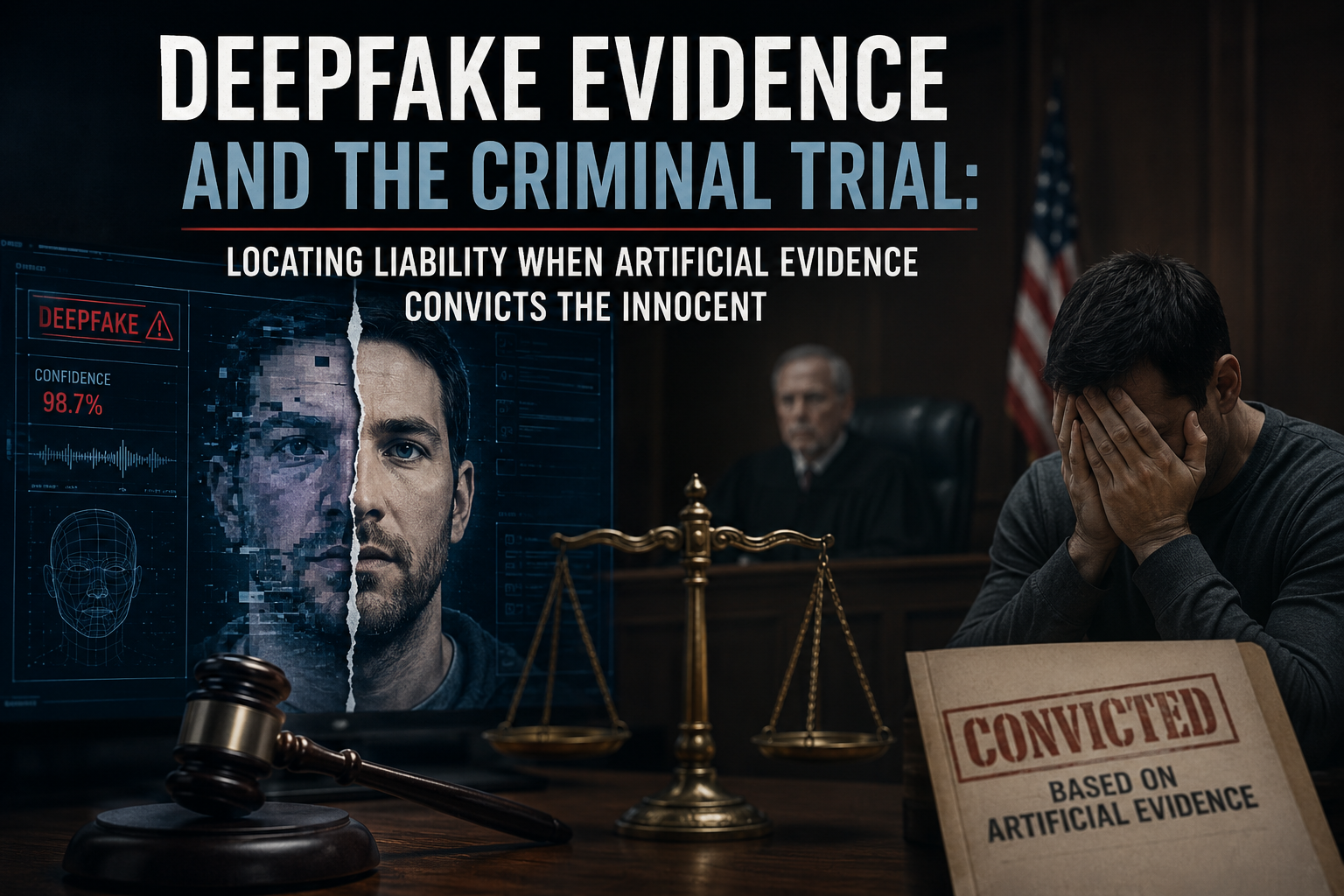
technology destabilises the evidentiary foundations of criminal adjudication, surveys the existing legal tools available to test the authenticity of electronic evidence, and asks the harder question that most commentary avoids: when a fabricated video convicts an innocent person, who answers for it– the investigator who relied on it, the forensic examiner who validated it, the prosecutor who tendered it, or the technology that made the deception possible in the first place? The article argues that the current framework, built for an era when evidence could be forged only with effort and skill, is structurally unequipped for evidence that can now be forged by anyone with a laptop, and it proposes a layered liability model to close that gap.
Keywords: deepfake, criminal evidence, electronic evidence, wrongful conviction, artificial
intelligence, forensic authentication, criminal liability.
I. Introduction
Imagine a criminal trial where the prosecution’s strongest exhibit is a video: the accused,
clearly recognisable, confessing to a crime in his own voice. The jury watches it twice. It
looks real because it is engineered to look real. It is not real. It was generated by a neural
network trained on a few minutes of publicly available footage of the accused’s face and voice,
stitched onto words he never spoke. Five years ago this scenario belonged to speculative fiction.
Today the software to produce such a clip is available for free, requires no technical background
to operate, and can be run on an ordinary phone.
This is not a hypothetical concern raised for dramatic effect. Deepfake technology the use of generative adversarial networks and diffusion models to fabricate convincing audio visual content– has already been used to manipulate elections, defraud corporations of millions of dollars through fabricated voice instructions, and create non-consensual explicit content of private individuals.1 It is only a matter of time– if it has not already happened in a case that went unnoticed– before such content is placed before a criminal court as evidence of guilt.
The law of evidence was not built for this problem.
It was built on the assumption that fabrication leaves traces: a splice line, a mismatched shadow, an inconsistency between audio and lip movement. Deepfake technology increasingly erases those traces. This article is not
about whether deepfakes are dangerous; that much is obvious. It is about a narrower and more
uncomfortable question– when the danger materialises inside a courtroom and produces a
wrongful conviction, whose failure was it?
II. The Evidentiary Threat: Why Deepfakes Are Different
Criminal procedure has dealt with forged and tampered evidence for as long as it has existed.
Whatmakes deepfakeevidence a distinct category of problem, rather than merely a new method
of an old crime, is threefold.
A. The collapse of the authenticity presumption
Courts have historically extended a soft presumption of reliability to photographic and audio
visual evidence, precisely because forging it convincingly required rare skill. That presump
tion is what deepfake technology attacks directly. Once fabrication becomes cheap and skill
independent, the presumption itself becomes indefensible, yet procedural practice has been
slow to catch up with the technical reality.
B. The detection arms race
Forensic detection of deepfakes relies on identifying digital artefacts– irregular blinking pat
terns, inconsistent lighting, unnatural pixel-level noise. These detection methods are published
in the same academic literature that trains the next generation of generative models to eliminate exactly those artefacts. Detection, in other words, is not a stable science the way fingerprint
or DNA analysis eventually became; it is a moving target that degrades with every published
countermeasure.
C. Theasymmetry of cost
Generating a convincing deepfake now costs very little in time, money, or expertise. Detecting
one with confidence sufficient for a criminal trial requires specialised software, expert testi
mony, and resources that most defence lawyers– particularly those representing indigent ac
cused persons– simply do not have. This asymmetry means the risk of wrongful conviction
through fabricated evidence falls disproportionately on those least equipped to contest it.
III. Testing Authenticity: What the Present Framework Offers
Before asking who should be liable, it is necessary to ask whether the existing law can even
catch a deepfake before it does damage.
A. Electronic evidence law
Jurisdictions that follow the common law tradition of evidence generally require that electronic
records be authenticated before admission, and many– India being a clear example– impose
a certification requirement for electronic evidence produced by a computer system.2 That cer
tification, however, verifies the chain of custody of a file– that it has not been altered after it
was recorded. It does nothing to verify that what was originally recorded reflected reality. A
deepfake video, generated and saved as a single unaltered file, can satisfy every procedural re
quirement of authentication while being entirely fictitious in content. The law, in short, is well
designed to catch tampering with genuine evidence, and poorly designed to catch evidence that
was fabricated from the outset.
B. Thescientific reliability standard
Common law systems have also developed doctrines for testing whether expert or scientific
evidence is reliable enough to go before a jury, most famously the Frye general-acceptance
standard and the later Daubert standard developed in United States federal practice, which asks
courts to assess the testability, error rate, peer review, and general acceptance of a scientific
technique before admitting evidence based on it.
These standards were designed to police
expert testimony about evidence, such as fingerprint or ballistic analysis. They were never
designed to police the underlying authenticity of a video file itself, and courts have not yet
developed a settled, uniformly applied test for admitting or excluding AI-generated content
offered as direct evidence of fact. This is, at present, a genuine vacuum rather than a grey area– no reported precedent in any major jurisdiction has yet laid down a definitive evidentiary test
for deepfake content, which is precisely what makes the question worth asking now, before the
vacuum is filled by a bad case.
IV. The Liability Vacuum: Who Answers for a Wrongful Conviction
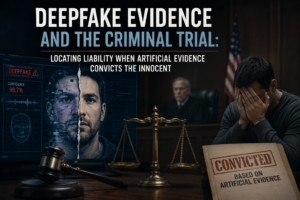
Assume the worst has happened: a person has been convicted substantially on the strength of a
fabricated video, and the fabrication is discovered only after conviction. Existing legal doctrine
offers several candidates for responsibility, and each is unsatisfying in a different way.
A. Thedeveloper of the generative model
It is tempting to locate liability at the source– the company or individual that built the tool
used to create the fake. But most generative AI tools have overwhelmingly legitimate uses (film
production, education, accessibility technology), and the doctrine of proximate cause struggles
to connect a general-purpose tool to one criminal misuse of it several steps removed. Holding a
developer criminally liable for every downstream misuse of a general-purpose model would be
analogous to holding a paper manufacturer liable for a forged will– technically traceable, but
doctrinally indefensible without evidence of specific intent or gross negligence in deployment
B. Theperson who fabricated the evidence.
This is the most doctrinally straightforward answer, and criminal law already has tools for it– forgery, fabrication of false evidence, and perjury-adjacent offences all apply cleanly once
the fabricator is identified. The difficulty is practical, not conceptual: deepfake creation leaves
few forensic fingerprints, can be done anonymously, and the fabricator may never be identified
at all. A liability theory that only works once you have already caught the culprit offers little
protection to the wrongly convicted person in the meantime.
C. Theinvestigating agency
A stronger case can be made for institutional liability where a police force or investigating
agency introduces AI-generated content without independent verification. Criminal procedure
already imposes a due-diligence standard on investigators for other categories of forensic ev
idence; there is no principled reason that standard should not extend to AI-generated audio
visual material, particularly once its fabrication risk is a matter of judicial notice. Negligent
reliance by an investigating agency– as opposed to deliberate fabrication– is better addressed
through disciplinary and civil accountability mechanisms than through criminal liability, but
accountability of some kind is essential, because the agency is the actor best positioned to
verify evidence before it enters the trial record.
D. Theprosecutor and the court
Prosecutorial ethics rules in most jurisdictions already require prosecutors not to knowingly
present false evidence. The open question is what “knowingly” should mean once deepfake
detection tools exist but are imperfect and unevenly available. A prosecutor who tenders a
video without any authentication effort, in a legal environment where the fabrication risk is
well known, arguably falls short of the good-faith standard the role demands– even without
actual knowledge of the fabrication. Courts, for their part, retain the ultimate gatekeeping
function, and arguably bear responsibility for developing an admissibility threshold specific to
AI-generated content rather than treating it as ordinary video evidence by default.
E. A layered model
No single actor in this chain is solely responsible, and treating the question as a search for one
culpable party misunderstands the nature of the harm. A more workable model treats liability as layered and proportionate to control: criminal liability for the fabricator where identifiable; a heightened due-diligence and disciplinary standard for investigators and prosecutors who fail to authenticate before reliance; and a narrow, negligence-based civil liability for developers only where a tool was deployed or marketed with actual knowledge of its use for evidentiary fabrication, or without reasonable safeguards against such use. This does not solve the problem of an unidentified fabricator, but it ensures that every institutional actor with the power to have
prevented the harm carries a proportionate share of the consequence for failing to do so.
V. Toward a Workable Response
Three reforms would meaningfully narrow the vacuum identified above, without requiring a
wholesale rewrite of evidence law.
Mandatory disclosure of provenance metadata, requiring that any AI-generated or AI
edited content be accompanied, where technically feasible, by cryptographic provenance
markers– a solution already being developed in industry standards such as the Coalition
for Content Provenance and Authenticity (C2PA), and one that legislatures could make a
condition of evidentiary admissibility rather than leaving to voluntary industry adoption.
Adedicated admissibility threshold for AI-generated content. Courts should require, as
a precondition to admitting contested audio-visual evidence, a certified forensic authenti
cation report addressing fabrication risk specifically– distinct from the existing chain-of
custody certification, which does not test this at all.
A statutory due-diligence standard for investigating agencies, mirroring the standards
already applied to forensic disciplines such as DNA and ballistics, triggered whenever con
tested evidence is audio-visual in nature and the accused disputes its authenticity.
VI. Conclusion
The criminal trial has always rested on a simple premise: that what the court can see and
hear, it can trust. Deepfake technology does not merely add a new method of committing an
old crime; it quietly withdraws the premise the entire evidentiary system was built on. The
question this article has tried to answer– who is liable when that trust is exploited and an
innocent person is convicted– does not have a single clean answer, and any commentary that
offers one should be treated with suspicion.
What the law can offer instead is a structure that distributes responsibility across every actor with the power to have caught the fabrication: the fabricator where identifiable, the investigator and prosecutor who failed to verify, and, in narrow and well-defined circumstances, the developer who built the tool without reasonable
safeguards. Until courts and legislatures build that structure deliberately, the risk is that it gets
built accidentally, in the aftermath of the first wrongful conviction that makes the front page.
References
[1] Indian Evidence Act, 1872, s. 65B.
[2] Bharatiya Sakshya Adhiniyam, 2023.
[3] Anvar P.V. v. P.K. Basheer, (2014) 10 SCC 473.
[4] Shafhi Mohammad v. State of Himachal Pradesh, (2018) 2 SCC 801.
[5] Arjun Panditrao Khotkar v. Kailash Kushanrao Gorantyal, (2020) 7 SCC 1.
[6] Frye v. United States, 293 F. 1013 (D.C. Cir. 1923).
[7] Daubert v. Merrell Dow Pharmaceuticals, Inc., 509 U.S. 579 (1993).
[8] Coalition for Content Provenance and Authenticity (C2PA), Technical Specifications
Disclaimer: This article is published for educational and informational purposes only and does not constitute legal advice, legal opinion, or professional counsel. It does not create a lawyer–client relationship. All views and opinions expressed are solely those of the author and represent their independent analysis. Times Law does not endorse, verify, or assume responsibility for the author’s views or conclusions. While editorial standards are maintained, Times Law, the author, and the publisher disclaim all liability for any errors, omissions, or consequences arising from reliance on this content. Readers are advised to consult a qualified legal professional before acting on any information herein. Use of this article is at the reader’s own risk.