AUTHOR: Soumyadipta Jana, BA LL.B, LJD Law College Tollygunge, University of Calcutta
ABSTRACT
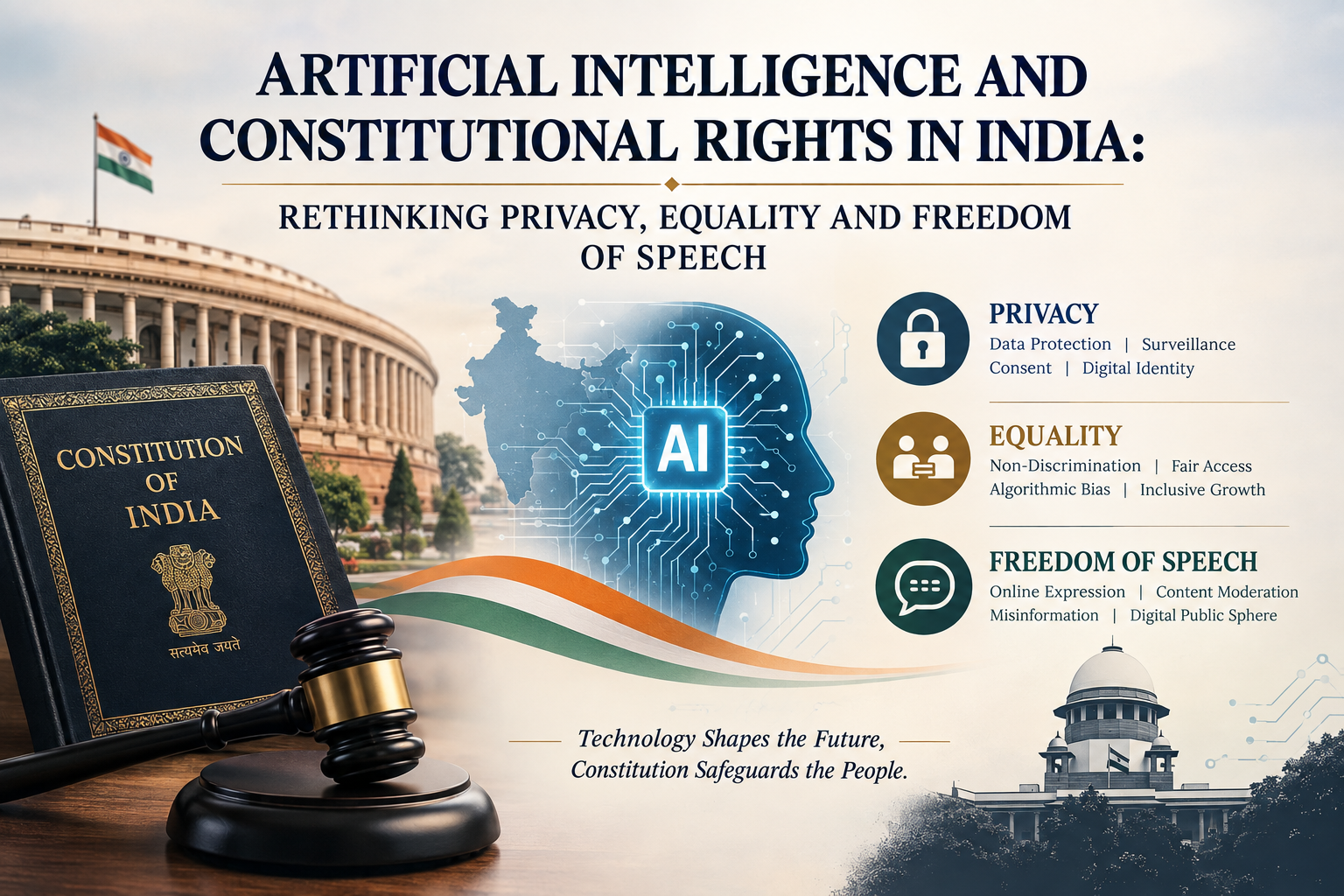
Artificial Intelligence (‘AI’) has evolved from a specialised field of computer science into a general-purpose technology capable of influencing decisions in employment, finance, healthcare, education, policing, public administration and digital communication. The rapid deployment of generative AI, automated decision-making systems and increasingly autonomous AI agents has created significant opportunities for economic and social development. At the same time, these technologies create difficult constitutional questions concerning equality, privacy, dignity, freedom of speech, procedural fairness and State accountability.
The Indian Constitution does not contain an AI-specific regulatory framework. Nevertheless, its fundamental-rights jurisprudence provides principles capable of governing technological power. Article 14 protects against arbitrary and discriminatory State action; Article 19(1)(a) protects freedom of speech and expression; and Article 21 protects life and personal liberty, within which the Supreme Court has recognised privacy, dignity and decisional autonomy. The decision in Justice K.S. Puttaswamy (Retd.) v Union of India is particularly significant because it recognises informational privacy as an important dimension of constitutional privacy.[1]
This paper examines the constitutional implications of AI through three principal rights: equality, privacy and freedom of speech. It analyses how algorithmic bias may implicate Article 14, how large-scale data processing and AI-enabled surveillance may threaten Article 21, and how automated content moderation, generative AI and synthetic media may affect Article 19(1)(a). It further examines proportionality, transparency, human oversight and effective remedies as constitutional safeguards.
The paper also evaluates India’s emerging regulatory architecture, including the Digital Personal Data Protection Act 2023, the Digital Personal Data Protection Rules 2025 and the India AI Governance Guidelines 2025. The latter represents a significant shift towards a principle-based, risk-sensitive and techno-legal approach rather than immediate enactment of a comprehensive horizontal AI statute.[2] A comparative reference is made to the European Union’s risk-based AI Act.
The paper argues that India’s appropriate response should neither be technological laissez-faire nor excessive prohibition. Instead, India should develop a constitutional model of AI governance founded upon legality, proportionality, transparency, accountability, non-discrimination, meaningful human oversight and effective remedies.
Keywords
Artificial Intelligence; Constitutional Law; Article 14; Article 19; Article 21; Privacy; Algorithmic Bias; Data Protection; AI Governance; Proportionality.
I. INTRODUCTION
Artificial Intelligence is increasingly becoming embedded in ordinary social and institutional life. Search engines, recommendation systems, automated fraud detection, facial recognition, generative AI tools, recruitment software and predictive systems are examples of technologies capable of influencing human behaviour and institutional decisions.
The significance of AI, however, is not merely technological. When an algorithm affects access to employment, credit, education, welfare benefits, healthcare or governmental services, the question becomes one of legal power. The crucial issue is no longer simply whether a machine can produce a particular result, but whether the process through which that result is produced is compatible with constitutional rights.
Traditional administrative law generally presumes the existence of an identifiable human decision-maker. An affected person can ordinarily ask which authority made the decision, what material was considered and what legal power was exercised. AI complicates this structure. A decision may emerge from a statistical model trained upon extensive datasets, with multiple technical layers between the person affected and the institution responsible for deployment.
The problem is particularly acute where AI is used by public authorities. A government cannot avoid constitutional scrutiny merely because a decision is technically generated by software rather than manually by a public official. The constitutional character of State action depends upon its substance and consequences, not merely upon the technological instrument through which it is performed.
The constitutional implications also extend beyond State action. Large digital platforms can influence public discourse, employment opportunities and access to information. Private entities may therefore exercise forms of technological power that have significant consequences for individual autonomy, even though the traditional horizontal application of fundamental rights may not always be straightforward.
India’s constitutional framework is sufficiently dynamic to respond to such developments. Article 14 has evolved from a formal classification doctrine into a broader principle against arbitrariness.[3] Article 21 has been interpreted to protect dignity, autonomy and privacy.[4] Article 19(1)(a) has been applied to contemporary forms of communication and expression.
The emergence of AI therefore provides an opportunity to ask a larger constitutional question: how should constitutional democracy respond when increasingly consequential decisions are mediated by systems that may be difficult to understand, challenge or attribute to a particular human decision-maker?
This paper argues that the answer lies in applying established constitutional principles to new technological circumstances rather than creating a wholly separate constitutional theory of AI.
II. RESEARCH QUESTIONS
This paper addresses five principal questions:
1. Whether algorithmic decision-making can create constitutional concerns under Article 14 where AI systems produce arbitrary or discriminatory outcomes.
2. How the constitutional right to privacy under Article 21 applies to AI systems involving large-scale collection, analysis and inference from personal data.
3. How AI-generated content, automated content moderation and synthetic media interact with freedom of speech and expression under Article 19(1)(a).
4. Whether India’s emerging statutory and policy framework adequately addresses these constitutional concerns.
5. What principles should form the foundation of a rights-based Indian framework for AI governance?
III. RESEARCH METHODOLOGY
The paper adopts a doctrinal method of legal research. Primary sources include the Constitution of India, legislation, delegated legislation and judgments of the Supreme Court of India. Secondary sources include government policy documents, international regulatory instruments and academic literature.
The research is analytical rather than empirical. It seeks to apply established constitutional doctrines to emerging technological circumstances and identify areas where existing legal principles may require institutional or legislative development.
IV. AI AS A CONSTITUTIONAL GOVERNANCE PROBLEM
AI is not inherently beneficial or harmful. Its constitutional significance depends upon its purpose, design, deployment and consequences.
The India AI Governance Guidelines 2025 recognise this dual character. The Guidelines describe AI as a general-purpose technology with substantial potential for productivity and development while identifying risks including deepfakes, misinformation, algorithmic bias and threats to safety and security.[6] They organise India’s governance philosophy around seven principles or ‘sutras’: trust, people first, innovation over restraint, fairness and equity, accountability, understandable by design, and safety, resilience and sustainability.[7]
This approach is important because it rejects a simplistic choice between innovation and regulation.
The constitutional question should instead be approached through a rights-impact framework.
An AI system used for weather forecasting is constitutionally different from an AI system used to determine whether an individual qualifies for a welfare benefit. Similarly, an AI system assisting a doctor is different from an autonomous system making an irreversible decision concerning a person’s liberty.
The degree of constitutional scrutiny should therefore correspond to the significance of the interests affected.
This is consistent with proportionality-based constitutional review. Where an AI system significantly interferes with a fundamental right, stronger safeguards should be required.
V. ARTICLE 14 AND ALGORITHMIC DISCRIMINATION
A. From formal equality to non-arbitrariness
Article 14 guarantees equality before the law and equal protection of the laws.
Indian constitutional jurisprudence has progressively developed Article 14 beyond the traditional classification test. In E.P. Royappa v State of Tamil Nadu, the Supreme Court associated equality with freedom from arbitrariness. This principle was subsequently reinforced through cases including Maneka Gandhi v Union of India.
The relevance to AI is immediate.
An algorithm may appear mathematically neutral while producing systematically unequal outcomes. The absence of an explicit discriminatory instruction does not necessarily establish the absence of discrimination.
For example, an automated recruitment system trained on historical employment data may learn patterns reflecting past institutional inequalities. If those patterns are reproduced in future recruitment, the resulting discrimination may be indirect rather than intentional.
The constitutional problem is therefore not limited to whether the programmer intended discrimination. It concerns whether the State’s use of the system results in arbitrary or unequal treatment.
B. Algorithmic bias
Algorithmic bias may originate at several stages: collection of biased data; incomplete datasets; inaccurate classification; inappropriate selection of variables; biased historical decisions; flawed model design; or discriminatory deployment.
Consider a hypothetical public-sector recruitment algorithm trained on ten years of historical appointments. If historical appointments disproportionately favoured one social group, an AI system optimised to predict ‘successful candidates’ may reproduce that historical pattern.
The system may therefore discriminate without containing any explicit instruction to do so.
This demonstrates an important distinction between formal neutrality and substantive equality.
A constitutional system concerned with equality cannot necessarily accept the proposition that an algorithm is neutral merely because it does not expressly classify people according to prohibited characteristics.
C. Opacity and Article 14
Opacity creates an additional difficulty.
Suppose an individual is rejected by an automated governmental system. The person asks why the decision was taken. If the authority responds only that ‘the algorithm determined the result’, the individual is effectively denied a meaningful explanation.
Such a system would create a serious rule-of-law concern.
Article 14 requires State action to satisfy constitutional standards of reasonableness and non-arbitrariness. A decision-making mechanism that prevents meaningful scrutiny may therefore be constitutionally problematic, particularly where significant rights or interests are affected.
The problem is not necessarily that every algorithm must be completely transparent in its technical architecture. Source-code disclosure may be commercially or technically inappropriate in some circumstances.
The stronger constitutional requirement is meaningful explainability.
The affected individual should ordinarily be able to understand the nature of the decision, the relevant categories of information relied upon, the authority responsible for the decision and the mechanism through which the decision can be challenged.
VI. ARTICLE 21 AND THE CONSTITUTIONAL RIGHT TO PRIVACY A. Puttaswamy and informational privacy
The Supreme Court’s nine-judge decision in Justice K.S. Puttaswamy (Retd.) v Union of India fundamentally transformed Indian privacy jurisprudence.
The Court unanimously recognised privacy as a constitutionally protected right and connected it with dignity, autonomy and liberty.[10] The judgment expressly recognised informational privacy as a dimension of privacy and acknowledged that threats to informational privacy may arise from non-State actors as well as the State.[11]
This principle is particularly significant for AI.
Modern AI systems are data-intensive. They may use personal information not merely to identify an individual but to infer characteristics, preferences, behaviour and potential future actions.
The constitutional concern therefore extends beyond the collection of information. It also concerns inference.
A person may never have expressly stated a particular characteristic, but an AI system may infer it from seemingly unrelated data points.
Consequently, constitutional privacy must be understood to include meaningful protection against unjustified informational profiling.
B. Privacy, dignity and autonomy
Privacy is not simply secrecy.
The constitutional conception of privacy protects an individual’s ability to exercise meaningful control over important aspects of personal life.
This is closely connected to the principle of dignity.
In Navtej Singh Johar v Union of India, the Supreme Court emphasised constitutional values of dignity, autonomy and individual choice.[12] Although the case concerned sexual orientation and Section 377 of the Indian Penal Code, its broader reasoning concerning autonomy is relevant to technological governance.
AI systems can threaten autonomy where they continuously predict, manipulate or influence individual behaviour.
For example, highly personalised systems may determine what information an individual encounters, which advertisements are displayed and which opportunities are presented.
The constitutional concern becomes particularly serious where individuals are unaware of the profiling taking place.
C. AI surveillance
The use of facial recognition, biometric identification and predictive analytics raises an even more serious privacy concern.
A State may have legitimate interests in preventing crime and protecting national security. However, the existence of a legitimate objective does not automatically make every surveillance mechanism constitutional.
In Puttaswamy, the Supreme Court articulated legality, legitimate State aim and proportionality as important requirements for restrictions upon privacy.
Accordingly, AI-enabled surveillance should ordinarily satisfy: a legal basis; a legitimate objective; necessity; proportionality; appropriate safeguards; and an effective remedy.
The constitutional question is therefore not whether surveillance is categorically prohibited. It is whether the particular form and intensity of surveillance can be justified under constitutional standards.
India’s Digital Personal Data Protection Act 2023 establishes a statutory framework for processing digital personal data.[14] The Act recognises the protection of personal data while simultaneously acknowledging the need to process data for lawful purposes.
The Digital Personal Data Protection Rules 2025 subsequently provided detailed subordinate legislation for operationalising the statutory framework.
The importance of this framework to AI is substantial because AI systems frequently require large quantities of data for training, evaluation and deployment.
However, data protection and constitutional privacy are not identical.
Data protection legislation creates specific statutory duties and rights. Constitutional privacy operates at a higher normative level and may impose requirements on State action beyond the statutory minimum.
The two regimes should therefore operate cumulatively.
A government agency should not be able to argue that an AI system is constitutionally valid merely because it technically complies with a data-processing statute.
Where fundamental rights are implicated, constitutional scrutiny remains applicable.
VIII. ARTICLE 19(1)(A) AND AI-MEDIATED SPEECH
A. Digital speech and Shreya Singhal
Freedom of speech and expression has acquired new significance in the digital environment.
In Shreya Singhal v Union of India, the Supreme Court struck down Section 66A of the Information Technology Act 2000 for violating Article 19(1)(a).[17] The decision remains central to understanding constitutional protection of online expression.
The judgment demonstrates that technological regulation cannot escape the constitutional requirements applicable to restrictions upon speech.
This principle becomes increasingly important as AI systems are used to determine which content users see, which content is removed and which content is amplified.
B. Automated content moderation
Large platforms may process enormous volumes of content that cannot realistically be reviewed manually.
AI therefore offers obvious advantages for content moderation.
However, automated systems can misunderstand satire, political criticism, journalistic reporting, artistic expression and academic discussion.
An AI system may therefore remove constitutionally valuable speech because it incorrectly categorises the content.
Where State action is involved, the constitutional concern is direct. Where private platforms are involved, the legal analysis is more complex because private entities do not necessarily exercise State power in the same manner.
Nevertheless, the State’s regulatory framework must itself remain consistent with Article 19. C. Deepfakes and synthetic media
Generative AI has created a new category of synthetic media capable of producing realistic text, photographs, audio and video.
Deepfakes may cause serious harms, including impersonation, reputational injury, electoral manipulation and fraud.
At the same time, synthetic media may have legitimate uses in satire, art, education and political commentary.
The regulatory challenge is therefore to distinguish harmful deception from legitimate expression.
A blanket prohibition on AI-generated content would risk excessive interference with Article 19(1)(a).
A more constitutionally defensible approach would focus on factors such as intent, deception, material harm, impersonation, consent, public interest and availability of less restrictive alternatives.
IX. PROPORTIONALITY AS THE CENTRAL CONSTITUTIONAL TEST
The doctrine of proportionality provides a useful framework for AI governance.
In Modern Dental College and Research Centre v State of Madhya Pradesh, the Supreme Court described proportionality through a structured inquiry involving legitimate purpose, rational connection, necessity and balancing.[18]
The same framework can be applied to AI.
Suppose the State proposes mandatory facial recognition in public places to prevent serious crime.
The first question would be whether crime prevention constitutes a legitimate objective. The second would be whether facial recognition is rationally connected to that objective.
The third would be whether less intrusive methods could achieve substantially the same objective.
The fourth would require balancing the security benefit against the privacy and autonomy interests affected.
This approach prevents technological capability from becoming a substitute for constitutional justification.
The fact that the State can deploy a technology does not establish that it may constitutionally deploy it without safeguards.
X. HUMAN OVERSIGHT AND THE RIGHT TO A REMEDY
One of the most important safeguards for high-impact AI is meaningful human oversight. The word ‘meaningful’ is crucial.
A nominal human review process would be inadequate if the human official simply accepts the AI output without independent consideration.
Meaningful human review requires: access to relevant information; authority to reject or modify the AI recommendation; sufficient expertise; responsibility for the final decision; and an opportunity for the affected individual to present relevant information.
This is particularly important in decisions involving criminal justice, employment, education, welfare, credit, immigration, healthcare and public benefits.
The right to an effective remedy is a foundational element of constitutional governance.
If a person cannot challenge an automated decision because the system is considered ‘too complex’ to explain, technological complexity effectively becomes a barrier to justice.
That outcome would be inconsistent with the rule of law.
XI. THE INDIA AI GOVERNANCE GUIDELINES 2025
The India AI Governance Guidelines released in November 2025 represent a major development in India’s AI policy architecture. The Government describes the framework as principle-based, risk-sensitive and designed to support responsible AI without unnecessarily restricting innovation.[19]
The Guidelines are organised around seven ‘sutras’: Trust is the Foundation; People First; Innovation over Restraint; Fairness and Equity; Accountability; Understandable by Design; and Safety, Resilience and Sustainability.
These principles have considerable constitutional resonance.
‘Fairness and Equity’ corresponds closely with equality concerns.
‘Accountability’ addresses responsibility for AI systems.
‘Understandable by Design’ responds to opacity and explainability.
‘People First’ reflects the constitutional emphasis upon dignity and human welfare.
The Guidelines also contemplate institutional mechanisms including an AI Governance Group, a Technology and Policy Expert Committee and an AI Safety Institute.[21]
The framework therefore represents an attempt to combine law, policy, technical standards and institutional oversight rather than relying exclusively on a single comprehensive AI statute.
XII. LIMITATIONS OF THE PRESENT INDIAN APPROACH
Despite these developments, important gaps remain.
A. Non-binding character
The Guidelines largely operate as a policy framework rather than a comprehensive rights-conferring statute.
The Government has indicated that the framework relies substantially upon existing legislation and sectoral regulation rather than creating a new horizontal AI law.[22]
This creates a potential enforcement gap.
Principles such as fairness and accountability may be normatively attractive but require enforceable mechanisms if they are to protect individuals effectively.
B. Absence of a general algorithmic impact-assessment regime
High-impact AI systems could potentially benefit from mandatory impact assessments covering privacy, equality, discrimination, cybersecurity, explainability, human oversight and available remedies.
A formal impact-assessment requirement would move governance from reactive regulation to preventive risk management.
C. Fragmented institutional responsibility
AI is cross-sectoral. Its regulation may involve MeitY, sectoral regulators, law-enforcement agencies, financial regulators, health authorities, education authorities and courts.
Fragmentation may produce inconsistent standards.
A coherent institutional architecture is therefore necessary.
XIII. COMPARATIVE PERSPECTIVE: THE EUROPEAN UNION AI ACT
The European Union provides a useful comparative model.
Regulation (EU) 2024/1689, commonly known as the EU AI Act, establishes a risk-based framework for AI. It categorises AI systems according to levels of risk, including prohibited practices, high-risk systems, transparency-risk systems and minimal-risk systems.[24]
The EU framework is particularly relevant because it expressly identifies fundamental-rights concerns.
High-risk applications include certain AI systems used in employment, education, access to essential services, law enforcement, migration and the administration of justice.
The framework also requires safeguards including risk management, data quality, logging, documentation, human oversight and accuracy for relevant high-risk systems.
As of 2026, important provisions of the EU AI Act have become applicable, while certain high-risk obligations remain subject to transitional arrangements.
The European approach demonstrates one possible model: classify risk and impose stronger duties as potential harm increases.
India need not copy the EU model.
The Indian regulatory environment, constitutional structure and developmental objectives are different. However, the EU approach provides a useful lesson: the intensity of regulatory obligation should correspond to the intensity of potential harm.
XIV. INDIA’S DISTINCTIVE CONSTITUTIONAL MODEL
India should avoid mechanically adopting either a laissez-faire model or the detailed regulatory architecture of the European Union.
A specifically Indian approach can be constructed around constitutional principles.
The framework should contain at least six elements: legality; proportionality; equality; explainability; human accountability; and effective remedy.
These principles already exist within India’s constitutional jurisprudence. AI governance should therefore be seen as an application of constitutional law to a new technological environment rather than an entirely new field disconnected from existing doctrine.
XV. AI AGENTS AND THE NEXT STAGE OF GOVERNANCE
The regulatory challenge is likely to become more difficult as AI systems evolve from passive tools into autonomous or semi-autonomous agents.
An AI agent may be capable of taking actions rather than merely producing information.
For example, an agent could potentially execute financial transactions, purchase goods, interact with government systems, communicate with third parties, manage digital accounts or perform multi-step tasks.
This raises a new question of attribution.
If an AI agent makes an unauthorised or harmful decision, who is legally responsible? The answer cannot be that the AI itself is responsible.
An AI system does not presently possess legal personality equivalent to a natural or juristic person. Responsibility must therefore remain attached to the humans and institutions that develop, deploy, authorise or control the system.
This issue has become practically relevant in India. In September 2026, reports indicated that NPCI was developing an AI-agent registry in connection with proposed agentic payments on UPI, illustrating how AI agents may soon interact directly with financial infrastructure.
The development demonstrates why AI governance must evolve beyond questions of data and content into questions of delegated agency, authentication, attribution and liability.
XVI. CRITICAL ANALYSIS
The central danger in AI governance is the creation of an accountability vacuum.
An individual may suffer a harmful consequence, while each participant in the technological chain points towards another actor.
The software developer may blame the deployer. The deployer may blame the training data. The data provider may blame the model. The model provider may claim that the output was generated in an unpredictable manner.
The result is a diffusion of responsibility.
Constitutional law cannot permit technological complexity to defeat legal accountability.
Where the State uses AI, the State must remain responsible for the legality and constitutionality of its action.
Where private actors operate in regulated sectors, sectoral law should establish appropriate responsibility and grievance mechanisms.
The second major concern is automation bias.
Human decision-makers may place excessive confidence in algorithmic outputs merely because the output appears scientific or mathematically generated.
This creates a paradox: human involvement may technically exist while genuine human judgment has effectively disappeared.
Human oversight should therefore be substantive rather than ceremonial. The third concern is inequality of technological power.
Large technology companies possess enormous quantities of data and computational resources. Individuals often have little ability to understand or challenge the systems affecting them.
Constitutionalism is partly concerned with controlling asymmetries of power.
AI governance should therefore not focus exclusively on the efficiency of technology. It must also ask whether individuals possess meaningful institutional mechanisms to contest technological power.
XVII. PROPOSED RIGHTS-BASED FRAMEWORK FOR INDIA
A future Indian framework should incorporate the following measures:
1. Fundamental-Rights Impact Assessment: AI systems deployed by public authorities and other high-impact entities should undergo an assessment addressing privacy, equality, speech, security and potential discrimination.
2. Algorithmic Audit: High-impact systems should undergo periodic independent testing for accuracy, bias, discriminatory effects, cybersecurity, explainability and system drift.
3. Right to Meaningful Explanation: Individuals should be informed when an AI system materially influences a decision concerning them.
4. Human Review: High-impact decisions should provide access to an appropriately empowered human decision-maker.
5. Data Governance: AI developers and deployers should implement data minimisation, accuracy, purpose limitation and security safeguards consistent with applicable law.
6. Record-Keeping: Institutions should preserve sufficient records to reconstruct significant automated decisions.
7. Effective Appeals: Individuals should be able to challenge consequential decisions through accessible procedures.
8. Special Protection for Vulnerable Persons: Children and socially or economically vulnerable groups should receive stronger safeguards against profiling and manipulation.
9. Regulatory Sandboxes: Controlled regulatory sandboxes can allow technological experimentation while reducing systemic risks.
10. Judicial Capacity Building: Courts and tribunals will increasingly encounter disputes involving AI. Judicial education concerning algorithmic systems, data science and technical evidence should therefore become an institutional priority.
XVIII. FINDINGS
The analysis produces the following findings.
First, artificial intelligence does not exist outside constitutional law. Where AI is used by the State, its deployment remains subject to fundamental rights.
Second, Article 14 provides a significant constitutional basis for challenging arbitrary or discriminatory algorithmic decision-making.
Third, Puttaswamy provides the central constitutional framework for evaluating AI-related privacy intrusions.
Fourth, Article 19(1)(a) becomes increasingly important where AI influences content moderation, information distribution and synthetic media.
Fifth, the principle of proportionality provides a common constitutional methodology for evaluating AI restrictions and deployments.
Sixth, India’s 2025 AI Governance Guidelines represent a meaningful development, but their largely principle-based nature means that implementation and enforceability remain important concerns.
Seventh, the Digital Personal Data Protection framework provides an important statutory foundation but does not exhaust the constitutional protection of privacy.
Eighth, comparative developments such as the EU AI Act demonstrate the value of risk-based regulation but should not be transplanted mechanically into the Indian legal system.
Finally, future AI governance must address autonomous agents, attribution and liability in addition to traditional concerns of privacy and data protection.
XIX. RECOMMENDATIONS
India should develop an AI governance architecture based on the following principles:
1. Constitutional supremacy over technological efficiency.
2. Risk-based regulation rather than blanket prohibition.
3. Mandatory rights-impact assessment for high-impact AI.
4. Independent algorithmic auditing for consequential systems.
5. Meaningful human oversight.
6. Procedural rights to notice, explanation and review.
7. Strong safeguards against discriminatory outcomes.
8. Clear institutional responsibility for AI deployment.
9. Effective grievance and appellate mechanisms.
10. Continuous regulatory review as technology evolves.
The objective should not be to prevent AI innovation. Rather, India should ensure that technological innovation takes place within the constitutional boundaries of dignity, liberty, equality and democratic accountability.
XX. CONCLUSION
Artificial Intelligence presents one of the most significant challenges to contemporary constitutional governance.
The Constitution of India was drafted in a technological environment fundamentally different from the present one. Nevertheless, its central principles remain sufficiently dynamic to address technological change.
Article 14 can respond to algorithmic discrimination and arbitrary automated decision-making. Article 19 protects expressive freedom in a digital environment increasingly influenced by algorithmic systems. Article 21, particularly after Puttaswamy, provides a powerful constitutional foundation for privacy, dignity and autonomy.
The emergence of AI does not therefore require the abandonment of established constitutional principles. Instead, it requires their careful application to new forms of technological power.
The India AI Governance Guidelines 2025 demonstrate that the country has begun developing such a framework. The Guidelines’ emphasis on fairness, accountability, understandability, safety and human-centred governance is consistent with the constitutional values underlying Articles 14, 19 and 21.[29] The Digital Personal Data Protection framework further establishes a statutory foundation for responsible data processing.
Yet significant gaps remain.
Principles require institutions. Transparency requires enforceable duties. Accountability requires identifiable decision-makers. Rights require remedies.
India must therefore avoid two extremes. The first is technological exceptionalism—the belief that AI should receive reduced legal scrutiny because its operation is technically complex. The second is technological prohibition—the belief that legal protection requires suppressing innovation.
Neither approach is constitutionally satisfactory.
The appropriate approach is rights-compatible innovation.
The central constitutional principle should be that technological sophistication cannot become a defence against accountability.
When an algorithm affects a person’s liberty, privacy, equality or ability to participate in public life, the individual must remain visible to the legal system. There must be a person, institution or authority capable of explaining the decision, defending its legality and correcting its errors.
Ultimately, the constitutional challenge presented by AI is not whether machines will become more intelligent than humans. It is whether human institutions will remain sufficiently accountable when increasingly important decisions are delegated to machines.
A constitutional democracy must answer that question in favour of human dignity, autonomy, equality and liberty.
Artificial Intelligence should therefore remain a tool of constitutional governance—not a substitute for it.
FOOTNOTES
1. Justice KS Puttaswamy (Retd) v Union of India (2017) 10 SCC 1.
2. Ministry of Electronics and Information Technology, India AI Governance Guidelines: Enabling Safe and Trusted AI Innovation (Government of India, 5 November 2025).
3. E P Royappa v State of Tamil Nadu (1974) 4 SCC 3.
4. Maneka Gandhi v Union of India (1978) 1 SCC 248.
5. Shreya Singhal v Union of India (2015) 5 SCC 1.
6. MeitY, India AI Governance Guidelines (n 2), introductory section.
7. ibid.
8. E P Royappa (n 3).
9. Maneka Gandhi (n 4).
10. Puttaswamy (n 1).
11. ibid.
12. Navtej Singh Johar v Union of India (2018) 10 SCC 1.
13. Puttaswamy (n 1).
14. Digital Personal Data Protection Act 2023, Act No 22 of 2023.
15. ibid, Preamble.
16. Ministry of Electronics and Information Technology, Digital Personal Data Protection Rules 2025 (notified 14 November 2025).
17. Shreya Singhal (n 5).
18. Modern Dental College and Research Centre v State of Madhya Pradesh (2016) 7 SCC 353. 19. Government of India, India AI Governance Guidelines (n 2).
20. ibid.
21. ibid.
22. Government of India, Ministry of Electronics and Information Technology, parliamentary response concerning the India AI Governance Guidelines (19 December 2025).
23. Regulation (EU) 2024/1689 of the European Parliament and of the Council of 13 June 2024 laying down harmonised rules on artificial intelligence (Artificial Intelligence Act).
24. European Commission, ‘AI Act: Regulatory Framework’ (updated 3 August 2026). 25. ibid.
26. ibid.
27. ibid.
28. Reuters, ‘India plans AI registry as it looks to roll out agentic payments, sources say’ (10 September 2026). 29. MeitY, India AI Governance Guidelines (n 2).
30. Digital Personal Data Protection Act 2023 (n 14); Digital Personal Data Protection Rules 2025 (n 16). 31. Selvi v State of Karnataka (2010) 7 SCC 263.
32. Internet and Mobile Association of India v Reserve Bank of India (2020) 10 SCC 274. 33. Anuradha Bhasin v Union of India (2020) 3 SCC 637.
34. K S Puttaswamy v Union of India (2018) 1 SCC 809.
35. Justice KS Puttaswamy (Retd) v Union of India (2017) 10 SCC 1.
36. Regulation (EU) 2024/1689 (n 23); European Commission, ‘AI Act: Regulatory Framework’ (n 24). 20
BIBLIOGRAPHY
Primary Sources
• Constitution of India 1950.
• Digital Personal Data Protection Act 2023.
• Information Technology Act 2000.
• Digital Personal Data Protection Rules 2025.
• Ministry of Electronics and Information Technology, India AI Governance Guidelines: Enabling Safe and Trusted AI Innovation (Government of India, 2025).
• E P Royappa v State of Tamil Nadu (1974) 4 SCC 3.
• Maneka Gandhi v Union of India (1978) 1 SCC 248.
• Selvi v State of Karnataka (2010) 7 SCC 263.
• Shreya Singhal v Union of India (2015) 5 SCC 1.
• Modern Dental College and Research Centre v State of Madhya Pradesh (2016) 7 SCC 353. • Justice KS Puttaswamy (Retd) v Union of India (2017) 10 SCC 1.
• Navtej Singh Johar v Union of India (2018) 10 SCC 1.
• K S Puttaswamy v Union of India (2018) 1 SCC 809.
• Anuradha Bhasin v Union of India (2020) 3 SCC 637.
• Internet and Mobile Association of India v Reserve Bank of India (2020) 10 SCC 274. International and Comparative Materials
• European Parliament and Council, Regulation (EU) 2024/1689 laying down harmonised rules on artificial intelligence (Artificial Intelligence Act).
• European Commission, ‘AI Act: Regulatory Framework’ (2026).
• UNESCO, Recommendation on the Ethics of Artificial Intelligence (2021). • OECD, OECD AI Principles.
Government and Policy Materials
• Ministry of Electronics and Information Technology, India AI Governance Guidelines: Enabling Safe and Trusted AI Innovation (2025).
• Ministry of Electronics and Information Technology, Digital Personal Data Protection Rules 2025.
• NITI Aayog, National Strategy for Artificial Intelligence: #AIForAll.
• Office of the Principal Scientific Adviser, Government of India, IndiaAI Mission materials.
Disclaimer: This article is published for educational and informational purposes only and does not constitute legal advice, legal opinion, or professional counsel. It does not create a lawyer–client relationship. All views and opinions expressed are solely those of the author and represent their independent analysis. Times Law does not endorse, verify, or assume responsibility for the author’s views or conclusions. While editorial standards are maintained, Times Law, the author, and the publisher disclaim all liability for any errors, omissions, or consequences arising from reliance on this content. Readers are advised to consult a qualified legal professional before acting on any information herein. Use of this article is at the reader’s own risk.