AUTHOR: Emmanuel Omole, University of Lagos
Abstract
This article rethinks the relationship between taxation and the right to development. Rather
than inventory taxation’s familiar benefits and harms, it asks why fiscal systems bound by
identical legal obligations produce such different developmental outcomes. Two Nigerian
data points frame the inquiry. Lagos State’s internally generated revenue rose from roughly
six hundred million naira a month in 1999 to one point three trillion naira across 2024 alone,
a story of coerced state building. Meanwhile, quantity surveyors have identified fifty six
thousand federally and state funded projects abandoned nationwide, worth an estimated
twelve trillion naira, proof that revenue collection alone secures no right at all.
Drawing on political economy’s theory of the fiscal contract, Amartya Sen’s capability approach, and the
socio-legal distinction between law in books and law in action, the article argues that the
United Nations Declaration on the Right to Development, proclaimed by General Assembly
Resolution 41/128, already presupposes a reciprocal bargain between coercive extraction
and delivered capability. Read this way, Articles 2(3), 4, 8, and 10 of the Declaration are not
free-standing guarantees but the doctrinal skeleton of a bargain that must be continuously
renewed through visible, enforceable reciprocity rather than assumed from the text alone.
The article traces this bargain through Lagos State’s renegotiated fiscal relationship with its
residents, including an executive default on a Supreme Court judgment that lasted three
years, and then identifies five specific fractures through which the bargain currently fails
elsewhere in Nigeria, namely regressive burden distribution, multiple and predatory taxation,
illicit financial outflows, unaccountable expenditure, and an international tax architecture
weighted toward capital exporting states. It evaluates each fracture against Nigeria’s Tax
Reform Acts of 2025, in force since January 2026, and concludes that recent statutory reform
has addressed the architecture of coordination while leaving the harder problem of
enforcement credibility largely untouched. Socioeconomic justice, the article concludes,
requires not simply more taxation but a fiscal relationship whose legitimacy is continuously
earned through demonstrable delivery.
Introduction
Between 1999 and 2024, Lagos State’s monthly internally generated revenue grew from
roughly six hundred million naira to a level that produced one point three trillion naira across
2024 alone, a forty five percent increase on the eight hundred and ninety five billion naira the
state raised the year before.
In the same country, over roughly the same period, the Nigerian
Institute of Quantity Surveyors identified fifty six thousand federally and state funded
projects abandoned mid construction, worth an estimated twelve trillion naira.2 Both figures
describe the same instrument, taxation, deployed by governments operating under the same
constitutional order and the same international development obligations. One figure describes
a state converting coercive power into public capability. The other describes coercion that
produced no capability at all. A purely textual reading of the United Nations Declaration on
the Right to Development, proclaimed by General Assembly Resolution 41/128 in 1986,
cannot explain the gap, because both outcomes sit under the identical duties set out in
Articles 2(3), 4, 8, and 10.3 What separates them is not the law on the page but the political
and social conditions under which that law is, or is not, honoured.
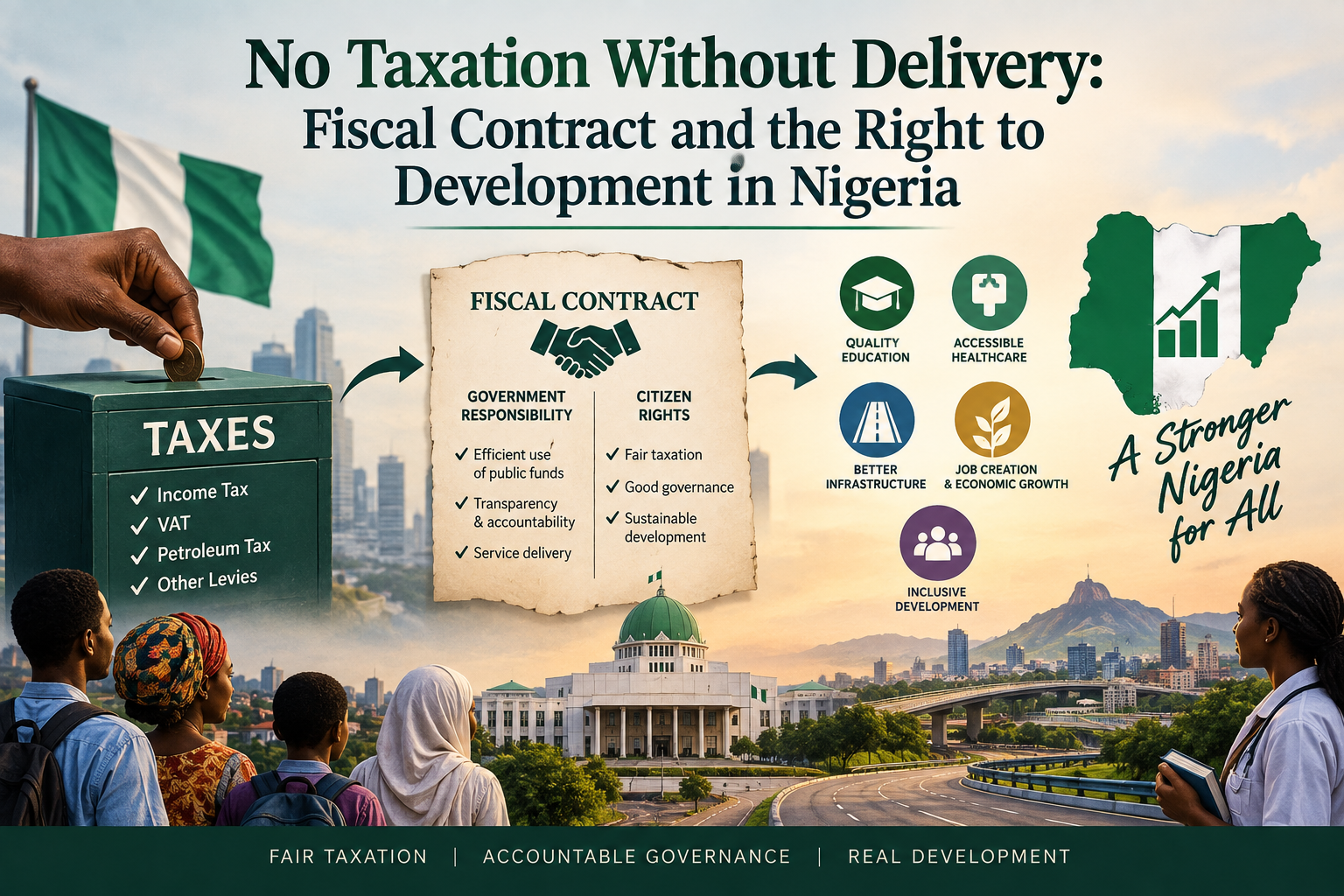
This article argues that taxation advances socioeconomic justice only where it functions as a
fiscal contract, a reciprocal and continuously renewed bargain in which the state’s coercive
claim on private income is matched by a visible and enforceable duty to convert that income
into the substantive freedoms Amartya Sen identified as the true content of development.
Political scientists and development economists have treated tax compliance as a function of
legitimacy rather than law alone for several decades.5 Nigerian legal scholarship on taxation
has been slower to absorb that insight, tending to treat the subject as doctrinal or technical
rather than as a site where law, political economy, and the sociology of compliance meet.
Recovering an interdisciplinary reading matters now because Nigeria’s tax architecture has
just been rebuilt. Four statutes signed in June 2025, the Nigeria Tax Act, the Nigeria Tax Administration Act, the Nigeria Revenue Service (Establishment) Act, and the Joint Revenue
Board (Establishment) Act, took effect on 1 January 2026 and offer a live test of whether
structural reform can repair a fiscal bargain on its own.
The argument proceeds in four movements. It first develops the fiscal contract as an
interpretive key for the Declaration’s correlative duties. It then examines Lagos State as an
instance of a bargain renegotiated into genuine reciprocity. It identifies five specific fractures
through which the bargain currently fails elsewhere in Nigeria. It closes by evaluating
Nigeria’s 2025 reforms against those fractures.
The Fiscal Contract as Interpretive Key
Political scientists have long described the relationship between rulers and taxpayers as an
exchange rather than a one-way extraction. Margaret Levi’s influential account treats state
revenue as a function of what she calls quasi-voluntary compliance, the willingness of
taxpayers to pay even where evasion is feasible, which she shows depends on taxpayers
trusting that others are paying too and that the state will honour its own side of the exchange.7
Mick Moore, Wilson Prichard and Odd-Helge Fjeldstad extend this logic directly to African
tax systems, asking whether taxation leads to improved governance, and conclude that it does
so only where citizens can observe and act on the link between what they pay and what they
receive. Even the practitioners running Nigeria’s own capacity building programmes have
adopted this language.
The joint Organisation for Economic Cooperation (OECD) and
Development and United Nations Development Program (UNDP) Tax Inspectors Without
Borders initiative, which has helped developing countries collect over two point seven billion
United States dollars in additional revenue since 2015, now describes its purpose explicitly as
rebuilding trust and renewing the social contract, not merely raising money. The vocabulary
shifts from discipline to discipline, contract, compliance, legitimacy, capability, but the
underlying structure does not change. Collection and delivery are not two stages linked by good intentions. They are two performances of a single bargain, and the bargain fails
wherever one side performs without the other.
Read through this lens, the Declaration on the Right to Development stops reading as a list of
aspirations and starts reading as the doctrinal skeleton of exactly this bargain. Article 2(3)
requires states to formulate national development policy aimed at the constant improvement
of the well-being of the entire population and the fair distribution of the resulting benefits.10
Article 8(1) requires all necessary measures to ensure equality of opportunity in access to
basic resources, education, health, housing, and a fair distribution of income, while Article
8(2) requires states to encourage popular participation as a condition of realising the right at
all.11 Article 10 requires the continuous formulation and implementation of policy and
legislative measures to progressively enhance the right, language that itself concedes the right
is never finally delivered but must be renewed.12 None of these provisions names taxation.
All of them describe what a state must deliver once it has taken a citizen’s income, and none
can be honoured without the fiscal capacity that taxation reliably supplies. The Declaration,
in other words, already assumes the fiscal contract. It regulates the delivery side of the
bargain and leaves the extraction side to domestic tax law, which is exactly why reading
either instrument in isolation, tax statute or human rights text, misses how the two actually
interact.
This is also why the inquiry that follows is socio-legal rather than purely doctrinal. Roscoe
Pound’s century old distinction between law in books and law in action remains the sharpest
available tool for the gap this article investigates, and Nigeria’s own constitutional history,
examined next, supplies an unusually direct illustration of it.13
When the Contract Holds: Lagos and the Politics of Reciprocity
Lagos State’s fiscal history supplies the clearest Nigerian illustration of a contract
renegotiated rather than merely enforced, and of the gap between formal entitlement and
lived practice that the preceding section anticipated. In 2004, the federal government under
President Olusegun Obasanjo withheld statutory allocations owed to Lagos State’s local
governments, citing the state’s creation of thirty-seven additional council areas beyond the twenty recognised in the Constitution. The Supreme Court ruled in Lagos State’s favour within the year.
The executive nonetheless continued to withhold the funds for three further
years, releasing them only in July 2007 under a successor administration. Formal law had
already resolved the dispute. Lived fiscal practice had not moved at all, which is Pound’s
distinction rendered in naira rather than theory.
The adversity proved transformative regardless. Then-Attorney-General, later Vice President,
Yemi Osinbajo has described the episode as forcing Lagos to think and act like a sovereign
government rather than a dependent one. Whatever the precise causal weight of that single
episode, the pattern that followed matches what Levi’s model would predict. Lagos did not
simply raise rates. It rebuilt the visible link between payment and delivery, expanding
property enumeration to more than eight hundred thousand parcels, digitising collection
through electronic filing, point of sale, and mobile payment channels, and integrating capital
gains, stamp duties, and land use charge administration onto a single platform. Monthly
internally generated revenue rose from roughly six hundred million naira in 1999 to between
forty five and forty eight billion naira by 2021, producing an annual total of one point three
trillion naira across 2024 alone, a figure that now funds over sixty percent of the state’s
budget and exceeds a third of all internally generated revenue collected by every Nigerian
state and the Federal Capital Territory combined.
The significant point is not the raw figures but what they demonstrate about the mechanism
connecting Article 8(1)’s promise of access to basic resources with the fiscal instrument that funds it. Coercion alone did not produce this outcome, since the 2004 withholding by itself
only produced three years of continued deprivation. Legal entitlement alone did not produce
it either, since the Supreme Court’s ruling changed nothing until the funds were actually
released. What produced the outcome was a state government that made the fiscal bargain
visible and credible enough that residents and businesses came to treat compliance as
worthwhile, exactly the quasi-voluntary compliance Levi describes and exactly the
observable link between payment and delivery that Moore, Prichard and Fjeldstad identify as
the precondition for taxation to build governance rather than merely extract from it. Lagos
converted fiscal autonomy into the kind of substantive capability Sen treats as development’s
true measure. The lesson generalises poorly if read as a simple instruction to raise more
revenue. Read as a lesson about reciprocity made visible, it explains why the same duties
under Articles 2(3) and 8 that bind Lagos also bind every other Nigerian government, where
the record looks nothing like Lagos’s.
When the Contract Breaks: Five Fractures
The wider Nigerian record reveals at least five distinct points at which the fiscal bargain
breaks down. Each is a different way of performing extraction without delivery, and each
maps onto a different textual duty in the Declaration.
The first fracture is distributive. A tax system that draws proportionally more from the poor
than from the rich inverts Article 2(3)’s promise of a fair distribution of benefits before any
spending decision is even made.22 A market trader who spends nearly all her income on
consumption pays Value Added Tax on almost every transaction, while a wealthier investor
pays the same tax only on the fraction of income actually consumed. Nordic tax and transfer
systems reduce market income inequality by a substantial margin, among the highest
reductions recorded across the Organisation for Economic Co-operation and Development,
while Chile, with a system weighted more heavily toward indirect taxation, achieves only a
fraction of that effect. Regressivity is therefore not an accident of taxation but a designed outcome, and Article 8(1)’s promise of a fair distribution of income obliges states to design
against it rather than default into it.
The second fracture is institutional. Multiple and overlapping levies imposed by federal, state
and local authorities on the same activity function as a tax on formalisation itself, and
Nigeria’s Small and Medium Enterprises Development Agency has linked this burden to the
roughly eighty percent of Nigerian small businesses that do not survive five years. The Joint
Revenue Board (Establishment) Act 2025 now exists to answer this fracture directly, creating
a coordinating forum across the three tiers of government for data sharing and dispute
resolution over exactly this kind of overlap.
Whether that forum closes the gap this article has already traced through Pound depends on enforcement capacity the statute’s text cannot itself supply, a point Nigerian commentary on the reform anticipated when it warned that legislative prohibition without credible institutional enforcement remains inadequate.28
The third fracture is extractive. Africa loses an estimated eighty-eight point six billion United
States dollars a year to illicit financial flows, equivalent to roughly three point seven percent
of the continent’s combined gross domestic product, and Nigerian surveys suggest a domestic
pattern to match, with roughly one in four Nigerian companies expecting to be asked for a
bribe in dealings with tax officials and more than half of citizens describing the tax
authorities as corrupt. This is precisely the fracture that a purely legalistic reading of Article
8(1)’s duty to take all necessary measures cannot repair by itself, since Nigeria’s statutory
prohibitions on bribery and abuse of office already exist and have existed for decades. David
Trubek and Marc Galanter’s warning against the assumption that legal instruments are self-executing applies with particular force here.30 What is missing is not text but the political
economy of enforcement.
The fourth fracture is one of accountability, and it operates even after revenue is honestly
collected. Fifty six thousand abandoned public projects worth twelve trillion naira show that
collection without completion breaches Article 2(3)’s requirement of constant improvement
in well-being just as thoroughly as regressive collection does. Moore, Prichard and
Fjeldstad’s question, whether taxation leads to improved governance, answers itself
negatively here. Taxation builds accountability only where taxpayers can observe and
sanction misuse, which is what Article 8(2)’s guarantee of popular participation presupposes
and what Nigeria’s historic budget opacity has long frustrated.
The fifth fracture is international rather than domestic. The OECD’s two pillar framework,
including a global minimum effective tax rate, allocates primary taxing rights toward the
capital exporting states where multinational enterprises are headquartered rather than the
developing states where value is often generated, constraining exactly the policy space
Article 4 obliges states to use in formulating international development policy.
Nigeria’s own Tax Act now imports a fifteen percent minimum effective tax rate for large
multinationals into domestic law, an acknowledgement that the country cannot yet opt out of
an architecture it did not design, even as it presses through the African Tax Administration
Forum and the emerging United Nations Framework Convention on International Tax
Cooperation for a fairer allocation of taxing rights.
Repairing the Contract: Priorities for a Post-2025 Nigeria
Nigeria’s 2025 reforms give this article an unusual advantage over most legal scholarship on
taxation and development, the chance to evaluate a live natural experiment rather than
propose one. The Nigeria Tax Act, Nigeria Tax Administration Act, Nigeria Revenue Service
(Establishment) Act and Joint Revenue Board (Establishment) Act consolidate more than a
dozen previously fragmented statutes, establish a single federal revenue collector in place of the former Federal Inland Revenue Service, create a Tax Ombud to receive taxpayer complaints, and expand the Tax Appeal Tribunal’s jurisdiction over disputes.
Measured against the first and second fractures identified above, this is genuine progress. A more
unified rate structure narrows the room for regressive drift, and the Joint Revenue Board
directly targets the institutional fracture of multiple taxation that Nigerian small businesses
have absorbed for years.
Measured against the third and fourth fractures, the reform is necessarily incomplete, because
no statute can legislate political will into existence. The Joint Revenue Board is designed as a
forum for coordination and dispute resolution. It is not, on the evidence available at the time of writing, an investigative body with independent power to sanction illicit flows or prosecute
misappropriation, which means the enforcement gap this article has traced through Pound and
through Trubek and Galanter remains open even after the most significant Nigerian tax
reform in decades. Closing it requires steps that follow from the fractures already identified
rather than from generic policy preference.
Expenditure accountability must be pursued with the same energy as revenue mobilization, through disaggregated public expenditure data, empowered Auditors-General, and consequences that reach beyond audit findings to actual prosecution where funded projects are abandoned.38 Digital administration should be
extended deliberately to reduce discretionary human contact at the point of collection,
following the model of the OECD and UNDP’s Tax Inspectors Without Borders programme,
which has already helped African tax administrations recover close to two billion dollars in
additional revenue through exactly this kind of capacity building.39 Nigeria’s advocacy
through the African Tax Administration Forum for a fairer international architecture should
continue in parallel with, rather than instead of, the domestic work of proving that additional
revenue collected at home will actually be seen, felt and delivered.
Conclusion
Taxation sits at the intersection of sovereignty, law and delivery, and no single discipline can
fully account for what happens at that intersection. Doctrinal analysis of Articles 2(3), 4, 8
and 10 explains what the Declaration on the Right to Development requires. Political
economy explains why states sometimes honour that requirement and sometimes do not. The
socio-legal distinction between law in books and law in action explains why the gap between
requirement and practice can persist for years even where the relevant judgment has already
been handed down, as Lagos State’s own history shows. Read together, these three registers
converge on a conclusion that a purely legal reading of the right to development cannot reach
alone, namely that the right is not funded by taxation so much as constituted by it, through a
bargain that must be renewed rather than assumed.
Lagos State’s fiscal history remains Nigeria’s clearest proof that the bargain can be
renegotiated even from a position of coercion and years of executive defiance. The five
fractures traced through Nigeria’s wider tax system show how easily the same bargain
collapses when reciprocity is not made visible or enforceable. Nigeria’s 2025 reforms address
the architecture of that reciprocity without yet resolving the harder question of whether
citizens can see, and act on, the link between what they pay and what they receive. Sen
argued that the expansion of freedom is both development’s primary end and its principal
means.41 Taxation, on the argument advanced here, is neither a burden to be minimised nor a
good to be maximised, but a covenant to be kept, and socioeconomic justice will be
measured, in Nigeria as elsewhere, by how faithfully that covenant is honoured on both sides.
Disclaimer: This article is published for educational and informational purposes only and does not constitute legal advice, legal opinion, or professional counsel. It does not create a lawyer–client relationship. All views and opinions expressed are solely those of the author and represent their independent analysis. Times Law does not endorse, verify, or assume responsibility for the author’s views or conclusions. While editorial standards are maintained, Times Law, the author, and the publisher disclaim all liability for any errors, omissions, or consequences arising from reliance on this content. Readers are advised to consult a qualified legal professional before acting on any information herein. Use of this article is at the reader’s own risk.