AUTHOR: Anil Pandit, NEF LAW COLLEGE, 3 YEARS LL.B.
ABSTRACT
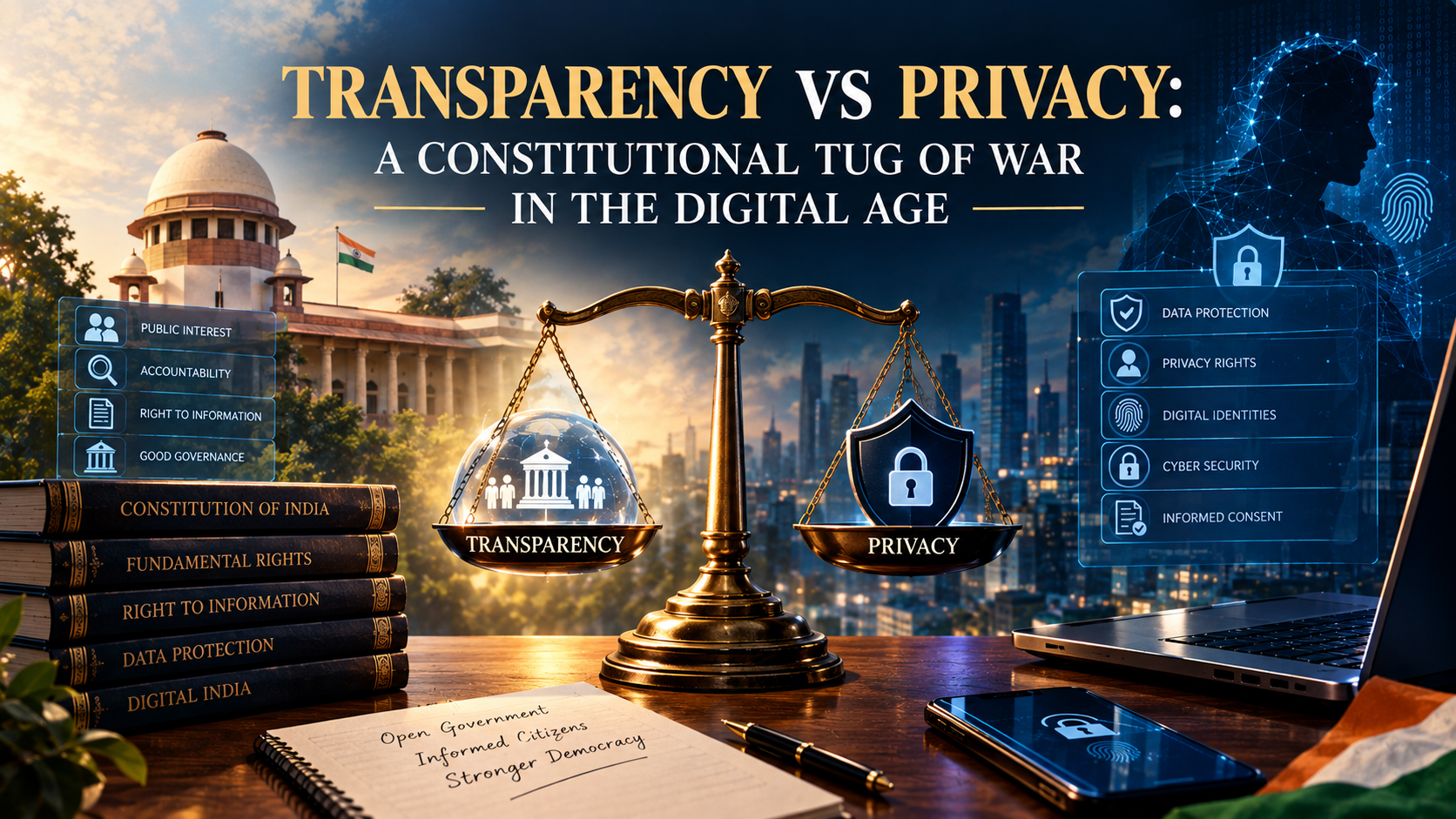
In a democratic country like India, transparency and privacy are both extremely important. However, they often clash when official government files contain personal details of individuals. The Right to Information Act, 2005 allows everyday citizens to ask for government records, while the Constitution protects a person’s private life as part of their personal freedom. Today, this problem has become bigger because government offices keep huge amounts of personal data in digital systems. This article looks at how the right to privacy and the right to information deal with each other in India. It studies Article 21, Article 19(1)(a), Section 8 of the RTI Act, major Supreme Court judgments, and updates brought by the Digital Personal Data Protection Act, 2023. It also examines the Digital Personal Data Protection Rules, 2025 and their step-by-step rollout. The main idea here is that privacy should not become an excuse for total government secrecy, and transparency should not become an excuse to destroy someone’s private life. We need a fair, balanced approach based on public interest.
Keywords
Right to Privacy, Right to Information, RTI Act, Digital Personal Data, Public Interest, Transparency, Data Protection
1. INTRODUCTION
People living in a democracy need to know how government departments work. Knowing the facts helps us understand official decisions, check where taxpayers’ money is spent, and hold leaders accountable. At the same time, every citizen has a personal life that should stay private unless there is a strong legal reason to reveal it. These two ideas collide when a file in a government office has both public details and private personal information mixed together.
This conflict is not about picking one right and completely ignoring the other. The real challenge is finding a way for both rights to exist side by side. The Supreme Court of India has ruled that privacy is a basic constitutional right. On the other side, our freedom of speech also includes the right to get useful information from public authorities. To help citizens get this information, the parliament passed the RTI Act.
Computers and the internet have made this situation even more sensitive. Today, government computers store employment records, ID numbers, bank details, medical records, and family data in digital format. Digital files can be copied and shared across the internet within seconds. Because of this, government officers must think carefully before making any file public. They need to check if sharing that file serves a real purpose for society.
2. CONSTITUTIONAL BASIS OF PRIVACY AND INFORMATION
In the landmark Puttaswamy case, a nine-judge bench of the Supreme Court declared that privacy is a fundamental right guaranteed under the Constitution. The judges linked privacy directly to human dignity and freedom. The Court also explained that any step taken by the state that touches privacy must follow proper law, have a valid reason, and be fair.
On the other hand, the right to receive public information comes under Article 19(1)(a), which protects our freedom of speech and expression. The Right to Information Act then gave this constitutional freedom a proper legal setup for asking information from government departments.
The Puttaswamy ruling is special for our digital world because it recognized informational privacy. It stated clearly that while the government can collect data to run welfare schemes, stop crimes, or collect taxes, it must handle that personal data responsibly and lawfully.
This constitutional setup proves that we cannot follow a simple shortcut where every single government file is made open to everyone. Public access is essential, but individual privacy is equally important under our Constitution. Officers must weigh both values whenever requested files contain personal details of an individual.
3. WHERE THE CONFLICT ARISES
The clash usually happens when someone files an RTI request asking for personal details about another person. Such requests might ask for job performance reports, disciplinary actions, medical papers, phone numbers, or private property details. Just because a government office holds these files does not mean they should be posted online or handed out to anyone who asks.
However, government officials should not use “privacy” as an easy shield to hide every record that mentions a person’s name. Sometimes, personal information is directly tied to official public duty. For example, records about how a officer used government funds, how someone was appointed to a public job, or serious corrupt activities belong to the public domain. In those cases, public interest matters more.
A good rule of thumb is to see where the information leans. If the data is purely about a person’s private life, privacy protection is very strong. But if the data is about how public power or public money was used, the need for public transparency becomes much stronger.
4. SECTION 8(1)(j) OF THE RTI ACT: THE 2025 CHANGE
Section 44(3) of the Digital Personal Data Protection Act, 2023 changed Section 8(1)(j) of the RTI Act. It replaced the long old paragraph with a short phrase: “information which relates to personal information”. This change was brought into real effect on 13 November 2025 through an official government notification.
This amendment is a big change because the new wording is much shorter than the old version. Earlier, the law allowed withholding personal info only if it had no connection to any public activity or if it invaded someone’s privacy without any big public reason. Now, the text simply mentions personal information.
However, this change does not mean all personal data must be blocked automatically. Section 8(2) of the RTI Act is still active. It clearly states that even if some information falls under exemptions, a public authority can still share it if the larger public interest is much bigger than any potential harm.
Public Information Officers must not give up after simply noticing that a file has “personal information”. They must look at the full law, including Section 8(2), rules about third-party notices, and separating private parts from official parts. People requesting info should also explain clearly how getting the data serves the public good, such as exposing corruption or improving accountability.
5. JUDICIAL APPROACH: WHAT THE EARLIER CASES TEACH
In the Girish Ramchandra Deshpande case, the Supreme Court dealt with an RTI request asking for an employee’s service career records, salary details, and personal asset details. The Court decided that such details counted as personal information under the rules existing at that time.
The lesson from this case today is not about blindly copying old sentences, but understanding why personal service files and private financial details deserve privacy. It reminds us that becoming a government employee does not mean losing all personal privacy rights.
In Canara Bank v. C.S. Shyam, the applicant asked for transfer lists, postings, and personal service details of bank employees. The Supreme Court ruled that these records were personal information. Because the person asking could not show any real public interest, the Supreme Court agreed that the bank was right to protect employee privacy.
This judgment points out the risk of mass data requests. Asking for huge bulk files about staff can end up leaking private lives even if single items look normal. Although decided under the older wording, the court’s thinking remains useful for understanding employee privacy.
In Subhash Chandra Agarwal, the Supreme Court carefully analyzed the connection between transparency and privacy. The Supreme Court pointed out that privacy and right to information are equal rights and one cannot simply crush the other.
This decision gives us the clearest guide. The Court looked at files regarding judges, including asset declarations. It stressed that while open government is necessary, personal dignity remains crucial. The judges suggested taking a case-by-case approach where officers measure the type of data, the actual public benefit, and the harm caused by leaking it.
These cases were decided before the November 2025 amendment. Therefore, we must read them carefully. Their value lies in helping us recognize what counts as sensitive personal data, but today we must apply the new text alongside Section 8(2).
6. DIGITAL PERSONAL DATA PROTECTION ACT, 2023 AND THE 2025 RULES
The Digital Personal Data Protection Act, 2023 establishes rules for handling digital personal data in India. It aims to protect digital personal information while letting organizations use data fairly for necessary legal tasks.
This law is directly linked to the RTI Act because its Section 44(3) changed Section 8(1)(j). Data protection and public disclosure are now closely linked together in Indian law.
The Digital Personal Data Protection Rules, 2025 were officially published on 13 November 2025. However, these rules do not start all at once. Rules 1, 2, and 17 to 21 came into force right away, but Rule 4 takes effect after one year, and Rules 3, 5 to 16, 22, and 23 take effect eighteen months later.
Understanding this step-by-step rollout is very important. It is incorrect to claim that the entire data protection law became active instantly in November 2025. As of September 2026, some rules are still waiting for their official start dates.
Digital files carry different risks compared to old paper files kept in store rooms. Once personal details are leaked on the internet, the owner loses control over how that data is shared or misused. That makes accidental leaks much more dangerous. On the positive side, digital records make searching public expenditures easier. The key objective is ensuring that digital access serves genuine public needs.
Data protection laws should not be used as a blanket excuse to turn every government document secret. Equally, the RTI Act should not be used as a license to publish everyone’s personal life. The right decision always depends on legal exemptions, public benefit, the type of information, and potential harm.
7. A PRACTICAL METHOD FOR BALANCING THE TWO INTERESTS
To make RTI decisions fair and reliable, officials can follow five logical steps:
First, officers must check the exact records requested. An RTI application might ask for five different items, where only one item is private. The entire application should not be thrown out just because one part contains personal details.
Second, officers must check if the information relates to public duty or public money. Files showing government spending, policy choices, or misuse of authority deserve transparency. Private items like family problems or health treatments require strict privacy protection.
Third, officers must judge the harm caused by disclosing details. Leaking medical history, home addresses, or private family matters causes deep personal harm without helping public accountability. If accountability can be achieved without revealing private details, those details should stay safe.
Fourth, officers must use the separation method. Section 10 of the RTI Act allows officers to separate private details from a page and give out the rest of the public information.
Fifth, officers must write down clear legal reasons for their decision. If an applicant is denied information, they deserve a clear legal explanation. Similarly, a citizen’s private life should not be exposed randomly just because a government system holds their file. Writing clear reasons stops both unnecessary secrecy and unnecessary leaks.
8. PUBLIC INTEREST SHOULD BE SPECIFIC, NOT JUST A LABEL
“Public interest” is a key term in this discussion, but it should not be used as a meaningless buzzword. A person asking for records should explain clearly how getting the information helps society. The officer must then verify if that reason is real and if the requested papers are truly necessary for that purpose.
For instance, asking for total money spent on constructing a local road is a genuine public interest request. But asking for the private medical records of a government worker does not help public accountability, unless it directly affects official duties. Many real-life cases fall between these two extremes and require careful study.
This balanced view also clears up a common misunderstanding: joining government service does not mean giving up all privacy rights. Public work invites reasonable public checking of official decisions, but a public servant still keeps a private personal life.
9. FINDINGS
This study leads to five clear findings:
1. Transparency and privacy are both fundamental rights that must be respected equally.
2. Simply storing personal files in a government computer does not make them open to everyone.
3. The 2025 amendment changed Section 8(1)(j), and RTI decisions today must follow this updated text.
4. Older Supreme Court judgments remain helpful to understand personal privacy, but their statutory parts must be read along with the new law.
5. Officers should follow a practical step-by-step method focused on the requested items, public accountability, harm prevention, public interest, and partial disclosure.
10. CONCLUSION
The debate between transparency and privacy will keep growing as government functions move online. India does not need to treat these two rights as enemies fighting against each other. Openness ensures honest administration, while privacy protects human dignity and personal freedom.
The legal position following the 2025 amendment requires careful handling. Section 8(1)(j) now uses a short phrase for personal information, while Section 8(2) continues to protect genuine public interest. The DPDP Act, 2023 and the 2025 Rules create a wider protection system, though different sections take effect on different dates. Authorities must avoid applying old rules blindly or assuming the whole new framework is fully active right now.
The best method is examining actual facts: what data is requested, why it is needed, how it relates to government accountability, and what harm it might cause. If only a portion of a document is private, that portion can be hidden while releasing the rest. Where a request invades private life without serving any real public purpose, privacy must be protected. A thoughtful, fact-based approach ensures RTI remains a powerful tool against corruption without turning citizen data into public property.
REFERENCES
1. Constitution of India, arts. 19(1)(a), 21.
2. Digital Personal Data Protection Act, 2023, No. 22 of 2023.
3. Digital Personal Data Protection Rules, 2025, notified Nov. 13, 2025.
4. Right to Information Act, 2005.
5. Justice K.S. Puttaswamy (Retd.) v. Union of India, (2017) 10 SCC 1.
6. Girish Ramchandra Deshpande v. Central Information Commission, (2013) 1 SCC 212.
7. Canara Bank v. C.S. Shyam, (2018) 11 SCC 426.
8. Central Public Information Officer, Supreme Court of India v. Subhash Chandra Agarwal, (2019) 16 SCC 1.
Citation
- Justice K.S. Puttaswamy (Retd.) v. Union of India, (2017) 10 SCC 1.
- Constitution of India, art. 19(1)(a).
- Digital Personal Data Protection Act, 2023, No. 22 of 2023, § 44(3); G.S.R. 843(E), Ministry of Electronics and Information Technology (Nov. 13, 2025).
- Right to Information Act, 2005, § 8(2).
- Girish Ramchandra Deshpande v. Central Information Commission, (2013) 1 SCC 212.
- Canara Bank v. C.S. Shyam, (2018) 11 SCC 426.
- Central Public Information Officer, Supreme Court of India v. Subhash Chandra Agarwal, (2019) 16 SCC 1.Central Public Information Officer, Supreme Court of India v. Subhash Chandra Agarwal, (2019) 16 SCC 1.
- Digital Personal Data Protection Act, 2023, No. 22 of 2023.
- Digital Personal Data Protection Rules, 2025, r. 1(2)–(4), G.S.R. 846(E), Ministry of Electronics and Information Technology (Nov. 13, 2025).
- Right to Information Act, 2005, § 10.
Disclaimer: This article is published for educational and informational purposes only and does not constitute legal advice, legal opinion, or professional counsel. It does not create a lawyer–client relationship. All views and opinions expressed are solely those of the author and represent their independent analysis. Times Law does not endorse, verify, or assume responsibility for the author’s views or conclusions. While editorial standards are maintained, Times Law, the author, and the publisher disclaim all liability for any errors, omissions, or consequences arising from reliance on this content. Readers are advised to consult a qualified legal professional before acting on any information herein. Use of this article is at the reader’s own risk.