AUTHOR: Gaurang Singh
Abstract
Artificial Intelligence (AI) is transforming almost every aspect of modern society, including the criminal justice system. The rapid development of generative AI has introduced new forms of digital evidence such as deepfake videos, AI-generated audio recordings, synthetic images, and machine-generated documents. While these technologies can assist investigators in solving crimes, they also create serious legal concerns regarding authenticity, reliability, admissibility, and fairness in criminal trials. Traditional rules of evidence were developed when human-created documents and physical evidence formed the backbone of judicial proceedings. Today, courts increasingly face digital material whose origin may be difficult to verify and whose authenticity can be manipulated within minutes.
India’s transition to the Bharatiya Sakshya Adhiniyam, 2023 reflects an effort to modernize evidentiary law in the digital age. However, the emergence of AI-generated evidence presents challenges that extend beyond statutory recognition of electronic records. Courts must now determine whether AI-created material can be trusted, how its authenticity should be verified, and what procedural safeguards are necessary to protect the rights of the accused while ensuring effective prosecution.
This article examines the growing role of AI-generated evidence in criminal trials, analyses the existing Indian legal framework, identifies practical challenges, and proposes reforms to ensure that technological innovation strengthens rather than undermines the administration of criminal justice.
Keywords: Artificial Intelligence, Criminal Trials, AI-Generated Evidence, Digital Evidence, Deepfakes, Bharatiya Sakshya Adhiniyam, Electronic Records, Criminal Justice.
Introduction
The criminal justice system has always relied upon evidence to establish truth. From eyewitness testimony and documentary records to forensic reports and electronic records, every generation has witnessed the evolution of evidentiary standards alongside technological progress. The emergence of Artificial Intelligence represents another significant milestone in this evolution, but unlike previous technological developments, AI possesses the unique ability to create convincing yet entirely fabricated content.
Today, sophisticated AI tools can generate realistic voices, videos, photographs, written documents, and conversations that appear indistinguishable from genuine material. A fabricated confession may sound identical to the accused’s real voice. A manipulated surveillance video may falsely depict a person at a crime scene. A synthetic image may influence public opinion even before a trial begins. These developments challenge one of the most fundamental assumptions of criminal adjudication—that seeing or hearing digital material is sufficient to believe its authenticity.
The legal implications are profound. Criminal courts are expected to determine guilt beyond reasonable doubt. This responsibility becomes considerably more complex when digital evidence itself is capable of deception. The possibility of fabricated electronic evidence not only threatens the rights of the accused but also undermines public confidence in the judicial process. Investigating agencies, prosecutors, defence lawyers, forensic experts, and judges must therefore adapt to an environment where digital authenticity can no longer be presumed.
India has made important legislative progress by recognising electronic evidence under the Bharatiya Sakshya Adhiniyam, 2023. Nevertheless, statutory recognition alone does not resolve the challenges posed by AI-generated material. Questions concerning authenticity, forensic verification, admissibility, chain of custody, expert testimony, and judicial standards remain largely unexplored in Indian jurisprudence.
This article argues that while Artificial Intelligence has the potential to strengthen criminal investigations through advanced forensic analysis and data processing, AI-generated evidence must be subjected to rigorous legal and technical scrutiny before it is relied upon in criminal proceedings. A balanced regulatory framework is essential to preserve both technological innovation and the constitutional commitment to a fair trial.
Meaning and Types of AI-Generated Evidence
Artificial Intelligence has fundamentally altered the nature of digital evidence. Unlike conventional electronic records, which generally capture events as they occur, AI systems are capable of creating entirely new content that may closely resemble reality. This shift has introduced a category of evidence whose authenticity cannot be judged merely by visual appearance or technical format. Instead, courts must examine how such material was created, whether it has been altered, and whether it can be relied upon during a criminal trial.
AI-generated evidence may be understood as any digital material that is wholly or partially created, modified, or enhanced through artificial intelligence and later presented during a criminal investigation or judicial proceeding. Such material may support the prosecution, strengthen the defence, or, if manipulated, mislead the court. Consequently, the focus should not be on whether AI has been used, but on whether the evidence is authentic, reliable, and legally verifiable.
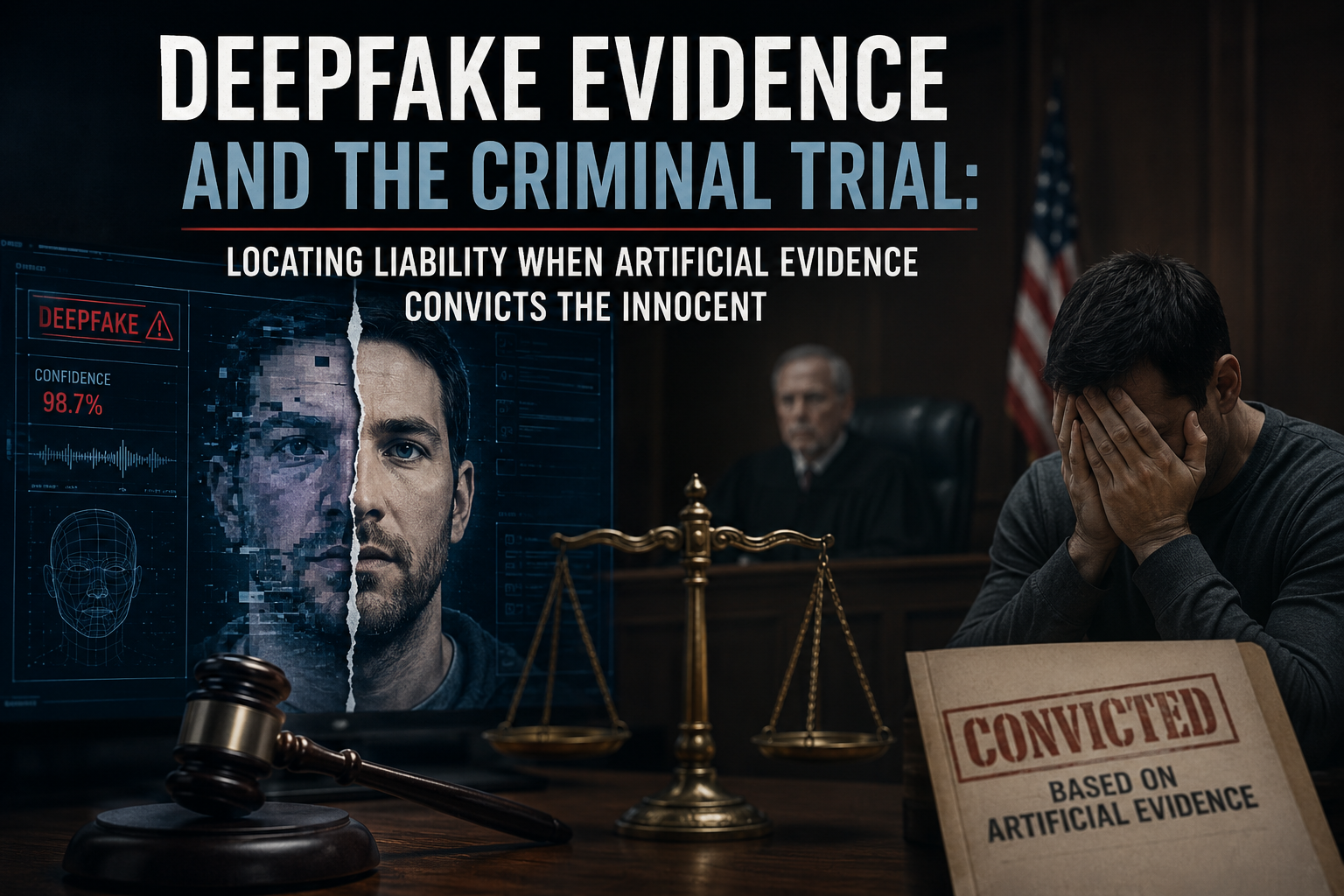
One of the most concerning forms of AI-generated evidence is the deepfake. A deepfake is a digitally created or manipulated video or audio recording that convincingly imitates a real person’s appearance or voice. Modern AI models can reproduce facial expressions, speech patterns, and body movements with remarkable accuracy, making fabricated recordings increasingly difficult to identify through ordinary observation. In criminal proceedings, such content could falsely portray an accused confessing to an offence, depict a witness making statements never actually made, or create misleading visual records of an alleged incident. Without scientific verification, reliance on such material could result in serious miscarriages of justice.
Another significant category is AI-generated audio. Voice-cloning technology enables AI systems to imitate an individual’s voice using only a small sample of original speech. A fabricated phone conversation or voice message may appear entirely genuine, especially where the listener is familiar with the speaker. As voice recordings frequently play an important role in criminal investigations involving threats, extortion, fraud, conspiracy, or corruption, the possibility of AI-generated audio raises important questions regarding authenticity and admissibility.
AI is also capable of producing highly realistic images and photographs. These images may depict locations, objects, injuries, or individuals that never actually existed. If presented without adequate forensic examination, such material could influence investigations or even affect judicial reasoning. This risk becomes particularly significant where visual evidence forms the primary basis of prosecution.
In addition, AI-assisted software can generate or substantially modify written documents such as emails, agreements, messages, reports, or digital communications. Although AI may legitimately assist investigators in organising information or analysing large volumes of data, fabricated digital documents present an entirely different concern. Courts must distinguish between AI being used as an investigative tool and AI being used to create evidence itself.
Artificial Intelligence also plays a growing role in digital forensic investigations. AI-powered systems can analyse CCTV footage, identify faces, detect suspicious behavioural patterns, recover deleted files, and process extensive digital records within a short period. When these tools merely assist investigators by analysing existing evidence, they may improve efficiency without compromising fairness. However, where AI independently generates conclusions without transparency regarding its methodology, courts should approach such outputs with caution. Judicial decisions must remain based on evidence whose reliability can be independently tested and challenged.
The increasing diversity of AI-generated material demonstrates that not every AI-assisted record deserves equal evidentiary value. A digitally enhanced CCTV image intended only to improve visibility differs significantly from a completely fabricated video created through generative AI. Similarly, an AI-assisted transcription of a genuine recording cannot be equated with an artificially generated conversation. Recognising these distinctions is essential for developing sound evidentiary standards in criminal trials.
Ultimately, AI-generated evidence should neither be accepted uncritically nor rejected merely because artificial intelligence was involved. Its evidentiary value must depend upon rigorous forensic verification, transparency regarding its origin, preservation of the chain of custody, and the opportunity for both parties to challenge its reliability before the court. Only through such safeguards can criminal justice maintain its commitment to fairness while adapting to rapidly advancing technology.
Legal Framework Governing AI-Generated Evidence in India
The increasing use of Artificial Intelligence in criminal investigations has raised an important legal question: does the existing Indian law adequately regulate AI-generated evidence? While the Bharatiya Sakshya Adhiniyam, 2023 (BSA) modernises the law relating to evidence and expressly recognises electronic records, it does not contain a dedicated framework for evidence created or manipulated through artificial intelligence. As a result, courts are required to interpret existing provisions in light of rapidly evolving technology.
One of the most significant developments under the BSA is the recognition of electronic and digital records as admissible forms of evidence, provided that the prescribed legal requirements are satisfied. This legislative recognition reflects the reality that criminal investigations increasingly rely upon CCTV footage, mobile phone records, emails, digital communications, GPS data, and other electronic materials. However, the law was primarily designed to address evidence generated through human activity or digital devices, rather than content autonomously created or altered by AI systems.
The foremost challenge concerning AI-generated evidence is authenticity. Before any piece of evidence is relied upon in a criminal trial, the court must be satisfied that it genuinely represents the facts it claims to depict. This principle becomes particularly difficult to apply where sophisticated AI tools can generate realistic videos, voice recordings, or photographs that are almost indistinguishable from genuine material. Visual appearance alone can no longer be treated as proof of authenticity.
A second concern relates to reliability. In criminal jurisprudence, the standard of proof is “beyond reasonable doubt.” If an AI-generated recording has been manipulated, edited, or produced using unreliable datasets, its evidentiary value becomes questionable. Courts must therefore examine not only the final output but also the process through which it was created. This may require expert testimony, forensic analysis, and technical verification before such material can safely be admitted.
The principle of chain of custody also assumes greater importance in the context of AI-generated evidence. Digital evidence may pass through multiple devices, cloud servers, investigators, forensic laboratories, and analytical software before reaching the courtroom. Every stage of handling must be properly documented to ensure that the material has not been altered, intentionally or otherwise. A break in the chain of custody may cast doubt upon the integrity of the evidence and weaken its probative value.
Another legal issue concerns the explainability of AI systems. Many advanced AI models operate as “black box” systems, producing outputs without revealing the reasoning behind their conclusions. If an investigating agency relies upon an AI tool to identify a suspect, detect suspicious behaviour, or analyse forensic material, the defence should have an opportunity to understand and challenge the methodology adopted by that system. A fair trial requires transparency, particularly where technological tools influence findings that may affect an individual’s liberty.
The constitutional guarantee of a fair trial further strengthens the need for judicial caution. Criminal courts must ensure that technological advancements do not dilute the principles of natural justice, the presumption of innocence, or the right of the accused to effectively challenge the evidence presented against them. AI-generated material should therefore be viewed as corroborative unless its authenticity and reliability have been independently established through recognised forensic procedures.
Although the Bharatiya Sakshya Adhiniyam provides a modern statutory foundation for electronic evidence, it does not specifically define AI-generated evidence, prescribe standards for its forensic verification, or establish protocols for examining AI-assisted investigative tools. This legislative gap creates uncertainty for investigators, prosecutors, defence counsel, and courts alike.
Given the pace of technological innovation, India may eventually require detailed statutory guidelines addressing AI-generated evidence. Such reforms could include mandatory forensic authentication of suspected deepfakes, accreditation standards for AI forensic tools, disclosure obligations regarding AI-assisted investigations, and specialised judicial training in digital evidence. These measures would not only improve the reliability of criminal trials but also strengthen public confidence in the administration of justice.
In conclusion, the Bharatiya Sakshya Adhiniyam, 2023 represents a progressive step towards recognising digital evidence, yet it is only the beginning of India’s legal response to artificial intelligence. As AI becomes increasingly integrated into criminal investigations, the law must evolve beyond recognising electronic records and develop a comprehensive framework capable of addressing the unique challenges posed by AI-generated evidence.
Challenges of AI-Generated Evidence in Criminal Trials
The emergence of AI-generated evidence has introduced challenges that extend beyond technology. It directly affects the principles of fairness, reliability, and justice that form the foundation of every criminal trial. While artificial intelligence offers powerful investigative capabilities, its misuse or unregulated use may compromise the integrity of judicial proceedings.
One of the greatest concerns is the rapid growth of deepfake technology. Advanced AI systems can produce highly realistic videos and audio recordings that are almost impossible to distinguish from genuine material without specialised forensic examination. In a criminal case, a fabricated confession, a manipulated CCTV recording, or an altered conversation may create a misleading narrative capable of influencing investigators, prosecutors, witnesses, and even the court. If such material is accepted without adequate verification, it may lead to wrongful convictions or the acquittal of actual offenders.
Another significant challenge is the difficulty of establishing authenticity. Traditionally, photographs, recordings, and digital documents were presumed to be reliable once their source was identified. AI has fundamentally altered this assumption. The existence of a digital file no longer guarantees that it accurately represents reality. Consequently, courts must increasingly rely upon forensic experts, metadata analysis, and scientific verification rather than visual observation alone.
The risk of wrongful conviction deserves particular attention. Criminal law demands proof beyond reasonable doubt because an individual’s liberty and reputation are at stake. If fabricated AI-generated evidence is mistakenly treated as genuine, an innocent person may face imprisonment despite having committed no offence. Such outcomes would undermine public confidence in the justice system and violate the fundamental principles of due process.
Equally concerning is the possibility that genuine evidence may be dismissed as fake. As awareness of deepfake technology grows, accused persons may argue that authentic recordings have been manipulated by artificial intelligence. This phenomenon, sometimes described as the “liar’s dividend,” allows genuine evidence to be questioned simply because convincing fake material has become easier to create. Courts must therefore develop balanced standards that protect both the prosecution and the defence from technological misuse.
Another practical difficulty relates to the limited availability of digital forensic expertise. AI-generated content evolves much faster than forensic detection tools. Investigating agencies may not always possess the specialised knowledge, software, or infrastructure required to identify sophisticated manipulation. Without regular training and technological upgrades, law enforcement agencies may struggle to distinguish authentic digital evidence from fabricated material.
The increasing dependence on private technology companies also presents legal concerns. Many AI tools used for facial recognition, voice analysis, and digital forensics are developed by private entities whose algorithms remain confidential. If courts rely upon conclusions produced by systems whose functioning cannot be independently examined, questions of transparency and accountability inevitably arise. Criminal justice should never depend upon technology that cannot be effectively scrutinised by both parties to a dispute.
Privacy and data protection represent another important dimension of the debate. AI systems frequently require access to large volumes of personal information for training and analysis. Excessive collection, storage, or processing of such data may interfere with an individual’s right to privacy. The challenge therefore lies in balancing effective criminal investigation with constitutional protections and respect for individual rights.
Artificial intelligence may also reproduce algorithmic bias. AI systems learn from historical datasets, and where those datasets contain social, racial, economic, or institutional biases, the resulting outputs may unfairly target particular individuals or communities. If such biased outputs influence criminal investigations, the principle of equality before the law may be compromised. Courts should therefore remain cautious before treating AI-generated conclusions as objective or infallible.
Finally, the legal system itself faces the challenge of keeping pace with technological innovation. Legislative reforms often require considerable time, whereas AI technologies evolve within months. This gap creates uncertainty regarding admissibility, evidentiary standards, expert testimony, and judicial evaluation. Until comprehensive legal standards are developed, courts must exercise heightened caution whenever AI-generated material is presented as evidence.
These challenges do not suggest that AI-generated evidence should be excluded from criminal trials altogether. Instead, they demonstrate the need for stronger procedural safeguards, robust forensic verification, judicial training, and clear legislative guidance. Technology should strengthen the search for truth, not weaken the safeguards that protect justice. A carefully regulated framework can ensure that artificial intelligence serves as an aid to criminal justice rather than a source of uncertainty or injustice.
Comparative Perspective and the Way Forward
The challenges associated with AI-generated evidence are not unique to India. Across the world, legal systems are attempting to balance technological innovation with the principles of fairness and due process. Although different jurisdictions have adopted different approaches, a common concern is ensuring that AI-generated material does not compromise the integrity of criminal trials.
In the United States, courts continue to rely heavily on established evidentiary principles while increasingly requiring expert testimony to establish the authenticity of digitally manipulated material. The growing use of AI has also encouraged law enforcement agencies to strengthen digital forensic practices before presenting electronic evidence in court.
The United Kingdom has similarly recognised the importance of digital forensic examination in criminal investigations. Investigators are expected to maintain the integrity of electronic evidence through proper documentation, preservation, and scientific verification. Courts have become increasingly cautious in evaluating digital material that may have been altered through advanced software.
The European Union has adopted a broader regulatory approach by emphasising transparency, accountability, and risk-based regulation of Artificial Intelligence. While these measures extend beyond criminal law, they reflect an emerging international consensus that AI systems influencing legal outcomes should be transparent, reliable, and subject to human oversight.
India can draw valuable lessons from these developments while designing a framework suited to its own constitutional and legal system. Rather than merely recognising electronic evidence, future reforms should specifically address the unique risks associated with AI-generated content.
Recommendations
A balanced legal framework should combine technological innovation with procedural safeguards. The following reforms deserve consideration:-
- A statutory definition of AI-generated evidence should be incorporated into future legislative reforms to eliminate ambiguity.
- Suspected AI-generated videos, images, and audio recordings should undergo mandatory forensic authentication before being relied upon in criminal proceedings.
- Standard operating procedures should be developed for investigating agencies regarding the collection, preservation, examination, and presentation of AI-generated evidence.
- Judges, prosecutors, defence counsel, and investigating officers should receive regular training in Artificial Intelligence and digital forensic science.
- Independent accreditation standards should be established for laboratories and experts examining AI-generated material.
- Parties relying upon AI-assisted investigative tools should disclose the methodology and limitations of such systems whenever necessary to ensure procedural fairness.
- Investment in indigenous AI forensic technology should be encouraged to reduce dependence on proprietary systems whose functioning cannot be independently verified.
These reforms would enhance both the credibility of electronic evidence and public confidence in the administration of criminal justice.
Conclusion
Artificial Intelligence has become one of the most transformative technologies of the twenty-first century. Its ability to generate realistic digital content presents unprecedented opportunities for criminal investigations while simultaneously creating serious risks for the administration of justice. The law can no longer assume that every photograph, recording, or digital document accurately reflects reality.
The Bharatiya Sakshya Adhiniyam, 2023 represents an important step towards recognising electronic evidence in India’s justice system. Nevertheless, the rapid evolution of AI-generated content demands a more comprehensive legal response. Questions relating to authenticity, reliability, explainability, forensic verification, and procedural fairness require specific legislative and judicial attention.
The future of criminal justice should not be viewed as a choice between technology and legal safeguards. Instead, the objective should be to ensure that technological innovation strengthens the search for truth without compromising the constitutional rights of individuals. Artificial Intelligence should remain a tool in the service of justice, not a substitute for judicial reasoning.
As AI continues to reshape the evidentiary landscape, India’s legal system must evolve with equal determination. Timely reforms, scientific verification, judicial preparedness, and transparent regulatory standards will be essential to ensuring that AI-generated evidence contributes to fair, reliable, and constitutionally sound criminal trials.
Disclaimer: This article is published for educational and informational purposes only and does not constitute legal advice, legal opinion, or professional counsel. It does not create a lawyer–client relationship. All views and opinions expressed are solely those of the author and represent their independent analysis. Times Law does not endorse, verify, or assume responsibility for the author’s views or conclusions. While editorial standards are maintained, Times Law, the author, and the publisher disclaim all liability for any errors, omissions, or consequences arising from reliance on this content. Readers are advised to consult a qualified legal professional before acting on any information herein. Use of this article is at the reader’s own risk.
References
1. Bharatiya Sakshya Adhiniyam, 2023.
2. Bharatiya Nagarik Suraksha Sanhita, 2023.
3. Constitution of India.
4. National Crime Records Bureau (NCRB) – Reports on Cyber Crime.
5. OECD, Artificial Intelligence Principles.
6. UNESCO, Recommendation on the Ethics of Artificial Intelligence.
7. European Union AI Act (for comparative understanding).
8. Scholarly literature on AI, digital evidence, and criminal justice.