AUTHOR: Jacob Chetachukwu Maureen, Ebsu, Law
Introduction
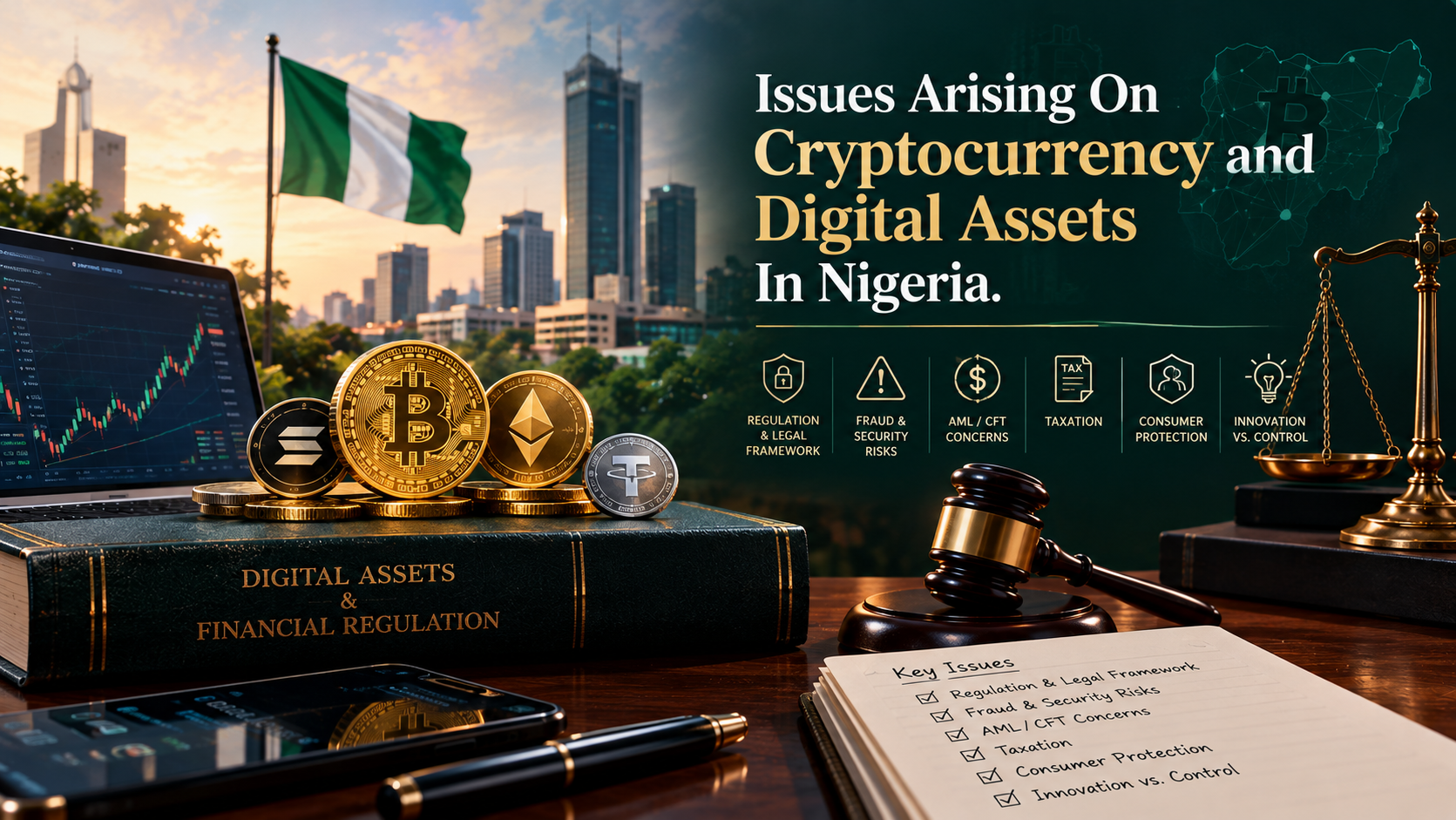
Cryptocurrency and digital assets have played a significant role in our everyday transactions,ranging from how people store value,make payments,invest,import and export goods across borders.However,their rapid growth has created serious legal issues in areas of regulation, fraud, taxation,money laundering, protection of the users of the products and financial stability.
Cryptocurrency can be defined as a form of digital currency that makes use of cryptographic measures to engage in business activities.It may not be a government issuing authorities.Examples of them are Bitcoins and Ethereum.
Digital Assets is so broad that it includesareas which includes digital tokens,tokenized financial instruments, cryptocurrencies and other financial assets existing in electronic forms, and may have economic value.
The central bank of Nigeria restricted the use of cryptocurrencies by regulated financial institutions, however,this was altered on December 2023 but strictly under laid down guidelines.The Investments and Securities plan also provides procedures for regulating digital and virtual assets within Nigerian’s capital market.
Challenges Of Cryptocurrencies And Digital Assets
A Fraud and protection of consumer’s protection:
Transactions may increase illegal schemes, fake investment platforms, and fraudulent digital wallets.The irreversible blockchain transactions makes it a Herculean task to retrieve stolen funds.
B Terrorism and laundering of money: ,
Cryptocurrencies can be transferred through borders,sometimes through anonymous and pseudonymous accounts,this might be used to transfer money illegally without traces.
C Cybersecurity and privacy:
Digiital wallets and cryptocurrency exchanges,might be vulnerable to hacking, theft and data breaches.Information gotten from transactions might remain accessible for a long period of time,thereby, leading to invasion of privacy.
Addressing Problems Arising From Digital Assets And Cryptocurrency
1 clarifying the roles of financial regulators.
2 Enforcement of licensing and compliance laws for digital service providers.
3 Strengthening of anti laundering and Cybersecurity rules.
4 Ensuring that consumers are protected against risks.
Conclusion
Cryptocurrency and digital assets are vital in modern transactions being carried out by businesses, individuals and institutions.They create room for financial inclusion, innovation and economic challenges but they also pose challenges emanating from fraud, taxation,phishing, privacy,money laundering and consumer’s protection.There need to be a balance between rules that protects investors and promoting innovation ito ensure that cryptocurrencies and digital assets contribute meaningfully to the development of Nigeria economically.
Disclaimer: This article is published for educational and informational purposes only and does not constitute legal advice, legal opinion, or professional counsel. It does not create a lawyer–client relationship. All views and opinions expressed are solely those of the author and represent their independent analysis. Times Law does not endorse, verify, or assume responsibility for the author’s views or conclusions. While editorial standards are maintained, Times Law, the author, and the publisher disclaim all liability for any errors, omissions, or consequences arising from reliance on this content. Readers are advised to consult a qualified legal professional before acting on any information herein. Use of this article is at the reader’s own risk.