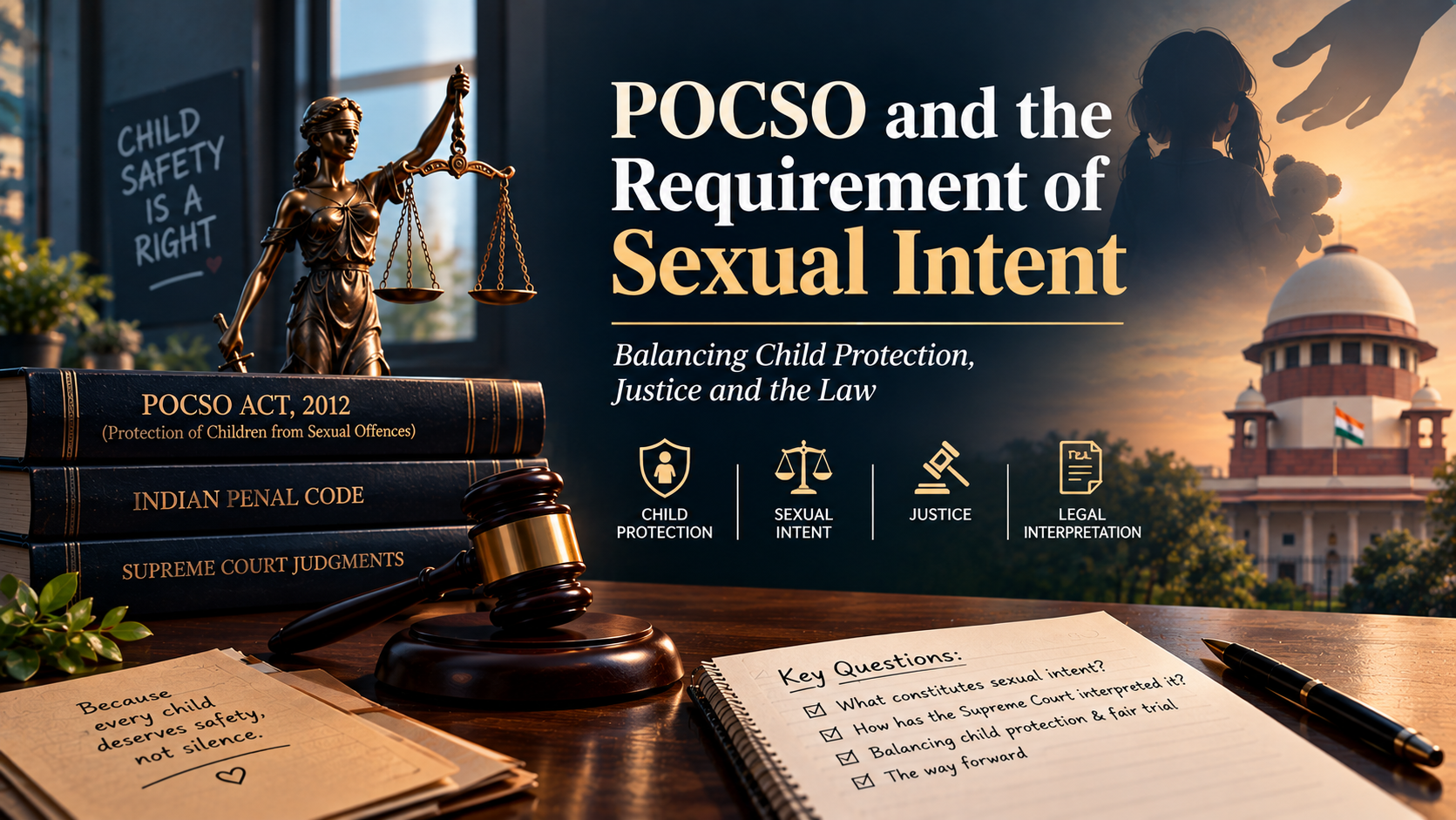
Understanding the Supreme Court’s Evolving Approach
AUTHOR: Riya Kumari | B.A. LL.B., United University, Prayagraj
Introduction
The Protection of Children from Sexual Offences Act, 2012 (“POCSO Act”) was drafted with one
clear purpose — to build a child-specific, gender-neutral shield against sexual abuse, filling the
gaps that the Indian Penal Code had long left open. Yet a statute is only as protective as the courts
that read it. Section 7 of the Act, which defines “sexual assault,” turns on a single phrase that has
generated more litigation than perhaps any other provision in the Act: “sexual intent.”
What counts as sexual intent, how it is to be proved, and whether its absence can excuse an otherwise invasive
act on a child’s body — these questions have occupied the Supreme Court repeatedly over the last
five years, most recently in a series of 2025–26 rulings that clarify how trial courts are expected to
approach POCSO cases. This article traces that journey: from the controversial “skin-to-skin”
interpretation, through the Supreme Court’s correction in Attorney General for India v. Satish, to
the Court’s most recent attempts to balance strict child protection against the lived realities of
adolescent relationships and mistaken prosecutions.
The Statutory Anchor: Sections 7 and 11
Section 7 defines sexual assault as touching the vagina, penis, breast, or anus of a child, or making
the child touch these parts of the accused or any other person, “with sexual intent,” or doing any
other act with sexual intent which involves physical contact without penetration. The provision is
built around two limbs — touching a specified body part, and any other act of physical contact —
but both limbs are held together by the same controlling phrase: sexual intent. Without it, the act
does not become “sexual assault” under the Act, however inappropriate or unlawful it may be under
some other provision of law.
Crucially, the Act itself never defines “sexual intent.” Section 11, dealing with sexual harassment,
offers the only legislative signpost: it clarifies that whether an act was done with sexual intent is a
question of fact. This single line has become the doctrinal foundation for everything that follows —
because intent is a state of mind, it cannot be produced as a document or an object before the court;
it has to be inferred from the surrounding circumstances, the nature of the act, the relationship
between the parties, and the explanation, if any, offered by the accused.
The “Skin-to-Skin” Controversy
The most consequential misreading of Section 7 came from the Nagpur Bench of the Bombay High
Court in January 2021. In two separate matters — one involving an accused who had pressed a
minor’s breast over her clothes, and another, Libnus, involving an accused who had held a child’s
hand and opened his own trousers in front of her — the High Court held that the absence of direct
“skin-to-skin” contact meant the acts fell short of “sexual assault” under Section 7. Groping through
clothing, on this reading, could at best attract the far milder offence of outraging a woman’s
modesty under Section 354 of the IPC, carrying a lighter sentence than the POCSO Act prescribes.
The ruling triggered nationwide outrage. It was criticised for reducing a child-protection statute to a
technical exercise in anatomy, and for creating a loophole through which an offender could escape
the rigour of POCSO merely because he had not removed the child’s clothing before touching her.
The Attorney General for India moved the Supreme Court in appeal within a day of the judgment,
and the acquittal was stayed pending final hearing.
The Supreme Court’s Correction: Attorney General for India v. Satish (2021)
On 18 November 2021, a three-judge Bench of Justices U.U. Lalit, S. Ravindra Bhat, and Bela M.
Trivedi unanimously set aside the Bombay High Court’s ruling. Writing for the Bench, Justice
Trivedi held that the “skin-to-skin” requirement was a narrow and pedantic reading that defeated
the very object of the legislation. Applying the principle ut res magis valeat quam pereat — that a
statute should be construed in a manner that gives effect to it, rather than one that destroys it — the
Court held that the controlling expression in Section 7 is “sexual intent,” not the medium of contact.
An act of touching a child’s sexual organs, or any other act of physical contact, done with sexual
intent, amounts to sexual assault regardless of whether it occurs directly on skin or through
clothing.
The judgment did more than reverse an acquittal. It fixed the analytical starting point for every
POCSO trial that has followed: courts are not to ask whether the contact was skin-to-skin, but
whether the prosecution has established, on the facts, that the touch or the act was accompanied by
sexual intent. That inquiry, being one of fact, is necessarily contextual — and it is in filling out that
context that the Supreme Court’s more recent decisions have made their contribution.
Reading Intent Into Conduct: The Post-Satish Trend
Once “sexual intent” was confirmed as the operative test, the harder question shifted to trial courts
and High Courts: how does one actually prove or disprove intent in the absence of a confession?
Two threads of reasoning have emerged in subsequent case law.
A. Presumption from proximity to specified body parts
Several High Courts, following the Supreme Court’s reasoning in Satish, have observed that once
the prosecution proves the foundational fact that an accused touched one of the four body parts
specifically named in Section 7 — the vagina, penis, breast, or anus — sexual intent behind that
touch is prima facie suspect.
This is read together with Section 30 of the POCSO Act, which allows the Special Court to presume the existence of a culpable mental state once the foundational facts of the offence are established, leaving it open to the accused to rebut that presumption by proving, on a preponderance of probability, that no such mental state existed. It bears emphasis that this sequence — foundational facts first, presumption afterward — is what Section 30 actually requires; the presumption is not a substitute for the prosecution proving the touch itself.
B. No automatic presumption for acts outside that category
Where the alleged conduct falls outside the four named body parts — for instance, a teacher
disciplining or physically correcting a student, or an adult touching a child’s back, shoulder, or
waist — courts have been far more cautious about assuming sexual intent. In Bhaskar Paul v. State
of West Bengal (2026 SCC OnLine SC 1833), decided on 8 September 2026, the Supreme Court
quashed POCSO proceedings against a geography teacher who had been accused of beating two
minor girl students and touching their backs, waists, and necks during class.
A Bench of Justices Ujjal Bhuyan and Atul S. Chandurkar set aside the Calcutta High Court’s order dated 27 April
2026, holding that the students’ statements did not disclose sexual intent, which remains necessary
to constitute an offence under Section 7. The Court acknowledged that the teacher’s use of corporal
punishment was inappropriate and that he ought to have been more sensitive while dealing with
young students, but held that this alone could not sustain a prosecution for aggravated sexual assault
under Section 10. The Bench also weighed the delay in lodging the FIR and the largely hearsay
character of the supporting statements, and observed more generally that a POCSO trial, even
where it ends in acquittal, can cause a teacher irreversible professional and personal harm — a
factor it treated as relevant to whether continuing the prosecution amounted to an abuse of process.
In a similar vein, the Delhi High Court in MRP v. State (NCT of Delhi) (2025) held that lying down
next to a minor victim may attract liability for outraging her modesty under the IPC, but without
proof of sexual intent, the same act is not sufficient to sustain a charge under Section 10 of the
POCSO Act. Read together, these decisions show the courts drawing a careful line: Satish prevents
offenders from hiding behind the absence of skin contact, but it does not license the prosecution to
treat every instance of physical proximity to a child as presumptively sexual. The factual inquiry
into intent remains the safeguard on both sides.
Sexual Intent, Consent, and Adolescent Relationships
A separate and more difficult strand of recent Supreme Court jurisprudence concerns cases where
the “offence” arises out of a relationship the adolescent herself does not regard as abusive. The
clearest illustration is a single set of proceedings arising from a 2018 West Bengal matter, in which
a 14-year-old girl had gone missing and was later found to have married the accused; the trial court
convicted him and sentenced him to twenty years’ rigorous imprisonment, but the Calcutta High
Court set that conviction aside. On 20 August 2024, the Supreme Court, hearing the State of West
Bengal’s appeal (Criminal Appeal No. 1451 of 2024) together with a suo motu writ petition it had
registered on the point, set aside the High Court’s acquittal and restored the conviction, firmly
reiterating that consent is not a defence under the POCSO Act and that the victim’s age, not her
stated willingness, determines criminal liability. Rather than sentencing the accused immediately,
the Court constituted an expert committee to assess the impact of incarceration on the victim, who
by then was living with the accused and their child.
After the committee submitted its report in January 2025, the same Bench delivered its final
judgment on 23 May 2025 under the title In Re: Right to Privacy of Adolescents (2025 INSC 778,
Suo Motu Writ Petition (C) No. 3 of 2023 with Criminal Appeal No. 1451 of 2024). Invoking the
Supreme Court’s complete-justice power under Article 142 of the Constitution, the Bench of
Justices Abhay S. Oka and Ujjal Bhuyan declined to send the accused to prison, on the specific
finding that continued incarceration would harm the victim and her child more than it would serve
any protective purpose, given the “complete failure of our society and our legal system” that had
already compounded her situation.
The Court was careful to record that this outcome was fact-specific and not to be treated as a precedent for future sentencing — the conviction itself, andthe irrelevance of consent to guilt, remained untouched. At the same time, the judgment used the occasion to flag, as a matter of policy, how the POCSO Act’s mandatory reporting obligation under Section 19 can deter adolescents from seeking reproductive healthcare, and how the Act’s rigid framework struggles to accommodate consensual adolescent relationships without diluting
protection for genuine victims of abuse.
What emerges from this line of cases is not a retreat from Satish, but a parallel concern: that sexual
intent and consent operate as distinct inquiries under the Act, and that mechanically applying the
statute in cases of adolescent relationships can sometimes cause the very harm the law was meant to
prevent. The Court has, so far, resisted judicially reading a “close-in-age” or Romeo-Juliet style
exception into the Act, treating this instead as a matter for Parliament, while using its sentencing
and Article 142 powers to soften outcomes in individual hard cases.
Guarding the Other Flank: Preventing Dilution at the Trial Stage
A related but distinct concern has occupied the Supreme Court where High Courts, at the
charge-framing or revision stage, have diluted the seriousness of a POCSO allegation — a problem
adjacent to, though not identical with, the sexual-intent inquiry discussed above. On 10 February
2026, in In Re: Order dated 17.03.2025 passed by the High Court of Judicature at Allahabad in
Criminal Revision No. 1449 of 2024 (2026 INSC 165), a Bench of Chief Justice Surya Kant and
Justices Joymalya Bagchi and N.V. Anjaria set aside an Allahabad High Court order that had
downgraded a POCSO matter — involving allegations that the accused had grabbed a minor girl’s
breasts, broken the string of her pyjama, and tried to drag her beneath a culvert — from the Special
Court’s original summons under Section 376 IPC (attempt to commit rape) read with Section 18 of
the POCSO Act, to the lesser offence of assault with intent to disrobe under Section 354B IPC read
with Sections 9 and 10 of the Act.
The Supreme Court, hearing the matter as a suo motu writ petition, held that on the complainant’s allegations the acts had clearly crossed the stage of mere preparation and amounted to an attempt to commit rape, and restored the original, more serious summons. The Court clarified that its findings were only prima facie and would not bind the trial on merits. In the same proceedings, the Bench, led by CJI Surya Kant, criticised the tone of the Supreme Court’s own 2023 Handbook on Combating Gender Stereotypes as impractical for
trial-level use, and directed the National Judicial Academy to constitute an expert committee to
draft more workable guidelines for judges handling sexual-offence trials — a process that
culminated in a fresh report, ‘Judgments and Gender: Sensitivity and Compassion in Writing
Judgments,’ released in August 2026. This is a signal that the Court sees inconsistent trial-court and
High Court practice in classifying and framing charges, quite apart from the sexual-intent inquiry
under Section 7, as a continuing source of injustice in this area of law.
A Working Test: How Courts Actually Infer Sexual Intent
Reading Satish together with the decisions that followed it, a working checklist can be drawn out of
the case law for how sexual intent tends to be inferred or negatived in practice:
- Nature of the body part touched — contact with the vagina, penis, breast, or anus is highly
relevant to the inquiry into sexual intent, particularly where the foundational facts of the alleged act
are established, under the first limb of Section 7. - Manner and duration of contact — forceful, repeated, or concealed conduct (for example,
pressing a body part, attempting to remove clothing, or restraining the child) points toward intent,
as seen in the underlying facts of Satish itself. - Context and relationship — conduct occurring in a recognised caregiving, teaching, or medical
relationship is scrutinised for a legitimate, non-sexual purpose before intent is inferred, as the
Supreme Court’s 2026 ruling in Bhaskar Paul illustrates. - Accompanying words or acts — sexual remarks, exposure, or attempts at further escalation
strengthen the inference, as in Libnus, where opening trousers alongside holding the child’s hand
was held sufficient. - Explanation offered by the accused — once the foundational facts are established, Section 30
permits the Court to presume the existence of the requisite culpable mental state, subject to rebuttal
by the accused on a preponderance of probability.
This is not a rigid formula, and the Supreme Court has consistently declined to reduce “sexual
intent” to a checklist in the text of its judgments — Section 11 itself insists it remains a question of
fact for each case. But the pattern above reflects how the principle in Satish has actually been
operationalised by subordinate courts over the last four years.
CONCLUSION
The Supreme Court’s decisions on sexual intent under the POCSO Act show a consistent approach:
The statute’s protective core is preserved, while mechanical or overbroad application of Section 7 is
avoided. Attorney General for India v. Satish closed the door on offenders escaping liability
through a technical, skin-to-skin reading of Section 7.
The subsequent line of cases — from the Supreme Court’s own 2026 ruling in Bhaskar Paul on corporal punishment to the Delhi High Court’s decision in MRP — has prevented the opposite excess, ensuring that ordinary physical contact in caregiving or disciplinary settings is not automatically criminalized. At the same time, the Court’s 2024–25 decisions on adolescent relationships and its February 2026 intervention on
trial-stage dilution show a Court trying to hold two commitments together: that consent can never
excuse an offence against a child, and that the law must still be applied with enough sensitivity to
avoid compounding harm in genuinely difficult cases.
Whether that balance is best struck through judicial interpretation alone or requires Parliament to legislate more precisely on adolescent relationships and sentencing discretion remains the open question going into the Act’s next phase.
Select References
- Attorney General for India v. Satish, 2021 SCC OnLine SC 1076 (Supreme Court of India, 18 November 2021).
Sections 7, 11 and 30, Protection of Children from Sexual Offences Act, 2012. - .MRP (Identity Withheld) v. State (NCT of Delhi), 2025: DHC:1378 (Delhi High Court). Bhaskar Paul v. State of West Bengal, 2026 SCC OnLine SC 1833, Criminal Appeal No. 4278 of 2026 (Supreme Court of India, 8 September 2026).
- In Re: Right to Privacy of Adolescents, 2025 INSC 778, Suo Motu Writ Petition (C) No. 3 of 2023 with Criminal Appeal No. 1451 of 2024 (Supreme Court of India, 23 May 2025); interim order dated 20 August 2024 in the same proceedings.
- In Re: Order dated 17.03.2025 passed by the High Court of Judicature at Allahabad in Criminal Revision No. 1449 of 2024 and ancillary issues, 2026 INSC 165 (Supreme Court of India, 10 February 2026).
- National Judicial Academy Expert Committee, ‘Judgments and Gender: Sensitivity and Compassion in Writing Judgments’ (August 2026), superseding the 2023 Handbook on Combating Gender Stereotypes.
Disclaimer: This article is published for educational and informational purposes only and does not constitute legal advice, legal opinion, or professional counsel. It does not create a lawyer–client relationship. All views and opinions expressed are solely those of the author and represent their independent analysis. Times Law does not endorse, verify, or assume responsibility for the author’s views or conclusions. While editorial standards are maintained, Times Law, the author, and the publisher disclaim all liability for any errors, omissions, or consequences arising from reliance on this content. Readers are advised to consult a qualified legal professional before acting on any information herein. Use of this article is at the reader’s own risk.