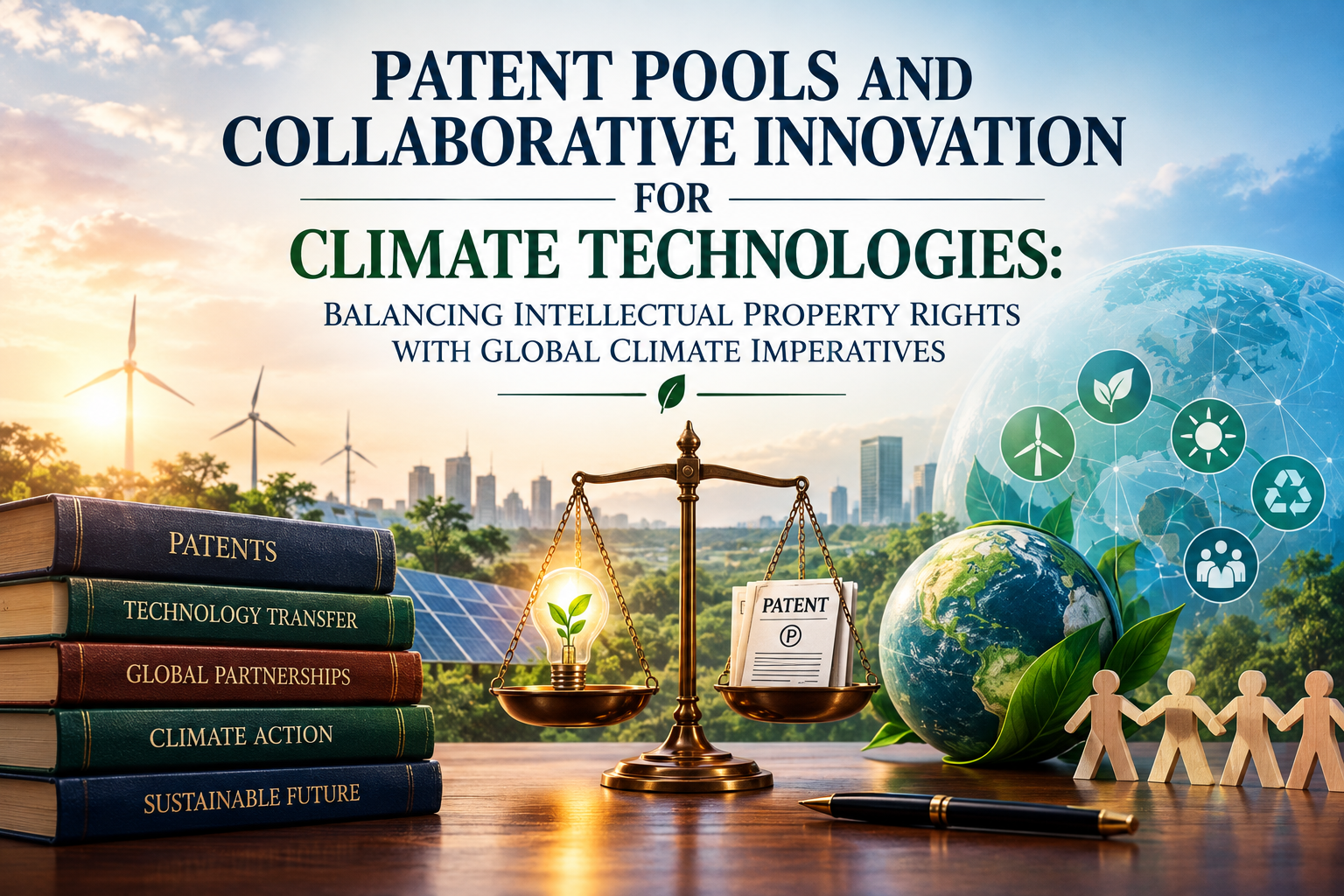
AUTHOR: Pranav Raj, Co-author: Vanshika Gupta, Gitarattan International Business School, GGSIP University
ABSTRACT
It is clear now that innovating and spreading green tech needs to happen much faster than before because the climate crisis is accelerating at a scary pace. The way patents work is kind of a disaster since giving inventors a monopoly encourages them to keep digging for new ideas but then this same thing blocks essential tools from getting to the places that need them most to stop the earth from being ruined. This is why things like patent pools and various shared intellectual property arrangements have appeared as ways that might balance the desires of inventors with what the planet actually requires. When owners of patents put their related inventions into a single group they can lower the costs of deals and avoid the licensing headache which makes accessing climate breakthroughs way easier.
This research examines the legal aspects and the policy hurdles tied to patent pools and other shared systems that try to give climate technology a real boost. It looks into the ways that competition laws and IP rules run into each other and it thinks about goals from the Paris Agreement and TRIPS while also studying how international groups attempt to make technology transfer a reality. Further the study analyzes current projects such as WIPO GREEN and Eco-Patent Commons to figure out if they are actually helping sustainable tech grow and spread more quickly.
The big takeaway is that collaborative IP models have a massive amount of potential to break down barriers but their real-world impact is limited by how they are governed and the fact that people only join if they want to. Plus there are antitrust concerns and a habit of big industry leaders just waiting on the sidelines. For this reason the author proposes a global framework that is more coordinated so that people feel comfortable joining these pools without losing the incentive to innovate that patents normally provide. By proposing specific shifts in law and policy to make shared licensing more robust this work contributes to the huge argument over
private ownership versus the shared battle against climate change. In the end the idea is that using collaboration to handle patents could be a vital tool for driving sustainable innovation and hitting those global climate goals.
Keywords: Patent Pools, Climate Technologies, Collaborative Innovation, Technology Transfer and Intellectual Property Rights
1. INTRODUCTION
The world needs international collaboration for scientific research and technological development and legal systems and economic activities to combat climate change which stands as the main environmental challenge of the 21st century. The world needs new climate technologies because rising temperatures and extreme weather events and biodiversity loss and energy security problems have created an urgent situation. The world requires renewable energy systems and carbon capture and storage technologies and electric mobility and sustainable agricultural practices and green hydrogen and energy-efficient industrial processes because these technologies serve as essential elements for achieving a low-carbon economy. The success of these technologies relies on two factors which are their native development and their ability to spread across all countries in both developed and developing regions.3
Intellectual property protection systems, especially patent law, function as critical factors that determine the success of climate technology innovation processes. Patent protection enables inventors to control their inventions for a predetermined time period, which creates a financial incentive for businesses to invest in research and development activities because they can recover their development expenses.4 The historical development of technology relies on this exclusive right system which provides vital motivation for technological progress. The public interest which ties to climate change technologies becomes a problem because exclusive rights to these technologies create obstacles that prevent people from accessing them. Developing countries face increased costs and delayed access to essential climate technologies because
3Intergovernmental Panel on Climate Change, Climate Change 2023: Synthesis Report (IPCC 2023). 4 William M Landes and Richard A Posner, The Economic Structure of Intellectual Property Law (Harvard University Press 2003).
The ongoing conflict between individual intellectual property rights and international public interests has become a major discussion topic in global legal and policy discussions. The international community demonstrated its dedication to controlling climate change through the Paris Agreement which established temperature limits and recognized technology development and transfer as vital elements of climate control.6 The Sustainable Development Goals establish their core sustainable development principles through their requirement for societies to create sustainable development solutions which require innovative industrial development and sustainable energy solutions and global partnership. The international community has failed to achieve its commitment because developing nations and least developed countries continue to face major challenges in obtaining environmentally friendly technologies.
Most patent licensing negotiations follow a traditional practice which requires patent owners to engage in direct talks with potential licensees. The business arrangement works well for most situations but becomes unworkable when multiple patents for the same technology exist. Climate technologies need various patented elements from different companies which results in what academics call a “patent thicket” because multiple patent rights create high transaction costs that hinder product development.7 The process of obtaining individual licenses from various patent owners creates major obstacles which hinder product development and increase expenses for businesses that want to create green products.
The situation has led to rising interest in collaborative intellectual property solutions which can create a balance between promoting innovation and achieving public interest goals. Patent pools stand out as one of the most effective institutional frameworks among these intellectual property solutions. Patent pools enable multiple patent owners to aggregate complementary patents and license them collectively through a single administrative framework which simplifies licensing procedures and reduces transaction costs while enabling wider distribution of technological innovations.8 Patent pools which started as tools for standardising industrial Technology have gained recognition as effective methods for improving climate technology access.
The development of patent pools has led to the creation of different collaborative innovation models which help organisations to share technological knowledge. The current set of collaborative innovation models includes patent commons and patent pledges and open innovation frameworks and cross-licensing arrangements and public-private partnerships and technology-sharing platforms. The models enable organisations to use their patents for strategic purposes which protect their intellectual property rights while they drive innovation and share their technology with others. The rising use of patent rights demonstrates that intellectual property rights can serve two functions because they function as exclusion rights and allow organisations to work together on international public good challenges.
Scientists have established that collaborative efforts between inventors and their intellectual property rights must be governed through shared protective systems. The World Intellectual Property Organization and other international organizations have developed WIPO GREEN as a platform which enables companies to voluntarily share their technology through their commitment to technology-sharing programs. The Eco-Patent Commons together with other private sector programs has shown that companies can achieve environmental benefits through patent-sharing without losing their competitive edge.
The research findings indicate that collaborative licensing systems function as an additional system which works alongside traditional patent protection methods. The research investigates how patent pools and collaborative innovation programs help advance climate technology development and distribution. The research investigates patent pool legal structures through its study of international intellectual property collaborative system practices while assessment examines implementation issues and international climate law and intellectual property protection frameworks. The article argues that while climate technology transfer barriers exist to solve multiple barriers, collaborative IP mechanisms serve as vital legal tools which balance innovation requirements with environmental needs.
2. UNDERSTANDING CLIMATE TECHNOLOGIES AND THE INTELLECTUAL PROPERTY FRAMEWORK
Climate technologies encompass numerous solutions which include products and processes and services that work to decrease greenhouse gas emissions while they improve energy efficiency and build climate resilience and support adaptation to environmental changes. The technology package includes renewable energy generation systems which consist of solar photovoltaics and offshore wind turbines and geothermal energy installations and bioenergy solutions and advanced battery storage technologies and hydrogen production systems and carbon capture and utilization technologies and smart electricity grids and sustainable transport systems and climate-resilient agricultural innovations.
The climate technologies produce significant benefits which extend beyond their direct users because they create positive externalities which extend beyond their immediate users. The international environmental goals receive direct support from their widespread adoption because they help improve public health and decrease fossil fuel use and create sustainable economic development. Climate technologies function as public goods which create tension between exclusive intellectual property rights and the needs of society.
The historical purpose of patent law exists to promote innovation through its system that provides inventors with temporary exclusive rights. The system operates on the basic principle that inventors will spend money on research and development when they receive security to their inventions for a specific time period. The disclosure requirement creates two benefits because it enables technological advancement while making scientific knowledge available to the public after patent applications undergo publication.
The Agreement on Trade-Related Aspects of Intellectual Property Rights (TRIPS) establishes minimum international standards governing patent protection among members of the World Trade Organization. Article 27 requires patents to be available for inventions across all fields of technology, provided they satisfy the criteria of novelty, inventive step, and industrial applicability. The TRIPS agreement permits some flexibility to member states through its Article 31 provision which allows compulsory licensing yet these tools have been used infrequently because they require specific procedures which restrict their actual use for speedy technology deployment.
The relationship between intellectual property protection and climate technology transfer has therefore become increasingly complex. Robust patent protection creates advantages for green innovation investment because it enables inventors to receive commercial benefits from their work. Excessive control over technologies which developing nations need to combat their severe climate challenges creates a barrier that prevents those nations from accessing essential technologies. The existing patent systems face significant scholarly research which examines whether they meet the particular needs of climate technology development.
Several empirical studies suggest that patents are not the sole determinant of technology diffusion. Successful technology adoption depends more on infrastructure and institutional capacity and investment environments and technical expertise and financing mechanisms and regulatory certainty than it depends on patent protection. 14 The process of international technology transfer requires intellectual property licensing to function as a vital element which becomes especially crucial in cases that involve advanced industrial technologies. The international climate governance system has started to prioritize collaborative methods because of the difficulties posed by compulsory patent restrictions.
The Technology Mechanism of the Paris Agreement establishes a framework for countries to work together on technology development and transfer, which the Technology Executive Committee and Climate Technology Centre and Network use for knowledge sharing and capacity development and joint innovation projects. The new institutional arrangements demonstrate an increasing understanding that nations should work together to achieve a balanced approach between protecting intellectual property rights and meeting international climate change targets.
3. PATENT POOLS: CONCEPT, EVOLUTION AND LEGAL FRAMEWORK
The patent pool system serves as the primary method for organizations to work together on intellectual property rights while addressing their needs to license various patent technologies.
The patent pool system operates through a contract which multiple patent holders establish to allow shared licensing of their chosen patents through either an independent licensing organization or a joint licensing system.15 The license system enables prospective licensees to acquire multiple patents through a single agreement which decreases their negotiation costs and streamlines their negotiation process and enables faster distribution of technology.
The roots of patent pools date back to the nineteenth century because people today consider them to be a modern development. The first documented patent pool in United States history emerged during the 1850s when sewing machine companies joined forces to create their first patent pool for resolving patent disputes and enabling production.16 The time period after that has seen patent pools become widely used in industries which need both technological interoperability and standardized procedures. The licensing agreements which support standards for DVD technology and MPEG video compression and LTE telecommunications and Wi-Fi have proven that businesses can successfully operate through collaborative patent licensing while maintaining their ability to innovate.
The growing complexity of climate technology development has created a situation where patent pools now serve an essential function. Modern renewable energy systems operate through multiple patented inventions which include all their different components from photovoltaic materials to battery chemistry and hydrogen electrolysers and smart grid communication systems and energy management software and carbon capture processes and advanced manufacturing techniques. Individual firms need all relevant patents to develop their complete climate solution because they cannot own all required patents. The distribution of patent rights among multiple parties creates substantial legal and business difficulties which lead to extended market delays and increased product development costs.
Patent pools work to solve these problems through their method of combining matching patents into a single system for licensing. The main administrator of the system assesses patent submissions from participating organizations to establish licensing conditions while managing royalty payments and distribution of income to patent owners through established distribution methods. The administrative system provides substantial operational benefits because it removes the need for duplicate contract discussions and it decreases legal ambiguity while it provides clear information to all parties involved in licensing.19
The legal framework of competition law provides an intriguing assessment of how patent pools function. Patent pools that adhere to proper design standards permit competitors to work together because they decrease legal disputes and support new product development while making technology accessible to users. Competitive licensing agreements that comply with legal requirements have been defined through guidelines which competition authorities developed to identify anti-competitive behavior.
The Department of Justice and the Federal Trade Commission in the United States have established that patent pools create significant operational benefits when they integrate patents that work together instead of replacing one another. The patent system creates an environment where essential patent pools become necessary for competition law compliance because they need to maintain outside licensing rights and transparent license fees. 20 The European Commission has established that patent pools create advanced innovation methods because they decrease transaction expenses and prevent businesses from establishing blocking positions which would hinder their work. The European Commission recognized that patent pools create new innovation possibilities when they decrease transaction costs but companies cannot use patent pools to establish price-fixing or market distribution mechanisms which would exclude competitors.
The distinction between complementary and substitute patents remains central to the legality of patent pools. Manufacturers need to use complementary patents together because those patents create the particular product or technological process for which they hold the patents. The substitute patents provide different technological solutions which can execute the same tasks without needing to work together. Pools that contain substitute patents will decrease market competition because they remove technological competition, but pools that contain complementary patents will boost efficiency through their support of integrated technological development.
Patent pools require implementation of legal safeguards which have attained status as best practices for their lawful operation. First, patent owners need to maintain control over their intellectual property rights through voluntary participation in the program. Second, pool members maintain their right to license their patents through independent channels which exist beyond the pool framework. Thirdly, only technically essential patents should ordinarily be included to prevent the accumulation of unnecessary market power. The licensing terms need to exist in a way which maintains their transparent and objective nature while treating all parties without discrimination. An independent expert evaluation process should determine both patent essentiality and royalty distribution to reduce conflicts between participating parties.
The safeguards serve to demonstrate that patent pools exist to enhance patent protection through their implementation because fragmented ownership hinders technological development. The patent pools create a new system for using exclusive rights which results in advantages for both innovators and technology users.
4. COLLABORATIVE INTELLECTUAL PROPERTY MODELS BEYOND PATENT POOLS
The established collaborative licensing framework of patent pools functions as one example while they exist within a larger movement which aims to create collaborative systems for managing intellectual property rights. The international community now recognizes climate change as a global threat which has led governments and international organizations and universities and businesses to test different approaches that drive innovation while protecting inventor rights. Open innovation represents one of the most important changes to establish boundaries because it defies the belief that organizations should develop new ideas within their own boundaries.
Organizations that implement open innovation create partnerships to share their knowledge and technologies and intellectual property rights with outside parties to achieve better research results and market success.24 Instead of using only internal research capacity, firms collaborate with universities, research centres, start-ups, government bodies and even other competitors in developing new technologies.
Climate innovation is ideally suited for open innovation since many environmental problems require an interdisciplinary approach that goes beyond the capacity of a particular organisation. Inventing hydrogen fuel technology, battery technology, carbon capture technology, and electricity technology usually requires the input of engineers, computer scientists, materials scientist, environmentalists, and manufacturing firms from different jurisdictions. Open innovation helps in facilitating such collaborations and avoiding unnecessary duplication of research work.
Patent commons is yet another type of collaboration in which patent holders voluntarily license some of their patents to the public without demanding the usual licensing royalties and restrictions on the use of these patents. In contrast to patent pools, patent commons does not necessarily have a central authority for licensing and distributing revenues generated from the licenses.
The most renowned example of a patent commons is the Eco-Patent Commons, formed by major multinationals in order to advance environmentally friendly technologies. Patent holders have contributed voluntarily certain patents concerning waste reduction, energy efficiency, recycling and pollution control to encourage companies to use environmental technologies without embarking on tedious licensing processes.25 The initiative proved that voluntary patent sharing was possible. The process failed to achieve its full value because only a small portion of patents were shared with the program and most patents used established technologies instead of new inventions.
The patent pledge functions as a related mechanism which enables patent holders to publicly declare their decision to refrain from patent enforcement against users who comply with established rules. Patent pledges enable technology providers to maintain their intellectual property rights while decreasing their legal obligations. The software industry adopted these arrangements as standard practice which later became a major force in developing climate innovation methods. Organizations use cross-licensing arrangements as a common method to work together on projects.
Cross-licensing agreements enable companies with matching patent rights to share their intellectual property while granting each party access to the other’s patented inventions. The agreements help parties reduce patent violation conflicts which results in faster product creation while supporting ongoing joint research efforts. Cross-licensing has gained significance in renewable energy sectors because modern energy solutions depend on multiple manufacturers’ protected technologies.
Public-private partnerships serve as important cooperative tools which drive climate innovation activities. The government provides financial support and regulatory assistance and research infrastructure and procurement commitments to private enterprises which deliver their technical expertise and manufacturing capacity and commercialisation capabilities. Universities conduct foundational research and transfer their innovations through licensing arrangements and collaborative research agreements which serve as their core activities.
The development of intellectual property governance in the modern era shows its advancement through these cooperative models. The existing system of patent rights creates market exclusivity but policymakers now understand patents as instruments which enable multiple parties to work together for global problem solving.
5. INTERNATIONAL EXPERIENCES: LESSONS FROM EXISTING COLLABORATIVE INITIATIVES
The existing international initiatives provide the best way to evaluate how effective collaborative intellectual property systems operate in practice. The combination of climate patent pools needs further development which currently exists at only limited operational capacity, but various organizations and programs have proved that collaborative licensing and technology-sharing systems can succeed.
WIPO GREEN stands as one of the most important programs which the World Intellectual Property Organization established in 2013. WIPO GREEN functions as an international marketplace that connects technology providers with organizations which need environmentally sustainable solutions instead of operating as a traditional patent pool. The platform enables licensing negotiations and research partnerships and technology transfer operations while safeguarding existing intellectual property rights.28
WIPO GREEN has established a collection of more than 1000 technological solutions which include renewable energy technologies and sustainable agricultural practices and waste management solutions and water purification systems and energy-efficient building methods and transportation technologies and climate change adaptation systems. The platform enhances visibility for partners which leads to a decrease in informational barriers that hinder international technology transfer activities between developed and developing economies.
The Medicines Patent Pool serves as another common reference point for organizations. The organization was created to make essential medicines accessible to people who need them but its institutional structure teaches important lessons about how to create environmental innovations. The Medicines Patent Pool which the United Nations established negotiates voluntary licenses with pharmaceutical companies while sublicensing patented medicines to manufacturers who serve low-income and middle-income countries. The initiative shows that collaborative licensing enables patent owners to maintain their rights while generating revenue through licensing deals and increasing product availability and achieving major benefits for the general public. Many commentators believe that experts should establish an institutional framework which would function as an equivalent to current climate technology infrastructure.
The international climate patent pool will create licensing agreements which cover renewable energy technologies and battery storage systems and carbon capture methods and hydrogen production technologies and climate adaptation innovations while providing equal access to developing countries which experience increased climate vulnerability. International environmental governance has developed a stronger focus on cooperative research and development activities which involve partnerships between different organizations. The Paris Agreement establishes technology development and transfer as core elements of global climate action through its Article 10 section and introduces a Technology Mechanism which will enhance research collaboration and technological innovation and capacity development.
The Agreement does not alter intellectual property rights but demonstrates that international research needs exist because countries require technological partnerships to address climate change. The rising need for joint research efforts has been demonstrated through the regional programs that work to develop new solutions. The European Union has supported numerous cross-border research partnerships through programmes encouraging joint development of clean energy technologies, hydrogen infrastructure, sustainable manufacturing, and digital climate solutions. The United States and Japan and South Korea have developed their own research initiatives which focus on collaborative research after their governments understood that joint research efforts will help them bring products to market while reducing their research costs.
The different international practices demonstrate that countries can implement shared intellectual property management systems without harming their existing patent protection systems. The commercial requirements of companies will stay intact when licensing systems are set up correctly to enable wider distribution of technological innovations. The main challenge for the project requires organizations to create governance systems which will make their programs attractive to all types of entities including governments and research institutes and multinational corporations and new innovators.
6. CHALLENGES AND LIMITATIONS OF PATENT POOLS AND COLLABORATIVE MODELS
Patent pools and collaborative intellectual property systems show significant potential yet face multiple restrictions which limit their effectiveness. The mechanisms enable technology transfer while decreasing licensing difficulties yet their actual use creates major legal and economic and institutional and policy issues. The success of collaborative licensing relies on two factors which include a suitable legal framework and the active participation of patent holders and governments and industries and international organisations. The climate technology sector, which needs patent pools for better adoption, faces multiple obstacles that prevent their full implementation.
6.1 Voluntary Participation and Limited Incentives
Most patent pools face their main obstacle because they operate on voluntary participation. Patent owners can choose whether to share their inventions through joint licensing agreements since no legal requirement exists to do so. Companies that spend large amounts of money on research and development see patents as essential business tools which help them achieve market dominance. The companies will avoid sharing their essential technologies with opponents and new market entrants because those technologies represent their main business functions.
Scientific research demonstrates that advanced climate technologies face significant obstacles due to their difficulty in reaching commercial viability. The companies involved in patent pools believe that their participation will decrease both their negotiation capabilities and their earnings from licensing agreements. The current collaborative programs depend on established technologies which have limited market value instead of using cutting-edge technologies that would create the highest environmental benefits.
6.2 Competition Law and Antitrust Concerns
The competition law compliance requirements create another major obstacle for the business. The proper design of patent pools establishes them as competitive systems, yet their incorrect construction permits anti-competitive activities to take place. Competition authorities remain cautious because collaboration among competing firms may potentially lead to price coordination, market allocation, reduced technological rivalry, or exclusion of new market entrants.
The presence of substitute patents in patent pools creates problems because these patents do not work together with other patents. The lack of proper protections makes it impossible to safeguard independent innovation while the joint licensing of competing technologies leads to market distortion. The assessment process requires competition authorities to evaluate patent essentiality together with licensing conditions and royalty structures and governance mechanisms before they can approve collaborative licensing agreements as valid contracts.
Intellectual property rights and competition law need to establish an appropriate equilibrium between their opposing requirements. Patent law creates exclusive rights which help drive innovation but competition law focuses on maintaining market competition. Patent pools must achieve their dual goals through transparent governance and independent management and equitable licensing methods.
6.3 Royalty Allocation and Patent Valuation
The distribution of licensing revenues among patent holders who participate in the program requires complex resolution. The commercial value and geographical coverage and remaining duration of protection patents show considerable variation across their different technological elements. Royalty distribution requires advanced valuation methods because they need to measure how each patent contributes to total patent value. Patent valuation itself presents considerable practical difficulties.
The economic significance of an invention may change rapidly because of technological progress and market demand and regulatory changes and scientific discoveries. Climate technologies include hundreds of interconnected innovations which create challenges for determining the value of specific patents. The process of determining royalty payments creates conflicts which discourage people from joining while it damages the ongoing success of shared licensing agreements.
6.4 International Governance and Regulatory Diversity
Climate technologies are developed through a process that involves patenting and manufacturing and commercialising their products across different countries which have different systems for intellectual property rights and competition regulations and environmental laws and industrial policies. The different regulations between countries make it difficult to create patent pools which several countries can use for international cooperation. The Agreement on Trade-Related Aspects of Intellectual Property Rights TRIPS establishes basic patent protection rules but countries maintain different patent examination methods and compulsory licensing systems and competition enforcement practices and court decision making procedures. The lack of an extensive international legal framework which controls climate patent pools prevents international partnerships while creating legal uncertainties which affect potential participants.
International climate negotiations have shown the different priorities which developed countries and developing countries have maintained throughout history. Developed nations require strong intellectual property rights protection to support their innovative activities while developing countries want more flexible rules which will help them share technology and adapt to climate change. The resolution of these conflicting viewpoints serves as the main obstacle which international climate governance must overcome.
6.5 Limited Participation of Developing Countries
Developing countries experience structural challenges that extend beyond their intellectual property rights issues. Advanced climate technologies cannot be used effectively because organizations face multiple obstacles which include their inability to access research facilities and financial resources and their lack of technical skills and manufacturing capacity and their particular institutional restrictions. The use of collaborative licensing systems by themselves cannot accomplish equal distribution of technological resources. Patent pools need additional support through combined capacity development and technical education and financial support and assistance with investment development and institutional growth. Developing countries lack the necessary policies which would enable them to transform their legal rights into actual technology implementation.
6.6 Emerging Technologies and Future Challenges
The fast development of new technologies creates more difficulties for governing authorities. The climate technologies sector now uses artificial intelligence, machine learning, quantum computing, synthetic biology, advanced materials science, and digital manufacturing technologies. The new technologies create intricate patent systems which feature multiple identical inventions and software patents and challenges with data ownership and partnerships between different industries.
Future patent pools must therefore address not only traditional mechanical inventions but also digital technologies, data-sharing arrangements, software interoperability, and algorithmic innovation. The existing legal frameworks need adjustments to support emerging technologies while maintaining research and development incentives.
7. THE INDIAN PERSPECTIVE: OPPORTUNITIES FOR COLLABORATIVE CLIMATE INNOVATION
India holds a special role in international climate change governance efforts. India must handle urgent development needs while meeting its extensive climate obligations because it ranks among the fastest developing economies and the most significant greenhouse gas emitters worldwide. The country needs to develop new energy resources and electric vehicle technology and sustainable farming methods and green hydrogen production facilities and climate-safe infrastructure through its renewable energy shift.
The Patents Act, 1970 establishes the legal framework governing patent protection in India while incorporating several public interest safeguards which protect individual rights and serve greater social purposes. Indian patent law has developed through time to support three essential goals which include making technology accessible to the public and enabling affordable access and supporting innovation research. The legislative framework establishes compulsory licensing and government usage provisions together with patent eligibility restrictions to maintain this legislative equilibrium.
However, compulsory licensing has been viewed as a special tool rather than a complete strategy for transferring climate technology. Too many compulsory licenses might create disincentives for foreign investments and cooperation on the international arena. Therefore, cooperative licensing arrangements and patent pools might become the more balanced commercial solution.
India has been showing increasing commitments to green innovation through programs like the National Green Hydrogen Mission, the National Solar Mission, the Faster Adoption and Manufacturing of Electric Vehicles (FAME) scheme, and Production Linked Incentives (PLIs) in advanced battery manufacturing and renewable energy. These examples show that India understands the importance of innovation in ensuring sustainable economic growth.
Research institutes such as the Council of Scientific and Industrial Research, Indian Institutes of Technology, and national labs produce plenty of patents related to renewable energy technologies, eco-friendly manufacturing, biotechnologies, and environmental engineering. Collaborative licensing would allow these inventions to be used by start-ups, small businesses, and domestic companies.
Start-ups and other innovative enterprises have appeared in India quite actively lately. Such firms possess the special skills but not the large patent portfolio and license agreements. Participation in patent pools would decrease entry barriers and stimulate innovation in collaboration.
Finally, being a strong supporter of the fair and equal technology transfer in international climate negotiations for long, India can become a leader in establishing cooperative licensing regime. With promotion of multinational climate patents’ initiatives and development of domestic innovation policies, India can play a significant role in international IP governance of the future.
8. RECOMMENDATIONS
The previous study reveals that professional research methods that involve shared ownership of intellectual property rights can speed up climate change innovations while maintaining the essential requirements for technological progress. The existing system requires comprehensive legal and policy changes, which must occur through joint efforts between different nations and international organisations. International organizations need to establish a Global Climate Patent Pool which will function according to open governance standards for international climate research. The platform would enable developed nations to voluntarily license their environmentally important technologies while providing developing nations with fair access through reasonable licensing agreements. The Medicines Patent Pool and WIPO GREEN offer essential institutional support which serves as the foundation for this initiative.
Second, governments could adopt fiscal and regulatory incentives that would stimulate participation in collaborative licensing agreements. These may include tax incentives, research funding, faster regulatory approval, as well as procurement preferences which would motivate the private sector to share their climate-related patents.
Third, competition authorities could issue sector-specific guidelines explaining the requirements of law that apply to climate patent pools. More regulation certainty would reduce worries about compliance and stimulate broader industry involvement.
Fourth, international financial institutions could support patent licensing schemes by investing in technical capacity-building, infrastructure development, and institution building in developing countries. Technology transfer cannot happen without capacity to absorb and use new technologies.
Fifth, digital technologies could be used to help manage patent pools. For example, artificial intelligence could help in determining whether the patent is essential; the blockchain could provide transparency and facilitate royalty distribution; finally, digital matchmaking platforms could be useful to link innovators and potential licensees worldwide.
Lastly, universities, research institutions, public labs, as well as private businesses, should be encouraged to establish collaborative research ecosystems based on climate innovation. Public private partnership remains critical to turn science into technology.
9. CONCLUSION
Climate change has become an unparalleled global problem that has demanded from the legal system to transcend its traditional understanding of exclusive intellectual property rights. Although patents serve as an irreplaceable means to foster research and innovation, the time of climate problems requires an additional tool which would help to implement technology transfer. The introduction of patent pools and collaborative intellectual property rights is one of such tools and represents an innovative combination of economic incentives of exclusive intellectual property and collective responsibility for our environment.
The article has proved that patent pools can facilitate technology transfer through reducing the number of transaction costs, easing the process of licensing, eliminating patent thickets and fostering technological collaboration without destroying the economic foundation of patent protection. Examples of successful use of collaborative licensing framework like WIPO GREEN and Medicines Patent Pool show that it is possible to reconcile commercial interests and welfare of all people. However, it is still limited because of its voluntary character, competition policy issues, management complications and imbalance of technological capacities of different countries.
Collaborative patent governance can provide a great opportunity for developing countries like India to enhance their innovations and to have access to advanced climate technologies that will enable them to reach sustainable development goals. Internationally, increased cooperation between governments, business, science and international organizations is required to create an intellectual property system that will meet climate challenges adequately.
Finally, patents should not be considered only as an instrument of exclusiveness but as legal mechanisms capable of promoting collaboration in case of shared human existential problems. In order to develop climate technology it is not enough to create innovations; it is necessary to establish such governance model which would encourage sharing of knowledge and scientific progress.
BIBLIOGRAPHY
Primary Sources
Legislation
• Agreement on Trade-Related Aspects of Intellectual Property Rights (adopted 15 April 1994, entered into force 1 January 1995) 1869 UNTS 299.
• Paris Agreement (adopted 12 December 2015, entered into force 4 November 2016) TIAS No 16-1104.
• The Patents Act 1970 (India).
Official Documents and Reports
• Intergovernmental Panel on Climate Change, Climate Change 2023: Synthesis Report (IPCC 2023).
• World Intellectual Property Organization, WIPO GREEN Strategic Plan 2024- 2028 (WIPO 2024).
Secondary Sources
Books
• Chesbrough H, Open Innovation: The New Imperative for Creating and Profiting from Technology (Harvard Business School Press 2003).
• Contreras JL, Patent Pools and Antitrust (American Bar Association 2019). • Landes WM and Posner RA, The Economic Structure of Intellectual Property Law (Harvard University Press 2003).
• Maskus KE, Private Rights and Public Problems: The Global Economics of Intellectual Property in the 21st Century (Peterson Institute for International Economics 2012). • Merges RP and Duffy JF, Patent Law and Policy: Cases and Materials (8th edn, Carolina Academic Press 2021).
Journal Articles
• Gilbert RJ, ‘Antitrust for Patent Pools: A Century of Policy Evolution’ (2004) 71 Antitrust Law Journal 603.
• Hall BH and Helmers C, ‘Innovation and Diffusion of Clean/Green Technology: Can Patent Commons Help?’ (2013) 66 Journal of Environmental Economics and Management 33.
• Yu PK, ‘The International Enclosure Movement’ (2007) 82 Indiana Law Journal 827.
Disclaimer: This article is published for educational and informational purposes only and does not constitute legal advice, legal opinion, or professional counsel. It does not create a lawyer–client relationship. All views and opinions expressed are solely those of the author and represent their independent analysis. Times Law does not endorse, verify, or assume responsibility for the author’s views or conclusions. While editorial standards are maintained, Times Law, the author, and the publisher disclaim all liability for any errors, omissions, or consequences arising from reliance on this content. Readers are advised to consult a qualified legal professional before acting on any information herein. Use of this article is at the reader’s own risk.