AUTHOR: Goodness Taiwo Kehinde, Federal University Lokoja
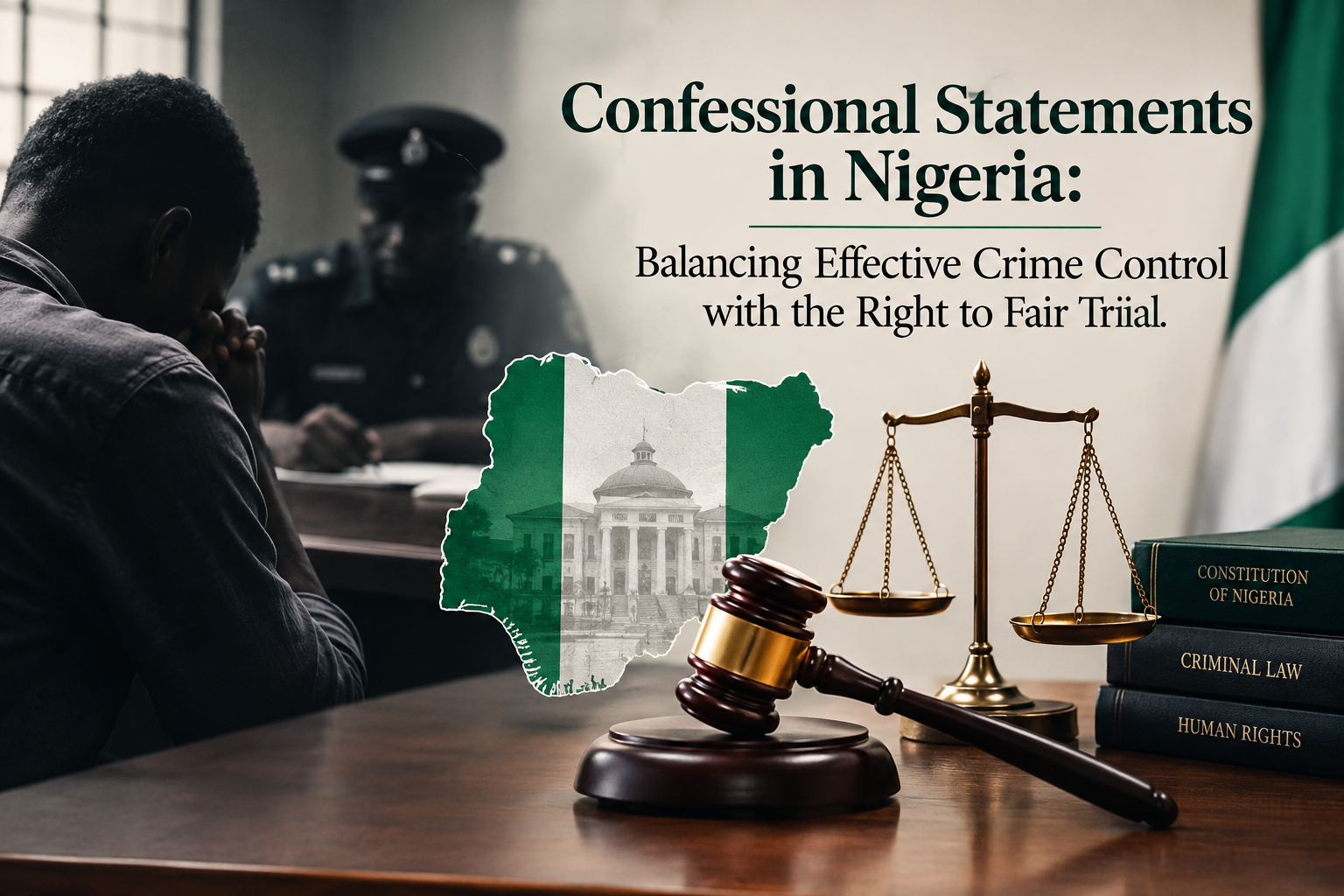
Criminal trials depend heavily on evidence, which may exist in several forms, including documentary, oral, and confessional evidence. One important form of evidence is the confessional statement.
Confessional statements are often regarded as one of the strongest forms of evidence in Nigeria.
Law enforcement agencies frequently rely on confessional statements to secure convictions. However, such confessions may be challenged where they are obtained through torture, intimidation, coercion, or other improper means.
This increasing attention to human rights and fair trial standards has raised questions about the reliability of some confessional statements. While confessional statements remain important in criminal investigations and prosecutions in Nigeria, persistent concerns regarding Involuntary confessions and weak procedural safeguards threaten the constitutional right to fair hearing and necessitate stronger legal and institutional reforms
Section 35 of the 1999 constitution of FRN¹ as amended provides for personal liberty. Torturing, beating, intimidating or abusing a person during confession or to give confessions is an affront to their personal liberty. Such a person may make statements that are not voluntary.
Section 36 of the Constitution² guarantees the right to fair hearing within a reasonable time by a court or tribunal established by law. This protection becomes particularly important where confessional statements are alleged to have been obtained through coercion or torture. In some instances, arrested persons are subjected to torture, intimidation, or other coercive methods aimed at extracting confessional statements.
Section 17 of the Administration of Criminal Justice Act³ allows the recording of statements of suspects and such statements may be taken in the presence of a legal practitioner of his choice or an officer of the practitioner of his choice or an officer of the Legal Aid Council where he has no legal practitioner. However, situations have happened where these statements are made without a Legal practitioner leading to abuse or torture. This as well is a violation of their right
A confession is defined in section 28 of the Evidence Act⁵ as an admission made at any time by a person charged with a crime, stating or suggesting the inference that he committed that crime. A confession is an admission of guilt made by an accused person. Confessions are regarded as powerful evidence because they constitute direct admissions of guilt by the accused person
Courts view a voluntary confession as strong proof since people rarely admit to crimes they didn’t commit. Under Sec 29(2) Evidence Act⁶, a voluntary confession alone can be enough to secure a conviction. For this reason, law enforcement agencies strengthen their cases and secure convictions. Trust in confessional statements is not always justified, it must be carefully scrutinized because a confession obtained in violation of human rights cannot be a solid foundation for criminal conviction.
In the case of Nwachukwu v State⁷, the Supreme Court held that a court can convict an accused person based solely on a voluntary confession, as long as the prosecution proves the confession was made freely and without coercion.
Confessions In criminal justice administration is important as it can simplify criminal trials. Instead of the long period of trial in court, it assists judges in giving out judgement faster and makes trial simple.
They may reduce Investigation time. Instead of the long process of investigation, confessions can be heavily relied on.
They also assist prosecutors in proving guilt.
While confessional statements are mostly relied on, there are dangers of overdependence on confessions.
Police may neglect proper investigation. They might put an end to an investigation as soon as it is made or even neglect making an investigation at all and when these is normalized, they do all they can to get confessions from the accused leading to torture, thereby making it Involuntary. In practice, some law enforcement officers rely heavily on confessional evidence, sometimes at the expense of thorough investigation and procedural fairness.
Pressure to obtain confessions can encourage abuse. Abuse which comes in various forms can be encouraged and even normalized as a result of pressure from the police. They may want to get the confessions by all means just to form evidence.
Risk of false confessions. Overdependence leads to risk of false confessions as confessions made by a suspect may not be true whether by means of police forcing the suspect to say what he wants him to say without independent reasoning and answer.
Efficiency in criminal justice should not override constitutional protections.
There are laws/Legal framework governing confessional statements in Nigeria which everyone is bound to obey.
The Constitution of the Federal Republic of Nigeria remains the supreme law from which all other laws derive validity. It provides under sections 35 and 36⁸ the right to personal Liberty and fair hearing respectively of every citizen. Right of bail to inmates awaiting trial, right to remain silent, right tobe informed the grounds for the arrest or detention, right to be brought before a court of Law within a reasonable time, right to be presumed innocent unless proven guilty, have a Legal practitioner defend him and so on.
Constitution safeguards are meaningful only when properly enforced.
Evidence Act,2011. Section 28 defines confession while section 29 provides for voluntariness requirements. A confession is inadmissible if obtained through torture, threat,oppression or inducement. In the case of IKPASA V AG BENDEL STATE⁹, the emphasized that a confession must be voluntary before it can be admitted in evidence. The Police Act 2020 contains provisions intended to regulate police conduct and promote accountability; however, allegations of coercion, torture, and abuse during interrogation continue to raise concerns regarding effective enforcement
Administration of Criminal Justice Act, 2015. Section 17 provides for recording of confessional statements, presence of Legal practitioner, electronic recording recommendations¹⁰.
These reforms exist in Nigeria as the ACJA issues by most states in Nigeria, implementation depends on whether each state actually complies with these laws effectively. Good laws alone do not guarantee Justice without Institutional compliance.
How then can the Judiciary approach these confessional statements?.
The Judiciary can properly approach these statements by testing for voluntariness. Courts should examine whether the confession was made freely and voluntarily. In DAWA V THE STATE¹¹, the court held that where the voluntariness of a confession is challenged, the court must conduct a trial-within-trial to determine its admissibility.
Trial-within-trial should be conducted if there is any doubt as to whether the confession was made voluntarily and whether they are admissible.
Retraction of confessional statements. Accused persons often deny confessions in court. Courts may still rely on retracted confessions if found credible. In UBIERHO V THE STATE¹², the supreme court held that a man may be convicted solely based on his confessions if it’s free, voluntary, direct and positive. But it’s desirable to have some outside evidence that makes the confession probable.
Courts should not place excessive reliance on retracted confessions where coercion is common. A confession only means something if one can trust how it was made. If people are often beaten, threatened, or held without a lawyer, a confession becomes more about surviving interrogation than telling the truth.
Corroboration and reliability. Confessions should not, on their own, be sufficient for conviction. A confession is only as reliable as the conditions under which it was made. In systems where coercion and irregular detention occur, a bare confession proves more about the interrogation than about the offence. The danger is that the court ends up convicting the process, not the conduct.
Independent corroboration supplies the necessary check. It need not be conclusive on its own, but it must confirm material facts within the confession that only the accused could have known.That link between statement and reality is what transforms a confession from a suspect narrative into admissible evidence of guilt.
Therefore, while the law may permit conviction on a confession alone, sound practice and the principle of safeguarding against miscarriage of justice requires that corroboration be insisted upon.
Convicting solely on confession is risky because confessions are not always true. Individuals may confess under conditions of psychological pressure, exhaustion, fear, or intimidation merely to end the interrogation process. Others do it out of confusion, mental illness or to protect someone else. Without outside evidence to back it up, it becomes difficult to determine if the confession matches reality or if it was made up. The bigger problem is that once there is a confession, investigations usually stop. If it’s false, the real offender stays free and an innocent person pays for it. That’s why courts treat uncorroborated confessions as unreliable on their own.
Nigerian courts should adopt stricter safeguards for confessions. The Evidence Act¹³ allows a conviction on a confession alone if it’s voluntary, but voluntariness is hard to test without recording or a lawyer present, which creates a real risk of false confessions. At minimum, courts should require audio-visual recording of interviews in serious cases and corroboration of material facts in the confession. This keeps confessions useful while cutting the risks of convicting the wrong person.
There are practical challenges and human right concerns
Police Torture and Coercion. One of the biggest practical challenges with confessional evidence is that allegations of torture and coercion during police interrogation remain common. In reality, some suspects confess not out of guilt but because of fear, violence, or the threat of further harm. This undermines the voluntariness requirement and raises serious doubts about the reliability of such statements. From a human rights perspective, forcing a confession violates the right to dignity and fair hearing, and risks convicting innocent persons on the basis of statements extracted under duress. The Anti-Torture Act¹⁴ seeks to address this by criminalizing torture and rendering evidence obtained through it inadmissible, but reports from human rights organisations continue to show that the practice persists in many police stations.
Torture undercuts justice because it makes confessions unreliable. When a statement is beaten out of someone, the court can’t tell if it’s true or just said to make the pain stop. That means innocent people get convicted and guilty ones may walk free, which defeats the whole point of a trial.
It also kills public trust in the police. Law enforcement is supposed to protect people and uphold the law, but once citizens see officers using violence to force confessions, public confidence in law enforcement diminishes when police institutions are perceived as instruments of coercion rather than protectors of justice.. People stop cooperating, stop reporting crimes, and start viewing the system as unfair and abusive. Over time, that loss of confidence makes policing harder and weakens respect for the law itself.
Weak Institutional Enforcement. Even when the law sets clear standards, weak enforcement at the institutional level makes those standards meaningless. The ACJA¹⁵ requires that confessions be taken with certain safeguards, but in practice many officers ignore these rules, either because they are unaware of them or because there’s no real consequence for breaching them. Most police stations still don’t have electronic recording equipment, so interrogations are done behind closed doors and it becomes difficult to prove what actually happened. Suspects also often face interrogation without a lawyer present, leaving them exposed and unable to assert their rights. When these safeguards are ignored, confessions lose credibility and the whole process looks less like justice and more like procedure on paper only.
A legal right without practical enforcement becomes ineffective.
Risk of Wrongful Convictions. False confessions are one of the main ways innocent people end up convicted. Under enough psychological pressure, even someone who didn’t commit the crime may confess just to end the interrogation or to please the officers. Vulnerable suspects, like minors or those without legal help, are especially likely to break under this kind of stress. The problem is that once a confession is before the court, it tends to override everything else. Judges and juries give it so much weight that it can lead to a conviction even when the rest of the evidence doesn’t add up.
Many other jurisdictions have made recorded interrogations mandatory to curb false confessions and disputes over what was said. In the UK, Australia, and several US states, police must electronically record interviews with suspects, especially for serious offences. The idea is that a clear audio or video record lets the court see whether the confession was voluntary and makes it harder for either side to misrepresent what happened in the interrogation room.
In Evaluating the Current Legal Framework, Has Nigerian law struck the correct balance?
The ACJA tries to balance crime control and suspect rights by setting procedural safeguards around confessions. In theory it works. In practice, the absence of enforcement and resources means the balance tips in favor of the prosecution.
Are current safeguards sufficient?
Not really. The law requires cautioning and encourages recording, but most stations lack equipment and suspects often face interrogation without counsel. Without practical access to these safeguards, they offer little real protection.
Are courts too willing to admit confessions?
Yes. Once a confession passes the voluntariness test under the Evidence Act, courts are quick to admit it. The focus is usually on whether it was made, not on how reliable it actually is.
Is there excessive reliance on confessional evidence?
There is. A confession tends to dominate the trial, and judges and juries give it outsized weight. That creates a situation where weak cases are salvaged by a single statement, increasing the risk of wrongful convictions.
Legal Safeguards vs. Practical Protection
Existence of legal safeguards means the law provides protections on paper like the ACJA’s rules on cautioning, counsel, and recording confessions.
Actual practical protection is whether those rules work in reality. If suspects face interrogation without lawyers, recordings aren’t made, and breaches go unpunished, the safeguards exist in law but not in practice.
The distinction matters because law on paper means little if it can’t be enforced when a suspect actually needs it.
Recommendations and Reforms
To strengthen Nigeria’s confession framework, interrogations for serious offences should be video recorded as standard. That creates an objective record and cuts disputes over coercion.
Legal counsel must be present during questioning, not just at arraignment. Early access to a lawyer reduces uninformed and pressured admissions.
The prohibition on torture needs teeth. Disciplinary and criminal sanctions for officers who breach it should be enforced consistently.
Police require training in investigative interviewing rather than confession-driven methods, so evidence collection goes beyond admissions.
Courts should apply a strict voluntariness test and exclude statements obtained improperly. That alone deters bad practice.
Independent, unannounced monitoring of detention centres would provide external oversight and deter abuse.
Reforms should strengthen both effective criminal investigation and constitutional rights protection
In conclusion, Nigeria’s law on confessions looks balanced on paper, but weak enforcement and overreliance on admissions make it unreliable in practice. Safeguards only matter if suspects can actually rely on them during interrogation.
My argument is simple, a confession should only count when it is voluntary and verifiable. Justice fails if it secures convictions at the cost of human dignity. The system must protect both effective prosecution and the rights of the accused.
A criminal justice system that secures convictions through involuntary confessions ultimately weakens public confidence in the rule of law.
¹ Constitution of the Federal Republic of Nigeria 1999 (as amended), s 35.
² Constitution of the Federal Republic of Nigeria 1999 (as amended), s 36.
³ Administration of Criminal Justice Act 2015, s 17.
⁴ Evidence Act 2011, s 29.
⁵ Evidence Act 2011, s 28.
⁶ Evidence Act 2011, s 29(2).
⁷ Nwachukwu v The State (2007) 17 NWLR (Pt 1062) 31
⁸ Constitution of the Federal Republic of Nigeria 1999 (as amended), ss 35–36 ⁹ Ikpasa v Attorney-General Bendel State (1981) 9 SC 7.
¹⁰ Administration of Criminal Justice Act 2015, s 15.
¹¹ Dawa v The State (1980) 8–11 SC 236.
¹² Ubierho v The State (2005) 5 NWLR (Pt 919) 644.
¹³ Evidence Act 2011, s 29(2).
¹⁴ Anti-Torture Act 2017.
¹⁵ Administration of Criminal Justice Act 2015, ss 15 and 17.
Disclaimer: This article is published for educational and informational purposes only and does not constitute legal advice, legal opinion, or professional counsel. It does not create a lawyer–client relationship. All views and opinions expressed are solely those of the author and represent their independent analysis. Times Law does not endorse, verify, or assume responsibility for the author’s views or conclusions. While editorial standards are maintained, Times Law, the author, and the publisher disclaim all liability for any errors, omissions, or consequences arising from reliance on this content. Readers are advised to consult a qualified legal professional before acting on any information herein. Use of this article is at the reader’s own risk.