AUTHOR: Rudra Pratap singh, Lloyd school of law, Greater Noida
Abstract
This article examines the complex relationship between the right to freedom of speech, hate speech regulation, and national security under the Indian constitutional matrix. Focusing on Article 19(1)(a) and the “reasonable restrictions” under Article 19(2), the paper analyzes how the judiciary protects democratic expression while preventing social disorder. Through a critical review of landmark judgments—including Shreya Singhal, Anuradha Bhasin, and recent milestones up to the defining Ashwini Kumar Upadhyay (2026) ruling—the study addresses the acute enforcement challenges posed by a fragmented penal framework and the transition to the new penal code, the Bharatiya Nyaya Sanhita, 2023. It distinguishes between healthy democratic dissent, offensive remarks, and targeted hate speech. Ultimately, the author offers a rigorous legal analysis and opinion, concluding that India requires unified statutory definitions and strict judicial proportionality tests to protect individual liberty without compromising state safety.
Keywords
Article 19(1)(a), Hate Speech, Constitutional Law, National Security, Proportionality, Bharatiya Nyaya Sanhita, Ashwini Kumar Upadhyay (2026).
Introduction
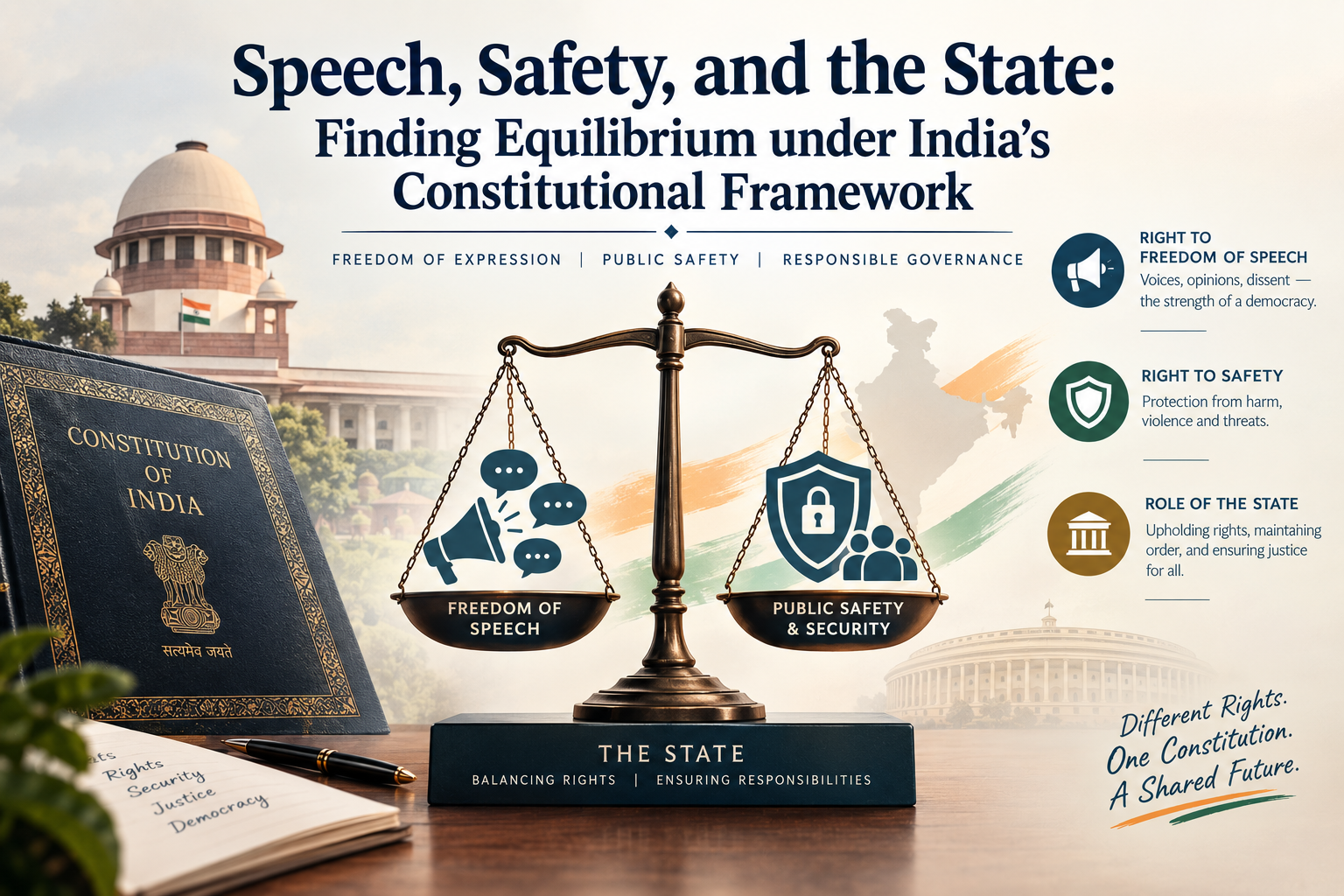
The right to speak freely is the core of any democratic country. In India, Article 19(1)(a) of the Constitution guarantees all citizens the right to freedom of speech and expression. This right allows people to share ideas, debate policies, and criticize the government. However, this freedom cannot be absolute. If speech is left completely unchecked, it can be used to spread dangerous misinformation, incite riots, or target vulnerable communities through hate speech. Therefore, the state must constantly find a balance. It must step in to stop speech that causes real-world harm, but it must not use safety as an excuse to silence peaceful critics or political opponents.
The digital era has made this balancing act much more difficult. In the past, speech was shared through physical newspapers, public rallies, or television broadcasts, which were relatively easy for the state to monitor. In a diverse country like India—where different religions, castes, and languages interact daily—inflammatory messages can spread rapidly. This digital speed often pushes the government to take fast, heavy-handed actions, such as blocking internet access or filing criminal cases.
This article provides a simple, direct analysis of India’s current legal framework for free speech. It reviews how the Constitution limits speech, how the law handles communal hate speech, and how the courts protect citizens from excessive government control. Finally, it looks at the transition to India’s new penal code, the Bharatiya Nyaya Sanhita (BNS), 2023, and offers a clear legal opinion on how to fix the current issues in our legal system.
1. The Legal Limits of Free Speech
The Constitution of India sets up a clear structure for free speech. While Article 19(1)(a) grants the right to express oneself, Article 19(2) allows the government to pass laws that place “reasonable restrictions” on this right. The government cannot restrict speech simply because it dislikes the message. Any restriction must be directly linked to one of the specific grounds listed in the Constitution, which include the sovereignty and integrity of India, the security of the State, public order, decency, morality, and the incitement of an offence.
The courts set a very high bar for when speech can be shut down under the guise of “public order.” In S. Rangarajan v. P. Jagjivan Ram (1989), the Supreme Court famously ruled that speech cannot be censored unless it poses an immediate danger to society, comparing it to “a spark in a powder keg.” This standard was reinforced in Shreya Singhal v. Union of India (2015), where the court struck down Section 66A of the Information Technology Act. The court explained that there is a vast difference between discussion, advocacy, and incitement. A citizen has the right to advocate for an unpopular or annoying idea; the police can only intervene if that speech directly incites immediate violence.
Recent judgments continue to uphold this protection. In Kaushal Kishor v. State of Uttar Pradesh (2023), a Constitution Bench ruled that the government cannot invent new reasons to restrict speech outside of what is written in Article 19(2), even for high-ranking public ministers. Furthermore, in Javed Ahmad Hajam v. State of Maharashtra (2024), the Supreme Court dismissed a criminal against a professor who criticized a political decision on a messaging app. The court firmly stated that peaceful protest and political disagreement are essential parts of a democracy, and criticizing the state does not mean a citizen is trying to promote public enmity.
2. Regulating Hate Speech and the Enforcement Problem
A major complication in Indian law is that our statutes do not contain a single, clear definition for the term “hate speech.” Instead, law enforcement uses a collection of different sections under the penal code. Recently, India transitioned from the old Indian Penal Code (IPC) to the new Bharatiya Nyaya Sanhita (BNS), 2023. The primary sections used to police harmful speech include:
Section 196 of the BNS (formerly Section 153A IPC): Punishes promoting enmity between different groups based on religion, race, or place of birth.
Section 299 of the BNS (formerly Section 295A IPC): Punishes deliberate acts intended to outrage religious feelings.
Section 353 of the BNS (formerly Section 505 IPC): Criminalizes spreading false rumors that cause public mischief or hatred.
Because these laws are written in broad language, they are frequently vulnerable to misuse. To guide the authorities, the Supreme Court has tried to define the actual harm of hate speech. In Pravasi Bhalai Sangathan v. Union of India (2014), the court explained that hate speech is not merely about hurting someone’s personal feelings; instead, it is a structural effort to marginalize vulnerable groups and country settings. Later, in Amish Devgan v. Union of India (2020), the court clarified that free speech covers ideas that may offend or upset people, whereas hate speech intentionally targets specific identities to create an atmosphere of active hostility and fear.
The boundaries of this issue were heavily debated in the major of Ashwini Kumar Upadhyay v. Union of India (2026). In this case, petitioners asked the Supreme Court to create new guidelines and special monitoring teams to stop hate speech at public rallies. However, the Supreme Court recognized the structural limits of its power under the separation of powers. The court ruled that it cannot act as a permanent national supervisor or create new criminal laws, as that responsibility belongs to Parliament. The judiciary emphasized that India’s existing BNS laws are perfectly adequate to handle communal hatred; the true failure lies in arbitrary local enforcement and the regular failure of police to apply the law equally to all offenders.
The court expressed a similar concern in Hindu Sena Samiti v. Union of India (2024), where it dismissed a broad petition against provocative political statements. The bench ruled that there is a strict difference between dangerous hate speech and making a false political claim. The court warned that if the state treats every wrong or highly offensive statement as a crime, it will cause a severe chilling effect, making citizens too afraid to participate in open public debates.
3. National Security versus Civil Liberties
Protecting national security is a fundamental duty of the government, but it often runs directly into conflict with individual freedom. The modern standard for balancing these two interests is the proportionality test, which was integrated into Indian law through the landmark privacy K.S. Puttaswamy v. Union of India (2017) and applied directly to speech controls in Anuradha Bhasin v. Union of India (2020). Under this test, if the government restricts a right for security reasons, it must prove that its action is necessary, logical, and the least harmful option available.
The historic battle over the colonial-era law of sedition (Section 124A of the old IPC) shows how easily security laws can be abused. In Kedar Nath Singh v. State of Bihar (1962), the Supreme Court ruled that criticizing the government is completely legal unless it involves an explicit intent to incite violence.
This debate has now shifted to Section 152 of the BNS, 2023, which formally removes the word “sedition” but introduces penalties for any act that “endangers the sovereignty, unity, and integrity of India.” Legal scholars are deeply divided over this change. While the government argues that the new section is necessary to protect the nation from secessionist threats, critics worry that the broad terminology could allow the executive to revive old sedition-style crackdowns under a new legal name.
The courts also applied strict scrutiny to modern security measures like internet shutdowns. In the Anuradha Bhasin (2020) case, which challenged long-term internet blocks in Jammu and Kashmir, the Supreme Court recognized that using the internet is a fundamental right under Article 19(1)(a) because it serves as a primary tool for expression and trade. The court ruled that indefinite internet shutdowns are entirely unconstitutional mandating that any shutdown order must be temporary, transparent, and subject to regular review by an administrative committee.
4. Comprehensive Legal Analysis
Doctrinal Evolution and the Judicial Retreat of 2026 :-
The constitutional rules governing free expression in India are undergoing a major shift, characterized by an increasing tension between active judicial intervention and the separation of powers. In Shreya Singhal (2015), the Supreme Court demonstrated an expansive, rights-protective approach by throwing out an entire statutory provision (Section 66A, IT Act) on grounds of vagueness and overbreadth. It established that the state cannot weaponize ambiguous language to cause a chilling effect on legitimate political discourse.
However, the 2026 Ashwini Kumar Upadhyay decision marks a distinct judicial retreat. Faced with demands to construct a standalone regulatory framework for hate speech, the Supreme Court correctly recognized its institutional limitations, choosing to defer the creation of new criminal offenses to Parliament.
The Structural Deficit of “Intent” and the Enforcement Paradox :-
In my opinion, the true crisis of free speech regulation in India is not a lack of laws, but an structural enforcement deficit driven by the subjective interpretation of “intent” by local law enforcement agencies. The text of Section 196 and Section 299 of the BNS, 2023 requires the presence of mens rea—specifically, a deliberate and malicious intent to cause communal enmity or outrage religious feelings. Yet, in practice, a dangerous enforcement paradox exists: the executive frequently utilizes these broad penal provisions to target investigative journalists, political dissidents, and satirists whose speech merely offends the state, while simultaneously demonstrating systemic inertia when majoritarian figures engage in actual, targeted vilification of vulnerable minorities.
This asymmetry occurs because the state consistently conflates “public order” with “governmental convenience.” When a local magistrate permits the filing of multiple, retaliatory police complaints (FIRs) across different jurisdictions for a single online remark, the legal process itself becomes the punishment. The Supreme Court’s failure in Ashwini Kumar Upadhyay (2026) to institute an independent, automated oversight mechanism to review these FIRs means that despite advanced judicial rhetoric, the protective shield of Article 19(1)(a) remains highly vulnerable to localized administrative malice.
Navigating BNS Section 152 and the Clear and Present Danger Threshold :- Furthermore, the legislative introduction of Section 152 of the BNS, 2023—which purports to eliminate the archaic word “sedition” while penalizing any act that “endangers the sovereignty, unity, and integrity of India”—presents an acute constitutional hazard. By omitting the strict requirement of “incitement to violence” or “tendency to create public disorder” established in Kedar Nath Singh (1962), Section 152 expands executive discretion.
I argue that Indian courts must firmly reject the broad “bad tendency” test and universally adopt a modern variant of the “clear and present danger” or “spark in a powder keg” standard formulated in S. Rangarajan (1989). To protect civil liberties from being completely consumed by national security pretexts, the state must prove an un-severable, immediate
causal link between the speech uttered and an actual breakout of physical violence. If an expression merely hurts sensibilities or challenges a state narrative without actively mobilizing a lawless crowd, it must receive absolute constitutional protection.
5. Conclusion
To protect both national safety and democratic expression, India must move away from arbitrary enforcement and focus on structural legal clarity. As recommended by the Law Commission of India in its Report No. 267 on Hate Speech, Parliament should introduce precise, narrow amendments to the penal code that clearly isolate actual incitement to violence against specific communities. By separating genuine hate speech from political offenses, law enforcement will clearer boundaries, and citizens will be protected from random arrests. Ultimately, a strong democracy does not achieve security by forcing its citizens into silence; it achieves stability by upholding the rule of law and protecting the free marketplace of ideas.
6.References
Constitution of India: Article 19(1)(a) and Article 19(2).
Kedar Nath Singh v. State of Bihar: AIR 1962 SC 955 (Also reported as 1962 SCR Supl.(2)769).
S. Rangarajan v. P. Jagjivan Ram: (1989) 2 SCC 574.
Pravasi Bhalai Sangathan v. Union of India: (2014) 11 SCC 477.
Shreya Singhal v. Union of India: (2015) 5 SCC 1.
K.S. Puttaswamy v. Union of India: (2017) 10 SCC 1.
Anuradha Bhasin v. Union of India: (2020) 3 SCC 637.
Amish Devgan v. Union of India: (2021) 1 SCC 1 (Also reported as 2020 SCC Online SC 994; decided 7 December 2020).
Kaushal Kishor v. State of Uttar Pradesh: (2023) 4, 1 INSC / SCC.
Javed Ahmad Hajam v. State of Maharashtra: [2024] 3 S.C.R 317, Also cited as 2024 INSC 187.
Hindu Sena Samiti v. Union of India: W.P.(Crl.) No. 437/2024.
Ashwini Kumar Upadhyay v. Union of India: (2026) INSC 432.
Law Commission of India: Report No. 267 on Hate Speech, Ministry of Law and Justice, Government of India, 2017.
Disclaimer: This article is published for educational and informational purposes only and does not constitute legal advice, legal opinion, or professional counsel. It does not create a lawyer–client relationship. All views and opinions expressed are solely those of the author and represent their independent analysis. Times Law does not endorse, verify, or assume responsibility for the author’s views or conclusions. While editorial standards are maintained, Times Law, the author, and the publisher disclaim all liability for any errors, omissions, or consequences arising from reliance on this content. Readers are advised to consult a qualified legal professional before acting on any information herein. Use of this article is at the reader’s own risk.