Written By: Reshma Tabassum
B.A. LL.B Student, Osmania University
Abstract
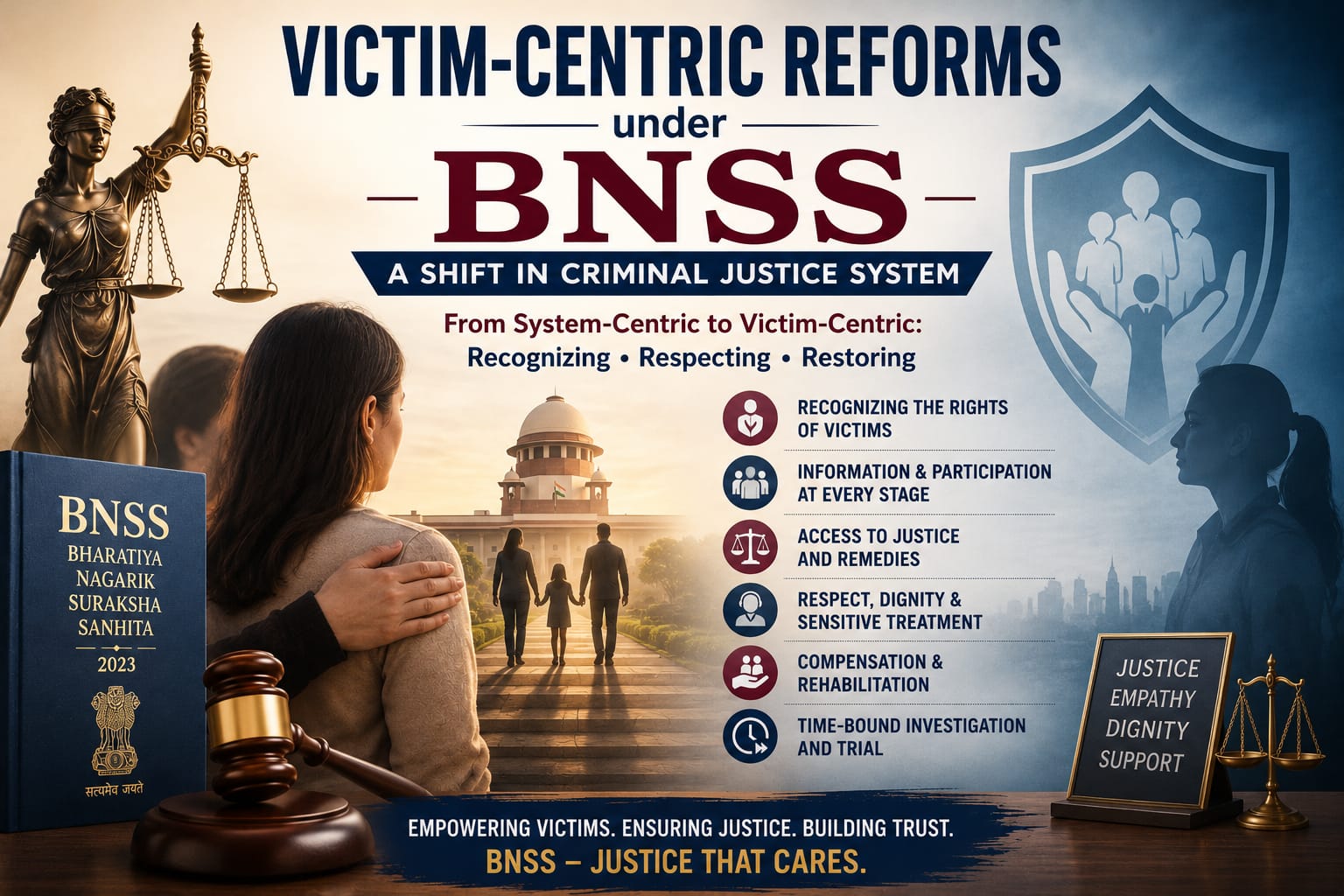
The Bharatiya Nagarik Suraksha Sanhita (BNSS), 2023 represents a major transformation in India’s criminal justice system by introducing a victim-centric approach to criminal procedure. Traditionally, the criminal justice system in India focused primarily on the accused, while victims remained marginalized and often ignored during investigation and trial. The BNSS attempts to address this imbalance by recognizing victims as important stakeholders in the administration of justice.
It introduces provisions relating to victim participation, protection, compensation, speedy justice, and use of technology for greater accessibility and transparency. These reforms aim to ensure fairness, dignity, and support for victims throughout the legal process. This article examines the legal framework, key features, legislative measures, landmark judicial decisions, and the overall significance of victim-centric reforms under the BNSS.
Introduction
The criminal justice system plays a vital role in maintaining law and order and ensuring justice in society. However, for many years, the Indian criminal justice system was criticized for being offender-centric, where the rights of the accused received greater attention than the suffering of victims. Victims were often treated merely as witnesses rather than individuals whose lives were deeply affected by crime.
The Bharatiya Nagarik Suraksha Sanhita (BNSS), 2023, enacted to replace the Code of Criminal Procedure, 1973 (CrPC), seeks to modernize criminal procedure and make the justice system more efficient, transparent, and victim-oriented. One of the most progressive aspects of the BNSS is its emphasis on victim rights and welfare.
The BNSS reflects the idea that justice should not only punish offenders but also restore the dignity, confidence, and rights of victims. Through various reforms, the legislation attempts to create a balance between the rights of the accused and the rights of victims.
Legal Framework in India
The concept of victim rights in India has evolved gradually through constitutional provisions, statutory laws, and judicial interpretations.
Constitutional Provisions
The Constitution of India provides protection to victims through various fundamental rights, including:
● Article 14 – Right to Equality
● Article 21 – Right to Life and Personal Liberty
● Article 39A – Equal Justice and Free Legal Aid
The Supreme Court has interpreted Article 21 broadly to include the right to fair investigation, speedy trial, dignity, and compensation for victims.
Statutory Framework
Before the BNSS, victim-related provisions existed under the Code of Criminal Procedure, 1973. However, such provisions were limited. The BNSS strengthens these protections by introducing more comprehensive victim-centric reforms. Other important legislations include:
● The Protection of Women from Domestic Violence Act, 2005
● The Protection of Children from Sexual Offences Act (POCSO), 2012
● The Scheduled Castes and Scheduled Tribes (Prevention of Atrocities) Act, 1989
● The Legal Services Authorities Act, 1987
These laws collectively contribute to victim protection and rehabilitation in India.
Key Features of Victim-Centric Reforms under BNSS
Right to Information
The BNSS ensures that victims are informed about important developments in their cases, including:
● Registration of FIR
● Progress of investigation
● Filing of charge sheet
● Bail proceedings
● Trial status
This provision enhances transparency and keeps victims actively connected to the justice process.
Victim Participation in Proceedings
Victims are given greater participation in criminal proceedings. They can:
● Present their views before the court
● Be heard during important stages of trial
● Participate in certain bail proceedings
This reform recognizes victims as stakeholders rather than passive observers.
Protection and Privacy of Victims
The BNSS places emphasis on protecting victims from threats, intimidation, and harassment. Protection of identity and privacy is especially important in cases involving:
● Sexual offences
● Women and children
● Vulnerable and marginalized victims
This helps reduce secondary victimization during investigation and trial.
Speedy Investigation and Trial
Delay in criminal proceedings often causes additional trauma to victims. The BNSS introduces time-bound procedures and promotes:
● Digital investigation methods
● Electronic communication
● Video conferencing
● Faster disposal of cases
These measures aim to ensure timely justice.
Victim Compensation and Support Services
The BNSS strengthens victim compensation mechanisms and support systems. Victims may receive:
● Financial compensation
● Medical assistance
● Legal aid
● Psychological counselling
● Rehabilitation support
Such measures help victims recover emotionally and financially from the impact of crime.
Legislative Measures
The Indian legislature has gradually introduced reforms to strengthen victim rights. Some important legislative measures include:
a) Criminal Law (Amendment) Act, 2008
This amendment inserted Section 357A in the CrPC, introducing the Victim Compensation Scheme.
b) Criminal Law (Amendment) Act, 2013
Enacted after the Nirbhaya case, this amendment strengthened laws relating to sexual offences and victim protection.
c)The BNSS further expands victim rights by emphasising:
● Victim participation
● Right to information
● Time-bound investigation
● Digital accessibility
● Victim dignity and protection
The legislation represents a major step toward a modern and humane criminal justice system.
Landmark Case: Delhi Domestic Working Women’s Forum v. Union of India (1995)
Facts of the Case
In this case, several domestic working women were sexually assaulted while travelling on a train. The victims faced serious difficulties in obtaining legal assistance, protection, and support during the criminal justice process. The incident highlighted the insensitive treatment often faced by victims of sexual offences in India.
A public interest litigation was filed before the Supreme Court seeking proper guidelines and protection for rape victims.
Issues Before the Court
The major issues before the Supreme Court were:
- Whether victims of sexual offences are entitled to legal assistance during investigation and trial.
- Whether the State has a duty to provide compensation and rehabilitation to victims.
- Whether the criminal justice system adequately protects the dignity and rights of victims.
JUDGMENT
The Supreme Court recognised that victims of sexual offences require protection, legal support, and compensation. The Court held that rape victims are entitled to dignity, privacy, and fair treatment under Article 21 of the Constitution of India. The Court issued important guidelines, including:
● Providing legal representation to victims at police stations and courts.
● Ensuring confidentiality of victim identity.
● Establishing Criminal Injuries Compensation Boards.
● Providing psychological and financial support to victims.
The judgment became a landmark step in recognising victim rights in India and influenced later victim-centric reforms, including provisions under the BNSS.
Importance of the Case
This case is considered a landmark judgment because it shifted attention toward the rights and welfare of victims rather than focusing only on offenders. It emphasised that the criminal justice system must be compassionate, supportive, and sensitive toward victims of crime.
Personal Analysis
In my opinion, the victim-centric reforms introduced under the BNSS are a progressive and necessary development in India’s criminal justice system. Earlier, victims often experienced neglect, delays, and lack of participation during criminal proceedings. The BNSS attempts to correct this imbalance by recognizing victims as central participants in the justice process.
The provisions relating to victim protection, information, compensation, and speedy trial reflect a more humane and compassionate approach to justice. The use of technology can also improve accessibility and efficiency for victims.
However, the real success of these reforms depends on effective implementation. Police authorities, courts, and government agencies must work together to ensure that victims actually benefit from these provisions. Awareness programs and proper training are also necessary for successful execution.
Overall, the BNSS marks an important shift toward a more inclusive, fair, and victim-oriented criminal justice system.
Conclusion
The Bharatiya Nagarik Suraksha Sanhita, 2023 signifies a historic shift in India’s criminal justice system from an accused-centric model to a victim-centric approach. By recognizing victims as active stakeholders in criminal proceedings, the BNSS aims to ensure fairness, dignity, transparency, and compassion in the administration of justice.
The reforms relating to victim participation, protection, compensation, and speedy justice strengthen the confidence of victims in the legal system. Although challenges in implementation remain, the BNSS has laid the foundation for a more humane and responsive justice system.
In conclusion, the victim-centric reforms under the BNSS represent a progressive step toward ensuring that justice is not only about punishing offenders but also about restoring the dignity, rights, and confidence of victims in society.
Disclaimer: This article is published for educational and informational purposes only and does not constitute legal advice, legal opinion, or professional counsel. It does not create a lawyer–client relationship. All views and opinions expressed are solely those of the author and represent their independent analysis. Times Law does not endorse, verify, or assume responsibility for the author’s views or conclusions. While editorial standards are maintained, Times Law, the author, and the publisher disclaim all liability for any errors, omissions, or consequences arising from reliance on this content. Readers are advised to consult a qualified legal professional before acting on any information herein. Use of this article is at the reader’s own risk.