BY : SHWETA PATHAK, GLA UNIVERSITY MATHURA
COURSE & YEAR : BA.LLB(H) & 1ST YEAR
ABSTRACT
The “ gig economy” is defined as a market based on fixed-term contracts or project based payments by a company, third party or online marketplace. This sector has experienced tremendous growth with the raise of interest, particularly in India, where there is a significant increase in short- term and flexible contract workers. These workers rely on completing tasks to receive payments rather then having a fixed salary or job security. In India the government has divided gig workers into two groups : platform workers and non-platform workers. Platform workers engage with companies through online platforms, while non-platform workers do not operate under such platforms.
INTRODUCTION
A gig economy is a free market system in which temporary positions are common and organizations hire independent workers for short-term commitments. A “gig” is a popular phrase for a temporary work assignment. Historically, this term has been used by musicians to refer to a live performance. The gig economy is a type of employment where companies engage temporary employees in place of full-time, permanent employees. The economic system in which a workforce of people referred to as gig workers, works as a side hustler is called the gig economy. People and youth always desire a job to support themselves, but the current unemployment rate is quite harmful. Everyone wants to work, and while it is still difficult to find jobs for young people, gig workers have a huge potential for employment.
Because of this, the gig economy is become a common urban phenomenon. The term “gig economy” refers to a workforce model in which workers are employed for specific projects and earn a living from those projects. Overall, the concept of the gig economy represents a shift in how work is organized and performed with implications for both workers and businesses in today’s rapidly evolving labour market. However, the extent and nature of gig work may vary across different regions depending on factors such as local regulations, economic conditions, and cultural norms. Customers now have an alternative to commercial goods and sectors thanks to the gig economy.
STEPS INVOLVED IN WORKING PROCESS
There are several steps involved in the working process of the Gig economy. These processes result in the production of cheaper, more efficient, and flexible services that can offer consumers a unique and fast alternative to regular, standardized business.
Platform Registration: Employees register on gig economy platforms by supplying the required data and confirming their identification.
Task Selection: Employees explore the platform’s various gigs or tasks, which range from ordinary duties like puppy walking or furniture assembly to driving, delivering, and freelance labour.
Acceptance: Workers may just accept them based on availability, geography, talents, and preferences, depending on the platform.
Task Completion: Employees finish the task at work in accordance with the specifications provided by the platform or client. This could be making deliveries, rendering services, or finishing a project.
Processing Payment: The portal processes payment after the task is finished. While there are several ways to pay, digital payment services or direct deposit are used often.
Feedback and Ratings: To preserve quality and confidence in the platform’s community, both the client and the worker are able to offer ratings and comments based on their experiences.
Repeat or Explore: Employees may decide, based on their availability and preferences, explore alternative options or to repeat the process with comparable work.
RISE OF GIG ECONOMY IN INDIA
According to a joint report by the Boston Consulting Group and the Michael & Susan Dell Foundation, the gig economy can support up to 90 million jobs in India’s non-farm sector alone. This corresponds to approximately $250 billion in work output, which could provide an additional 1.25% to India’s GDP. Technological innovation, increased desire for flexible work, and unemployment have all contributed to a significant shift in the global labour structure. According to a report by the Boston Consulting Group, there are 15 million gig workers working in India in the software, professional services, and shared services sectors, including digital marketing, at-home health care services, senior care assistance, IT and IT-enabled services, and the media sector (which includes freelance photographers and content writers).
In the gig economy, the digital platforms were crucial in connecting employment suppliers and seekers when intermediaries were not present. The gig workforce in India help in the increase of the total employment rate and total living standard of the people in India.The Central Government has chosen to train state and central officials on developing forms of employment, technological change, rights, labour protection, social security regulations, and global gig and platform worker practices. Gig workers are not given social security entitlements, which often causes hardship among this rising class of employment. According to ASSOCHAM research, the gig economy has the potential to grow to $455 billion at a Compound Annual Growth Rate (CAGR) of 17% by 2024, with 350 million gig employment expected in 2025.
In recent years there has been rapid growth in gig economy in India as per the Niti Ayog report of June 2022, 87 lakh (8.7 million) gig workers were there in 2021-22, which is 2.9% of the non-farming workforce or 1.7% of the total workers in India. In 2022-23, 99 lakh (9.9 million) workers were engaged in the gig economy constituting 3.2% of the non-agricultural workforce or 1.9% of the total workforce in India. The report estimates that the gig workforce can rise to 2.35 crore workers, forming 6.7% of the non-agricultural workforce or 4.1% of the total workers in India by 2029-30.
The legal challenges faced by gig workers
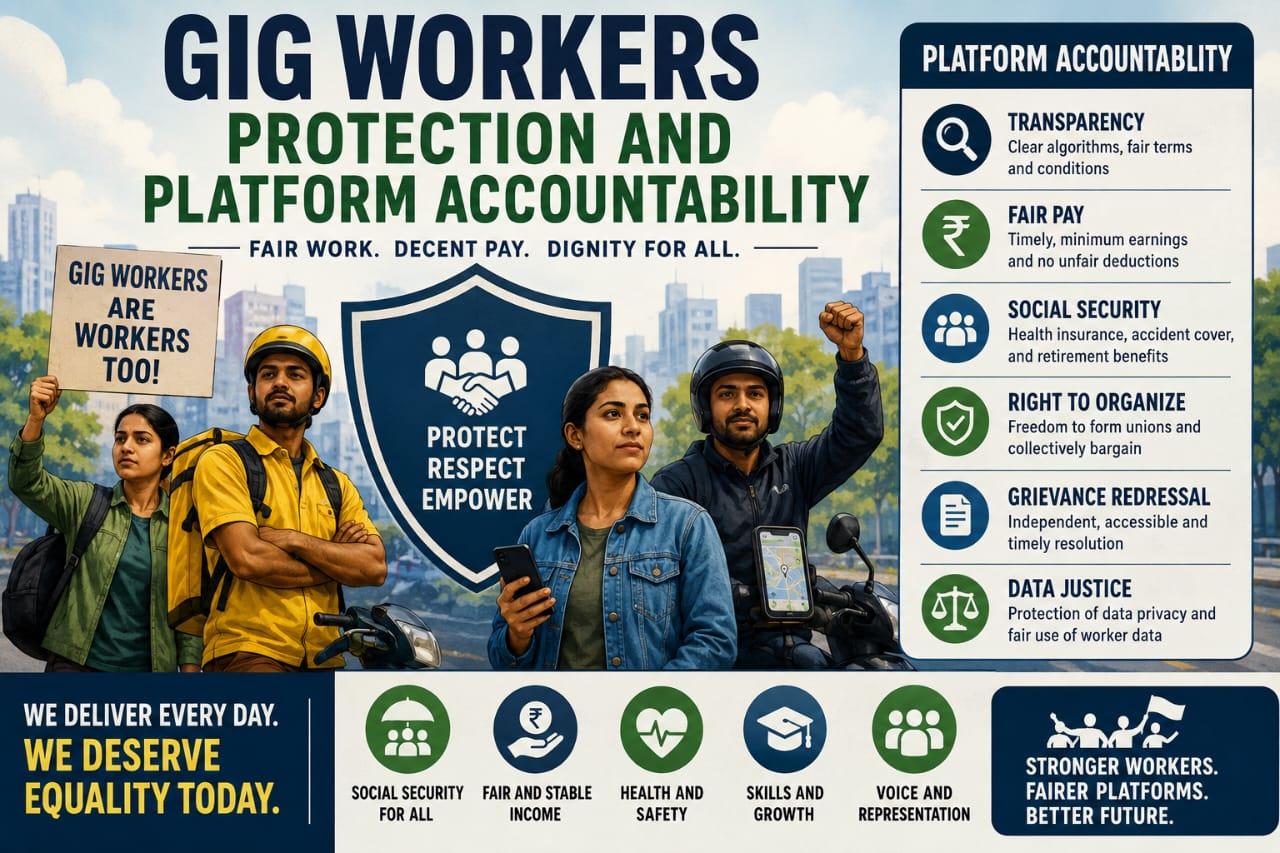
- Ambiguity in Legal Definitions: Indian labour law does not want gig workers to be clearly defined. They consider GIG workers as having vanity jobs which creates loopholes exposing them to lacking formal employee rights. At the moment, there is no mechanism for distinguishing between an employee and a contractor, and hence workers’ rights such as a minimum wage, protection in working conditions, and right to unionization are non-existent.
- Issues related to classification: Regarding the decision-making of gig workers as independent contractors there are several problems. Platforms also behave in a fashion similar to traditional employers, regulating their workers’ work schedules, wages, and rates of performance. The main case here includes the Uber drivers’ employment status; this was in the UK Supreme Court in the case of Uber BV vs Aslam, the court found that Uber drivers require minimum wage India about deciding gig engagers as employees .and holidays among other basic employment rights.
- There are social security issues: Gig workers, for instance, they are not privileged to the social security status of employees like health insurance, pension, and unemployment among others. Some of these issues will be addressed under ‘Code on Social Security, 2020’, wherein the gig and platform workers shall be covered. There is a proposed social security fund for these workers that is quite pro-working on the process. Thus, despite the relative novelty of implementation, it is apparent that an array of gig workers remains under-protected.
- Issues of Fair Wages and Working Conditions: Several gig workers state that they make less than minimum wage and that they dedicate several hours to ensuring that they make ends meet. Right now, no governing body is involved in guaranteeing that gig workers are being paid a reasonable wage or that they aren’t employed in environments that could be dangerous. One must not forget that the gig economy in India is highly volatile given recent strikes by delivery workers of platforms like Zomato and Swiggy.
Gig workers under the ambit of Contract Labour Act
The Contract Labour (Regulation and Abolition) Act, 1970 regulates engagement of contract labour in India, including work done through third-party contractors. There is scope for gig workers who work for platforms to be “contractors” under this law. This imposes obligations on employers to comply with the requirements under this law, including welfare and health obligations to be provided to employees such as the provision of canteens, first aid, etc. Yet, this law has still not been applied by most platforms nor has it been discussed by any Indian Court.
The Employment Compensation Act, 1923 mandates that the employer pay compensation for accidents arising out of and in the course of employment. The applicability of this law to gig workers also remains to be determined by Courts. If this does apply to gig workers, it would go a long way in ensuring compensation for occupational safety hazards.
Gig workers under the new Labour Codes
The new Labour Codes of 2019 defines a gig worker as “A person who performs work or participates in a work arrangement and earns from such activities outside of traditional employer-employee relationship”.
Even though gig workers will get protections such as minimum wages, crucial protections related to occupational health and safety still remain to be addressed. Once the current draft Code becomes a law, gig workers would get schemes which are notified by the State and Central Government, including life and disability cover.
While gig work has become a necessity for both the workers and the platforms hiring them, regulation of the gig work remains vital to ensure that these classes of workers are given the same opportunities and protections as other employees covered under various labour laws in India. Labour disputes will continue to increase manifold and assume new shapes and forms with the advent of technology. Proposing legislative tools and policy frameworks as well as a review of the draft Code is essential in ensuring the protection of rights of gig workers.
Conclusion and Suggestions
India has a growing population and a persistent unemployment issue since a sizable portion of the population continues to work in unskilled labour. This highlights the susceptibility of employees who use online platforms. Therefore, to protect these workers’ rights, we need to classify the kind of jobs they perform on these online platforms as well as the regulations that can control them. It is time for us to advance because many tasks are now completed using technology, and customer behaviour plays a bigger part in identifying these workers and protecting their rights. One of the most susceptible groups in the workforce is the gig economy. Due to the unusual nature of gig employment and legislative uncertainty, businesses have been able to continuously use their employees dishonestly without fear of legal repercussions. New legal structures, specific to the needs of the “shared economy,” may be developed as an alternative to the traditional methods of classifying workers as either employees or independent contractors. Multiple theorists propose a third kind of worker status they call “dependent contractors,” who “occupy a midway ground between the conventional employees and independent contractors.”
Disclaimer: This article is published for educational and informational purposes only and does not constitute legal advice, legal opinion, or professional counsel. It does not create a lawyer–client relationship. All views and opinions expressed are solely those of the author and represent their independent analysis. Times Law does not endorse, verify, or assume responsibility for the author’s views or conclusions. While editorial standards are maintained, Times Law, the author, and the publisher disclaim all liability for any errors, omissions, or consequences arising from reliance on this content. Readers are advised to consult a qualified legal professional before acting on any information herein. Use of this article is at the reader’s own risk.