By: Srishna R
Christ Academy Institute of Law, Bengaluru, Karnataka
ABSTRACT
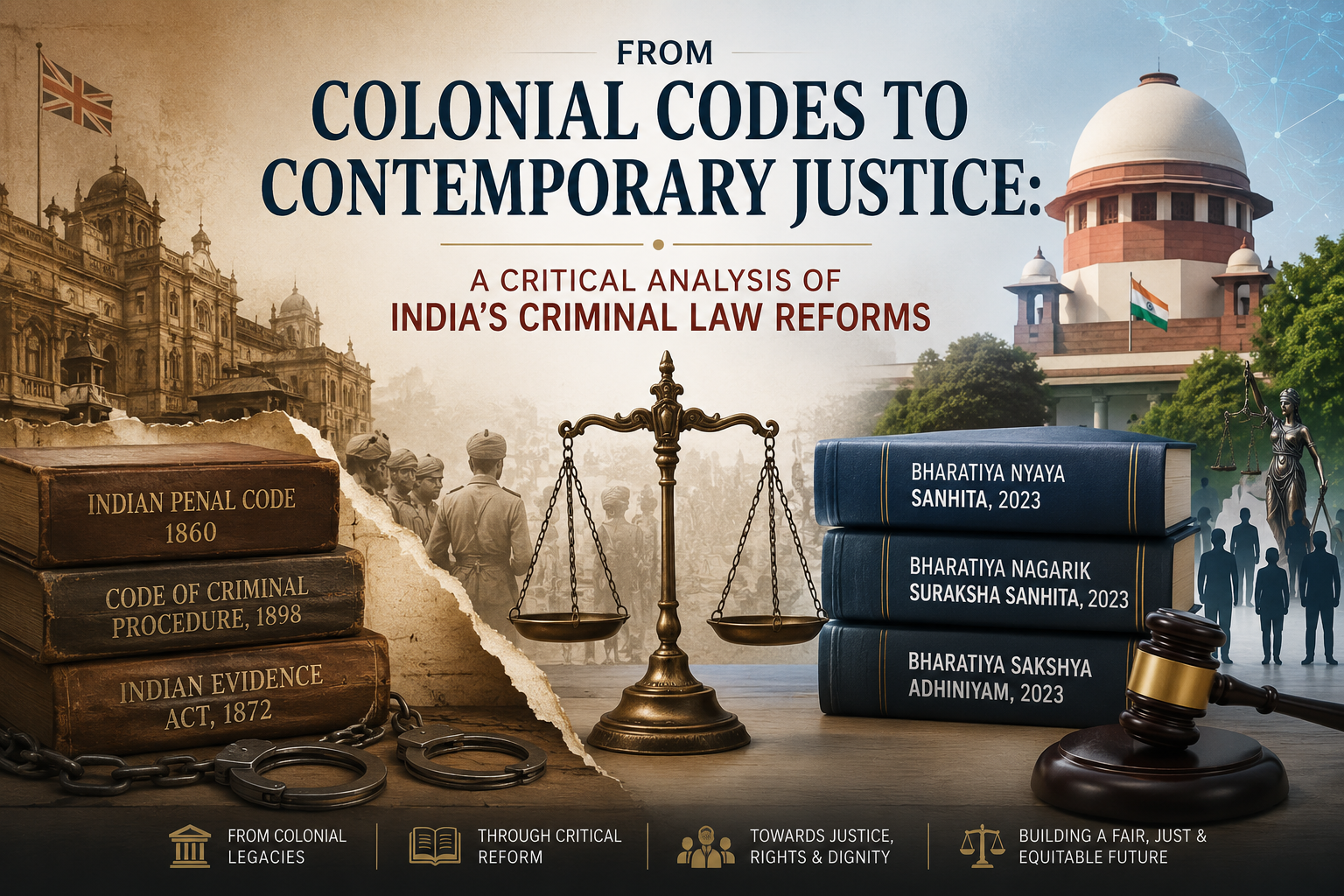
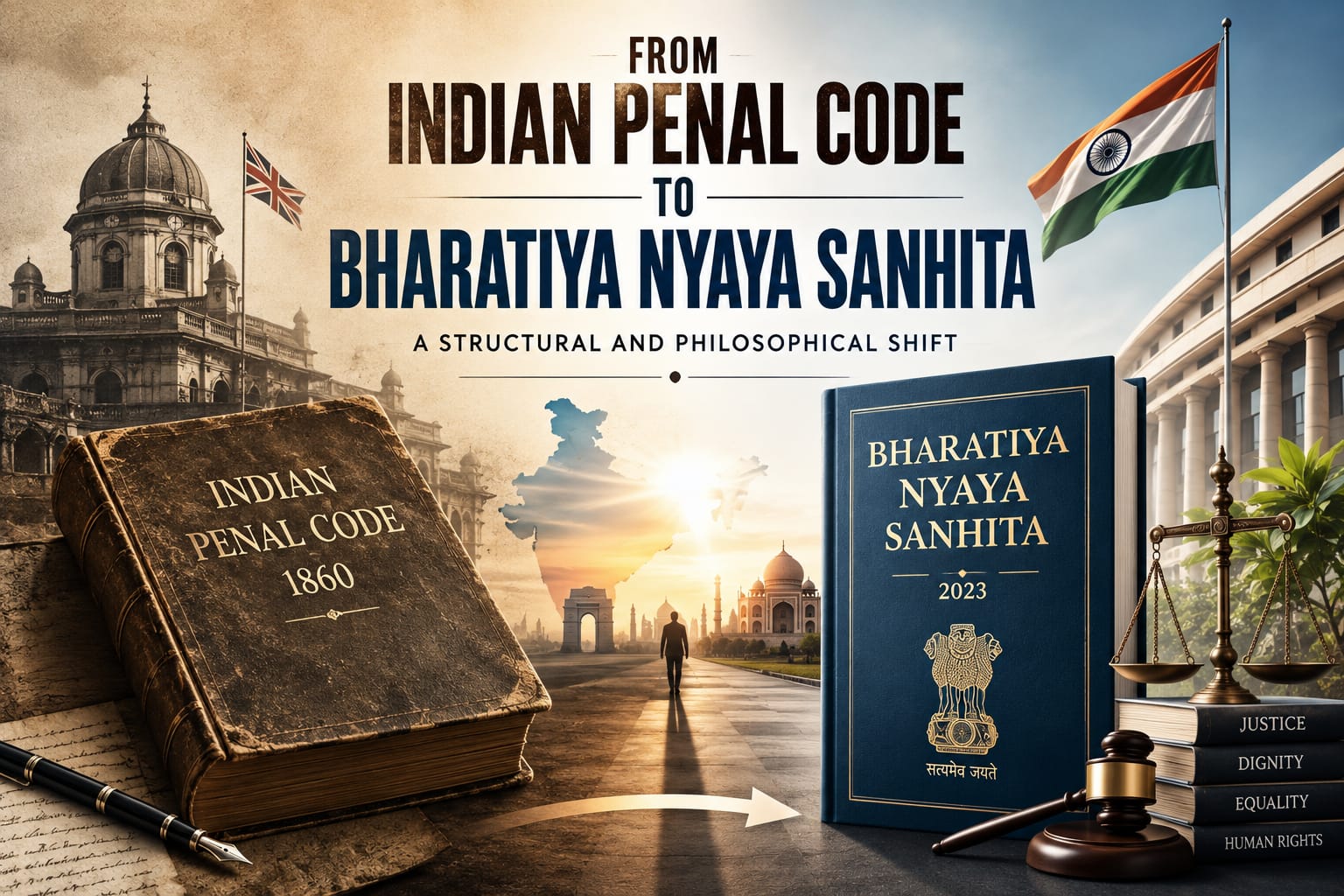
The Indian criminal justice system has seen a major shift from the Indian Penal Code (IPC), 1860 to the Bharatiya Nyaya Sanhita (BNS), 2023. The British colonial rulers developed the IPC as a system to control India while they disregarded the Indian social and cultural justice systems that existed in the country. The BNS system aims to create a new system which will fulfil modern requirements and uphold Indian constitutional principles and Indian traditional beliefs. The research article investigates how the BNS introduced both structural changes and philosophical transformations.
The BNS system establishes new structural components which include crime classification systems with legal definitions and establishes new crime categories which cover terrorism and organized crime and cyber offences and it abolishes outdated laws through specific regulations that protect national sovereignty and territorial integrity. The philosophical change shows a transition from colonial systems which enforced punishment to modern judicial systems which protect citizen rights and treat all victims equally while holding offenders accountable through contemporary technological methods.
The article examines whether the BNS system has abandoned colonial practices or maintains its former control methods under different designations. The research compares legal frameworks with their intended legislative goals to international standards in order to identify existing difficulties and needed changes. The legal transformation creates a new criminal justice framework which combines traditional practices with present-day methods and constitutional principles to meet the requirements of India’s evolving democratic framework.
Keywords: Indian Penal Code, Bharatiya Nyaya Sanhita, Criminal Law Reform, Decolonization of Law, Constitutional Justice.
INTRODUCTION
The Indian Penal Code of 1860 has functioned as India’s primary legal framework for more than 150 years. The IPC was developed under Thomas Babington Macaulay to establish unified and complete criminal laws for the entire Indian subcontinent. The Code achieved outstanding success through its legal code creation and detailed legal language presentation but its core design was built to support colonial powers who sought to maintain dominance over indigenous communities. The independent nation of India adopted the IPC through various changes which updated its content to reflect changing social norms and constitutional developments. Legal experts and practitioners have maintained that the Code retained outdated legal standards because it used archaic terminology and included rules that prioritized state interests over citizen rights.
The Indian government has now introduced the Bharatiya Nyaya Sanhita which will replace the function of the Indian Penal Code after multiple demands for its complete restructuring in recent times. This reform is not just a technical amendment but an effort to reframe criminal law in the context of modern times which include the rise of technology and new types of crimes and new values which include justice and equality and human dignity under the Constitution. The BNS develops its legal framework through three main functions which include creating precise definitions of legal terms and establishing new crime categories and developing methods to combat present-day problems which include organized crime and cyber-crime.
The system wants to transform its colonial foundations by adopting a justice approach which centres both indigenous values and the needs of local citizens. The transition from the IPC to BNS marks a pivotal moment for Indian legal development because it introduces new elements while maintaining existing elements which lead to a more effective system of criminal justice.
HISTORICAL BACKGROUND OF INDIAN PENAL CODE
The Indian Penal Code (IPC) which the British Empire established in 1860 served as one of the first complete criminal law systems that British rulers introduced to India during their colonial period. The First Law Commission which the British Empire established in1834 appointed Thomas Babington Macaulay as its leading figure who drafted the document. The IPC aimed to establish a standard criminal law framework which would enable judges to apply the law throughout all of India’s colonial territories. Before the law was passed different regions of India used different criminal laws which created problems for British officials who needed to enforce the law across multiple areas.
The IPC received significant influences from English common law together with European legal systems which existed during that time period. The Code was designed to define criminal offenses and their corresponding penalties while it also served as a tool for maintaining population control. The legislation created multiple sections which established governmental power and public safety as more important responsibilities than individual rights. Colonial authorities used sedition laws and unlawful assembly regulations to protect their power against revolts while they worked to keep political order.
The IPC incorporated ethical standards from the Victorian period which displayed itself through rules about sexual behaviour and obscene material and personal behaviour. The Code received positive feedback for its clear presentation and organized structure and enduring design but its critics maintained that the Code operated outside democratic systems which value fundamental rights and equality and individual freedom.
NEED FOR REFORM
The need to reform the Indian Penal Code (IPC), 1860 arose from a combination of social, technological, and constitutional developments which showed its inability to handle modern day problems. The IPC established a complete legal system which maintained its validity throughout time but its original colonial design and subsequent small updates made it unfit for present day requirements of India.
The need for legal changes developed because different types of criminal activities started to emerge. The fast development of technology has resulted in the rise of various cybercrimes which include identity theft and online fraud and data breaches and digital harassment. The growing threat of organized crime networks and international criminal operations and terrorist activities needed an improved legal system which contained precise guidelines because the existing IPC framework failed to meet these requirements.
The outdated and disputed laws which existed at the time proved to be an essential element in determining the outcome. The law on sedition under Section 124A of the IPC received widespread criticism as a tool that colonial authorities used to suppress dissent while they restricted freedom of speech. The constitutional provisions from that time period proved to be incompatible with fundamental rights and civil liberties during the democratic period which operated according to constitutional governance.
The IPC legal system faced two major problems because of its complicated structure and its outdated language. The 19th century legal code became difficult to understand because of its complex vocabulary which made it hard for common people and law enforcement officials and legal professionals to comprehend the content. The legal system experienced delays because of two problems which included ambiguous language and people applying the law in different ways. The public demands for a justice system.
The IPC system established its main focus on defining criminal acts and their corresponding penalties while it dedicated minimal attention to safeguarding victims and helping them recover. The current legal systems show a growing trend towards endorsing restorative justice methods which include victim restitution and fair administrative processes. The combination of these factors created a necessary requirement for complete system changes which resulted in the establishment of a contemporary legal system that emphasizes accessibility and fairness.
STRUCTURAL CHANGES IN BHARATIYA NYAYA SANHITA
The Bharatiya Nyaya Sanhita (BNS) 2023 establishes major structural changes which will update and streamline both Indian criminal law and its existing legal system. The modifications enable users to understand legal material better while modernizing legal practices and solving contemporary problems which exist outside the traditional framework established by the Indian Penal Code of 1860.
- Reorganization of Offences
The BNS establishes its most important structural change through its complete system for organizing criminal offenses. The BNS links similar offenses through its structured system while the IPC presents its legal provisions in a fragmented way which creates weak connections between different sections. The new organization of the material establishes a clear pathway for understanding the content which benefits legal professionals and law enforcement organizations and ordinary citizens. The BNS establishes straightforward classification systems which help decrease legal uncertainty while producing consistent law enforcement and judicial outcomes. - Introduction of New Offences
The BNS establishes new criminal categories through its contemporary judicial system which discovers offenses that existed before yet needed better criminal definition in the IPC. The new system will now recognize terrorism offenses and organized crime activities together with cyber-related criminal activities. The legal system needs this provision because it recognizes how criminal activities develop through technological progress and worldwide connectivity. The legal system uses this approach to combat technological threats which emerge from advanced criminal networks. - Removal and Modification of Colonial Provisions
The BNS introduces its main achievement through its process of removing and changing all legal elements which stem from colonial powers. The most prominent example is the abolition of the sedition law, previously found under Section 124A of the IPC. The law has been replaced with restricted legal definitions which specifically describe crimes that threaten India’s sovereignty and territorial unity and national integrity. The shift serves to establish a connection between democratic principles and constitutional protections through which criminal laws should operate. - Simplification of Language
The legal system needs this essential transformation because it requires attorneys to use plain language which all people can understand. The IPC’s archaic and complex terminology often created barriers to understanding and implementation. The BNS uses straightforward language which enables all people including citizens and police officers and judicial officials to better understand legal rules. The new process will increase transparency while decreasing errors which lead to judicial delays in legal proceedings.
PHILOSOPHICAL SHIFT
The switch from the Indian Penal Code 1860 to the Bharatiya Nyaya Sanhita 2023 brings about both structural changes and fundamental changes to Indian criminal law. The BNS system seeks to display democratic values which respect human rights while allowing society to develop.
- From Colonial Control to Citizen-Centric Justice
The IPC protected colonial rule through its system which safeguarded governmental authority while disregarding individual rights. The system of the law was designed to allow government authorities to use legal power as a means of control over the community. The BNS system implements a new judicial system which focuses on serving the needs of citizens. The system defines its core values through three principles which include accountability and fairness and individual rights protection. - Victim-Centric Approach
The criminal justice system now shows greater consideration for victims through its new philosophical framework. Under the IPC, the focus was largely on defining offences and prescribing punishments, with limited attention to the needs and rights of victims. The BNS system creates mechanisms which protect victims and provide them with justice through compensation and expedited legal proceedings. This practice demonstrates a shift towards restorative justice which acknowledges the effects of criminal behaviour on victims and emphasises the need to penalize offenders. - Gender Sensitivity and Neutrality
The BNS demonstrates a developing understanding of gender which exists in criminal law. The BNS modernizes traditional IPC rules which stemmed from patriarchal standards by implementing gender-sensitive and gender-neutral elements. The debate about this shift continues because people still question whether all gender identities receive proper protection and whether the current system protects all identities. - Integration of Technology
The BNS recognizes that technology now plays an important role in both criminal activities and crime investigation processes. The system proves its flexible legal framework by accepting digital evidence and handling cyber-related crimes. The system demonstrates future-oriented methods which protect the criminal justice system from becoming outdated in our digital society.
CRITICAL ANALYSIS
The Bharatiya Nyaya Sanhita (BNS), 2023 functions as a major reform which changes the entire Indian criminal justice system. The examination shows that the law presents essential changes yet maintains some existing elements while creating major difficulties needs to be understood and executed.
- Continuities with the Past
The BNS established its goal to eliminate colonial legal systems yet it kept multiple aspects which reflect the Indian Penal Code (IPC) system from 1860. The existing law still permits authorities to maintain power through their control over public safety matters and national security operations. The new law which succeeds the sedition law creates provisions that address acts against India sovereignty and territorial integrity yet critics express concerns about potential abuse of these new regulations. The critics claim that these rules will function as instruments to suppress dissent and limit free speech just like the dangerous legal systems which existed during colonial times because they lack effective protection measures. - Ambiguities and Challenges
The introduction of new definitions creates significant difficulties because their meaning remains uncertain. The current world requires terrorism and organized crime and state offense laws which exist in broad and flexible legal frameworks. The existing definition lacks specific details which enable law enforcement agencies and judicial systems to interpret the rules in different ways. The existing uncertainty creates multiple outcomes which affect both legal professionals and ordinary citizens. The legal system needs clear rules which protect citizens from unpredictable enforcement actions. - Implementation Concerns
The BNS achieves its objectives through proper execution of all its components. Police officers and lawyers and judges need complete training to move from the existing IPC system to the new legal system. The process needs active institutional preparedness which requires organizations to establish new operational frameworks and build necessary equipment and modern technology systems. The good intentions of the reforms will not succeed because organizations lack proper training and understanding of their planned changes. The successful execution of the project needs different groups to work together while monitoring progress and maintaining constitutional principles throughout their work.
COMPARATIVE PERSPECTIVE
The law comparison between Bharatiya Nyaya Sanhita BNS 2023 and present-day international criminal codes shows both shared legal patterns and ongoing legal conflicts. Criminal codes now include provisions for organized crime and terrorism and cyber-crimes and international criminal activities because countries update their legal systems to meet new demands. The BNS represents a major development for India since it brings Indian criminal justice systems into alignment with current global legal practices.
The two legal systems share a common point because both systems treat organized crime and terrorism as separate serious criminal offenses. The United Kingdom Serious Crime Act 2015 and the USA PATRIOT Act serve as examples of jurisdictions that created special laws to combat criminal networks which threaten national security. The BNS establishes organized crime provisions which create structured frameworks to address criminal offenses that have become more advanced and operate across national borders. The Indian Penal Code IPC 1860 originally defined criminal categories without any comprehensive approach to these specific categories.
The two legal systems establish cybercrime through their current legal systems as their main point of connection. Countries worldwide have updated their criminal laws to address offences such as hacking, identity theft, and online fraud. The BNS system adds to existing legal systems which include the Information Technology Act 2000 by showing how digital evidence functions and how modern societies require laws to adjust to upcoming technological changes. The worldwide trend shows that criminal law systems need to include current technological use in their legal processes.
The BNS system faces ongoing examination because it needs to find proper equilibrium between safeguarding personal rights and maintaining national security measures. European democratic legal systems require their judicial systems to implement strong protective mechanisms which safeguard civil rights and ensure that punishments match the severity of offenses and provide judicial control over legal proceedings. The BNS modernizes criminal law through its current efforts but its national security and public order provisions create problems because they define standards which law enforcement may use to establish suspicious behaviour. The struggle to maintain security while upholding basic rights exists in India as a common issue that affects international criminal law systems.
The BNS system shows different results because it employs punitive methods instead of the restorative justice approaches which some jurisdictions use to replace imprisonment. The system includes reform elements but experts disagree about how much it has adopted international standards of progressive practices. The BNS system shows substantial progress toward international legal standards which help to fight contemporary crimes but its success depends on how well it maintains enforcement authority while safeguarding citizen rights.
CONCLUSION
The Bharatiya Nyaya Sanhita (BNS), 2023 marks a crucial milestone which advances India’s criminal justice system through a combination of structural changes and new legal principles. The law seeks to replace the Indian Penal Code (IPC), 1860 with contemporary legal standards which match present-day conditions and constitutional principles and democratic values. The legal system aims to enhance its accessibility and modern relevance through its use of simpler language and its new framework for organizing offences and its introduction of cybercrime as a new offence category.
The BNS establishes a philosophical shift which leads from state government control to a system that protects citizens through justice rights and accountability. The system now includes more victim protection measures and gender perspective evaluation and technological development solutions which create a better understanding of justice as an inclusive process. The BNS implementation process will determine whether the law succeeds or fails. The success of these ref
Disclaimer: This article is published for educational and informational purposes only and does not constitute legal advice, legal opinion, or professional counsel. It does not create a lawyer–client relationship. All views and opinions expressed are solely those of the author and represent their independent analysis. Times Law does not endorse, verify, or assume responsibility for the author’s views or conclusions. While editorial standards are maintained, Times Law, the author, and the publisher disclaim all liability for any errors, omissions, or consequences arising from reliance on this content. Readers are advised to consult a qualified legal professional before acting on any information herein. Use of this article is at the reader’s own risk.