By: Shreya Shrestha
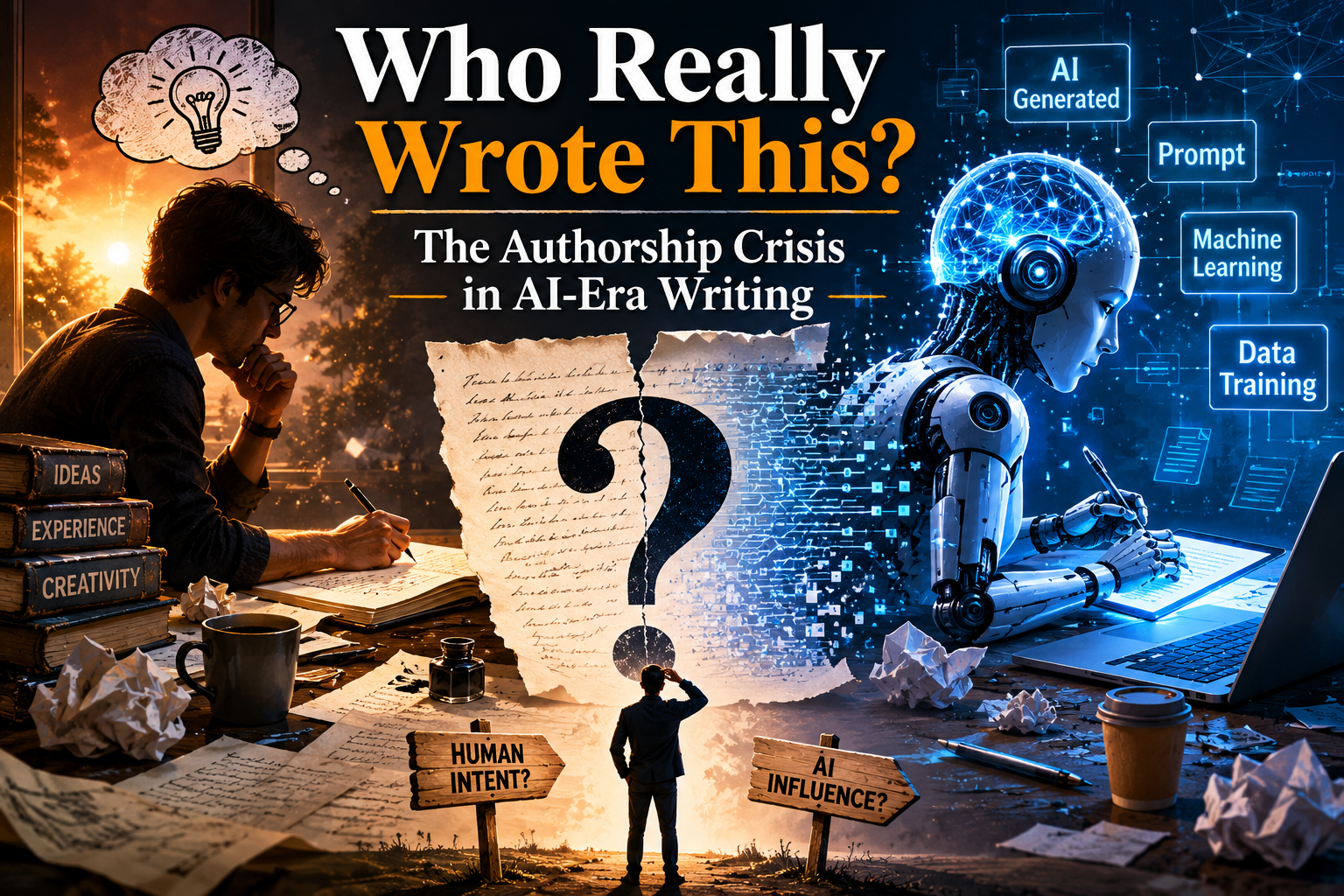
You begin with a writing task that’s still a bit rough, so you call upon AI tools. Before you know it, your writing is gone, replaced with something effortless, almost unrecognizable. You work with such finesse that the final product is barely even yours. Now be honest: whose words are you publishing?
This is the dilemma many of us face in today’s AI-enabled world. It’s not that unusual anymore. Throughout professional organizations, as well as publications, many authors secretly depend on AI to perfect, refocus, or redo their writing. The line between human and AI writing is blurring faster than laws can keep up. And this raises a fundamental question: if the essence of the intellectual idea and expression is generated through AI, do humans qualify as the authors anymore?
How common is AI-assisted writing, and what does the law say about AI authorship?
Use of AI technology is increasing. More writers use it to tweak a sentence here, reconstruct paragraphs there, or sometimes rework entire pieces. This, begs the question of who may lawfully claim their right as authors.
In Thaler v. Perlmutter (2025), the D.C. Circuit Court of Appeals ruled that, under the Copyright Act of 1976, the Creativity Machine wasn’t eligible for recognition as its own author, as every eligible work must be “authored in the first instance by a human being. However, this court decision didn’t address the issue of whether a human behind the design or control of the AI might be considered its own author if the AI produced the work. Although this decision involved totally AI-authored works, it still leaves undecided the complex issues associated with collaborative human-AI-authored works, such as- at what point human authorship ceases if human authorship relies upon excessive AI aid?
The call for clarity is urgent. Empirical studies on personalized Large Language Models writing identify the so-called AI Ghostwriter Effect. Study participants claimed authorship of writings produced with the aid of AI, but in most cases didn’t disclose their use of AI as a writing tool. Only well under one-fifth mentioned AI as a co-author. About 57% did not favor the mandatory disclosure of AI usage. This shows that there is a gap between authorship claims and disclosure requirements.
Who decides what counts as ethical AI use, and can any tool truly catch hidden ghostwriting?
Even with improved regulations and rules, the dynamic is far from black-and-white. AI assistance ranges across a spectrum with a mere edit here, a tweak there or ,massive makeover. With every example, the human input differs. Who decides what is ethical and what crosses the line into ghostwriting? Morality varies from person to person; one writer may see heavy AI use as cheating, while another may view it as an acceptable collaboration.
Who sets the disclosure guidelines, and how strict should they be?
There are technologies that can detect AI on the web, though they don’t offer foolproof detection. These technologies attempt to identify text generated with AI, although this text would easily evade detection with sophisticated rewriting. More problematic is that false positives might wrongly implicate human effort, a twist that ironically may involve the AI that generated the text being detected.
Ultimately, this tension points out a bigger challenge: our moral and ethical “radar” is subjective, and technical tools alone cannot solve the problem. What is required is a set of clear, widely respected standards concerning the disclosure of AI, independent of improved detection technology. A writer must strike a chord between transparency and cooperative writing, giving proper credit for AI contributions that greatly impact the final product. However, the larger scientific, academic, or researching communities must collectively develop proper standards.
How do writers stay accountable in the age of AI?
What this means is that there must be a harmony between human creativity and the efficiency that AI provides. Tackling authorship in the AI era calls for careful consideration of legal and ethical factors. Although there is a lot that AI may offer with regards to editing, polishing, or restructuring, human authorship still takes center stage. Our creativity in terms of the ideas that we come up with, structuring arguments, as well as our decisions, form the essence of human authorship.
Institutional roles must also not be underestimated. Publishers, academia, as well as professional bodies, must be able to offer direction, promote best practices, and increase awareness so that AI-enabled writing helps increase, as opposed to diminishing, trust.
The law must also adapt. An update of copyright law and IP policy that takes into consideration hybrid human-artificial intelligence works will provide clarity in responsibility and prevent any form of litigation. Harmony in ethics, policies, and legislation will provide a conducive environment for AI as a tool that facilitates collaboration, as opposed to being a cause of confusion.
Ultimately, AI is reshaping how we understand writing, creativity, and ownership. It can improve efficiency and expression, yet it also challenges accountability and integrity.
How much assistance is too much, and who decides the limits?
Can authors truly claim ownership when AI plays a significant role, or are we entering an era where the line between human and machine creation is permanently blurred?
The choices we make today will not just shape norms: they will redefine the meaning of authorship.
Are we ready for that future?
REFERENCES
https://law.justia.com/cases/federal/appellate-courts/cadc/23-5233/23-5233-2025-03-18.html
https://nquiringminds.com/ai-legal-news/Thaler-v-Perlmutter-Court-Affirms-Human-Authorship-Requirement-for-Copyright-Protection/
https://www.courthousenews.com/wp-content/uploads/2025/03/thaler-v-perlmutter-dc-circuit-opinion.pdf
https://www.ipinitalia.com/copyright/thaler-v-perlmutter-the-latest-in-a-series-of-copyright-denials-for-ai-art/
https://www.authorsalliance.org/2025/03/19/thaler-v-perlmutter-d-c-court-of-appeals-confirms-that-a-non-human-machine-cannot-be-an-author-under-the-u-s-copyright-act/
https://dl.acm.org/doi/10.1145/3637875
https://dl.acm.org/doi/10.1145/3637875
Disclaimer: This article is published for educational and informational purposes only and does not constitute legal advice, legal opinion, or professional counsel. It does not create a lawyer–client relationship. All views and opinions expressed are solely those of the author and represent their independent analysis. Times Law does not endorse, verify, or assume responsibility for the author’s views or conclusions. While editorial standards are maintained, Times Law, the author, and the publisher disclaim all liability for any errors, omissions, or consequences arising from reliance on this content. Readers are advised to consult a qualified legal professional before acting on any information herein. Use of this article is at the reader’s own risk.